

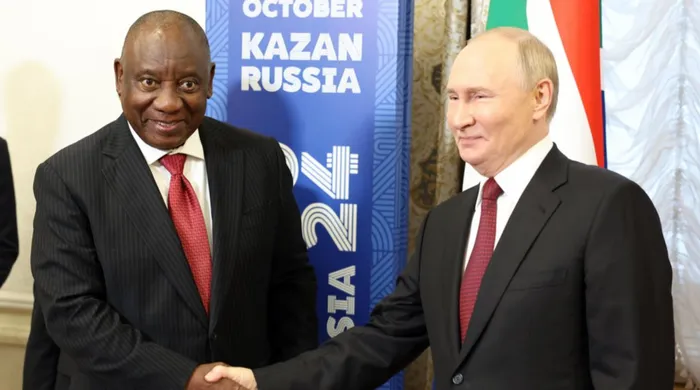
President Cyril Ramaphosa with President Vladimir Putin of Russia.
Image: The Presidency / X
I was once sent an intelligence dossier in South Africa. It was thick with information — names, dates, locations, behavioural profiling, and layers of claims presented with the cold, administrative tone familiar to intelligence documentation. I was specifically directed to a section that alleged, in disturbing detail, that President Cyril Ramaphosa had a sexual predilection involving underage boys. The sheer volume, the formatting, the structure — all of it created the impression of credibility. I destroyed it immediately.
Not because I support Ramaphosa politically — I am vehemently opposed to his neoliberal political stance — but because I recognised precisely what such a document intends to do. Intelligence dossiers are not instruments of justice; they are instruments of influence. Their purpose is to inject accusation into the bloodstream of public consciousness, where it settles permanently whether proven or disproven. Once released, it functions as truth in the imagination. That moment revealed how effortlessly a person, a party, or a nation can be convicted by narrative rather than by evidence.
This is exactly how the West has framed President Vladimir Putin.
The ICC now alleges Putin “is responsible for the war crime of unlawful deportation and transfer of children from occupied areas of Ukraine to the Russian Federation,” citing Articles 8(2)(a)(vii) and 8(2)(b)(viii). The Court further claims there are “reasonable grounds” to believe he bears individual criminal responsibility directly, jointly, through others, and through “failure to control” subordinates during the period from 24 February 2022 onward.
Yet the geopolitical consequences of this warrant expose its purpose more clearly than its legal language. The warrant restricts Putin’s travel, creates diplomatic hesitation, disrupts summits, justifies sanctions, and isolates a BRICS powerhouse through the performance of legality rather than its universal application. The ICC has never indicted the architects of violence against Iraq, Libya, Afghanistan, Yemen, or Gaza. Its moral outrage appears only where Western power demands a spectacle.
The missing children narrative furnishes that spectacle — emotional, simplified, and designed for consumption. Little attention is given to the thousands of children lost through undocumented Ukrainian evacuation routes, informal European placements, and collapsed administrative systems in the early chaos of war. The human tragedy is selectively curated — loudly exaggerated when it implicates Russia, muted when it implicates the West’s proxy.
South Africa’s unquestioning alignment with this framework signals a drift away from the non-aligned posture that once shaped our moral authority. Ramaphosa’s endorsement of a warrant designed to isolate a BRICS ally rewrites our role from sovereign actor to pliant participant in Western strategy. It was signed without national debate, without parliamentary reckoning, and without asking what precedent it sets for African leaders in future conflicts where Western narratives dictate guilt.
And this returns me to that thick dossier.
If Ramaphosa is comfortable lending South Africa’s name to a global system where accusations become conviction through their circulation alone, then how would he have responded if the dossier handed to me had been released into the public as unquestioned truth? How would he withstand a world where lawfare replaces law, where media replaces evidence, and where the story matters more than the facts?
Because we now live in a time when media has become a central weapon of war — soft power with hard consequences, shaping public consent long before diplomats meet or soldiers deploy. The nation that controls the narrative controls the battlefield, and those without media sovereignty remain governed by voices not their own.
This is why the BRICS and Global South must pursue a Bloc Security Council that defends against media warfare — an infrastructure capable of challenging Western propaganda with documentation, investigation, and independent platforms. We require resources to build a robust ecosystem of information that exposes the mechanics of manufactured truth and prevents the Global South from being narrated into subservience.
Until we command our own story, we will continue to live inside someone else’s script — and be punished for refusing to perform it.
And what of the missing children themselves?
Those relocated through Russia’s administrative systems remain traceable through the very bureaucracy the West refuses to acknowledge. Files exist. Guardianship logs exist. Medical records exist. Returns have been documented. Russia’s state machinery — slow, methodical, possibly maddening — nevertheless leaves paper trails. Meanwhile, the children who vanished through Ukraine’s fragmented evacuation routes, undocumented crossings, volunteer handovers, and corrupt intermediaries are rarely spoken of. They are not the centre of a warrant, not the subject of Western outrage, not the moral refrain played on loop for public consumption.
Those children — the ones genuinely lost — remain invisible because their disappearance serves no geopolitical purpose. They are the real victims of this war and its propaganda — pawns swept off the table while the West performs its moral pantomime and chases Putin as the villain of choice. The narrative is loud. Their names are silent. And until truth matters more than strategy, those missing children will remain missing — traded in the shadows of Western geopolitical manoeuvres while the world is instructed to look only in one direction.
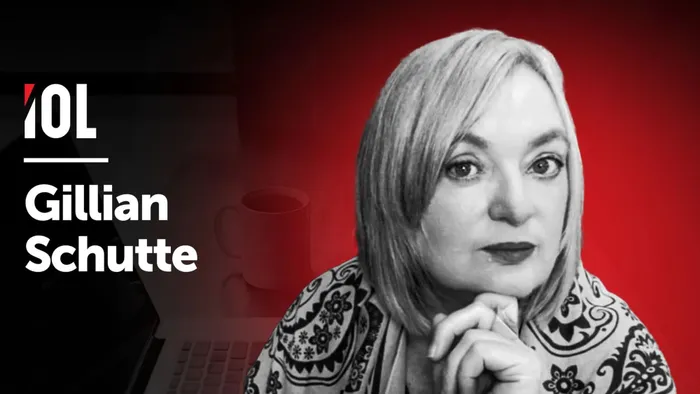
Gillian Schutte delves into the dangers of media warfare, and how controlling the narrative often results in a miscarriage of justice.
Image: IOL
* Gillian Schutte is a South African writer, filmmaker, poet, and uncompromising social justice activist. Founder of Media for Justice and co-owner of handHeld Films, she is recognised for hard-hitting documentaries and incisive opinion pieces that dismantle whiteness, neoliberal capitalism, and imperial power.
** The views expressed do not necessarily reflect the views of IOL or Independent Media.