

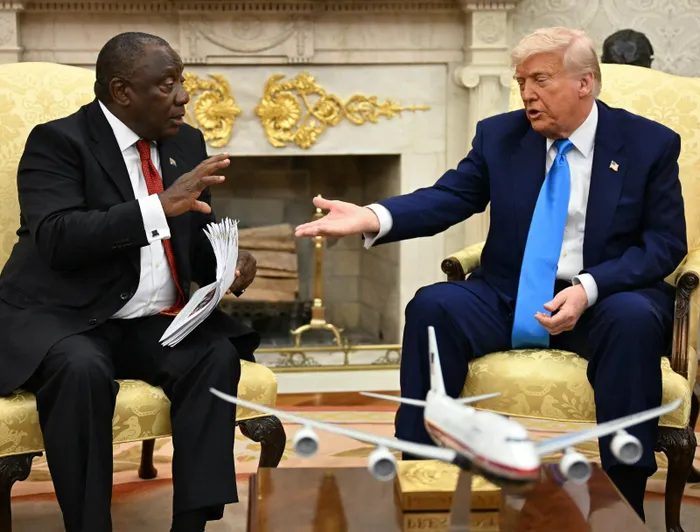
President Cyril Ramaphosa and US President Donald Trump. Gillian Schutte examines the structural vulnerabilities facing BRICS in an era of sustained hybrid warfare. It argues that quiet diplomacy has reached its strategic limit and that the bloc requires a dedicated Security Council capable of coordinating defence, regulating cross-border military cooperation and protecting member states from information-based destabilisation.
Image: File / AFP
The expansion of BRICS has intensified an internal contradiction. The bloc positions itself as an emerging centre of global realignment, yet it continues to operate through diplomatic restraint inside a system that offers no reciprocal respect for sovereign autonomy. As Hedley Bull argued in The Anarchical Society (1977), international order depends on a minimal consensus among major powers. That consensus no longer exists. Western actors now treat rising powers as entities to be contained rather than as equal participants in a plural order.
Russia and China attempted to navigate this environment through quiet diplomacy. They acted as if patience and non-confrontation could shelter Global South realignment from retaliation. This assumption has collapsed. External powers increasingly shape the internal political and informational environments of BRICS members. Quiet diplomacy now provides access points for penetration rather than protection. Multipolarity cannot deepen within such a framework.
BRICS operates inside a global system defined by hybrid coercion. Sanctions, financial exclusion mechanisms, targeted lawfare, donor-driven institutional influence, cyber disruption and narrative operations are used to erode cohesion rather than to secure conventional victory. Susan Strange’s work on structural power, particularly in States and Markets (1988), helps explain this dynamic. Western dominance over finance, information infrastructures and global institutions allows them to shape the conditions under which BRICS members must operate. These structural advantages are not episodic. They are continuous.
Hybrid pressure does not affect all BRICS states equally. Barry Buzan’s writings on uneven security vulnerabilities make this clear. Russia, China and Iran face direct containment. South Africa and Brazil are highly exposed to donor-driven media ecosystems. India is pressured through competitive alignment. Middle Eastern and African BRICS states operate inside contested regional environments shaped by global leverage. This unevenness enables adversarial powers to disrupt the bloc by targeting its most penetrable member.
A diplomatic association that functions inside a coercive system must develop collective security capacity or else remain permanently unstable.
The recent incident around South African MK security training in Russia demonstrated an institutional gap at the heart of BRICS cooperation. Without a bloc-governed system for authorising inter-country military movement, adversarial actors can weaponise ambiguity. A voluntary training exchange becomes framed as illegality. A cooperative defence exercise becomes interpreted as covert mobilisation. The absence of structure invites destabilisation.
A BRICS Bloc Security Council would address this by institutionalising authorisation procedures, joint registries, personnel vetting and coordinated diplomatic protections. This is consistent with the insight, derived from Buzan’s security-complex theory, that regions with high interdependence require institutional mechanisms to prevent misinterpretation and external manipulation.
The purpose is defensive rather than expansionist. It is to ensure that cooperation cannot be easily miscast by foreign actors seeking to weaken the bloc’s internal stability.
The information domain has become a spectacle of conflict in its own right. Media networks, civil society structures and digital platforms function as instruments of influence. These dynamics resonate with Frantz Fanon’s analysis in The Wretched of the Earth (1961), where he describes how domination is reproduced not only through force but through psychological and epistemic manipulation.
South Africa demonstrates how information warfare operates. Foreign-funded narratives trigger political turbulence whenever the state engages BRICS partners. Judicial actions, parliamentary debates and civil-society campaigns reflect this influence. Sovereignty becomes destabilised from within before policy is even implemented. Without coordinated information-defence capacity, BRICS members remain susceptible to internal disruption orchestrated externally.
This raises a fundamental strategic question about whether states experiencing high internal vulnerability can adopt autonomous security positions without collective protection.
This requires real thought about constructing think tanks that can feed into a strongly resourced and intellectually rigorous alternative media ecosystem. Such institutions would need to produce high-quality research, maintain strict methodological standards and refuse ideological drift, because information has become a strategic terrain of contestation rather than a neutral space. BRICS-aligned states cannot navigate hybrid conflict while sourcing their interpretive frameworks from institutions funded and shaped by Western strategic interests. An independent information ecosystem is essential for countering the pressures generated by empire-driven media operations. This system would not operate as propaganda, but as a sovereign structure of knowledge production that protects democratic agency, supports foreign-policy autonomy and provides analytical integrity in environments where information is routinely used to destabilise governments committed to multipolar realignment. Without this intellectual infrastructure, BRICS states remain dependent on adversarial epistemic systems, which undermines the very sovereignty they seek to reclaim.
Venezuela illustrates the costs of resisting Western coercion alone. It endured sanctions, attempts to fracture its military, information warfare and prolonged economic strangulation. It survived because Russia intervened. That intervention represented concentrated burden-sharing. The cost fell on one ally rather than a collective structure. If Venezuela had belonged to a BRICS security framework, retaliation would have been dispersed and escalation thresholds would have shifted.
South Africa demonstrates the other dimension of vulnerability. Every move toward BRICS alignment triggers domestic turbulence fuelled by donor-linked institutions, factional elites and strategically timed media interventions. Internal volatility becomes a geopolitical pressure point. Russia as well as the MK Party are particularly targeted in 2025, by the Daily Ma*er*ck and News 2*.
A Bloc Security Council would provide the institutional capacity to coordinate intelligence, regulate cross-border deployments, stabilise internal disturbances, and distribute the burden of external pressure. This aligns with the logic of structural reform that Susan Strange and later Global South development theorists insisted is necessary when confronting asymmetric systems of power.
The future of BRICS hinges on whether it chooses to construct this body. Without it, the bloc remains a symbolic formation operating inside a system designed to weaken any attempt at sovereign realignment.
Gillian Schutte examines the structural vulnerabilities facing BRICS in an era of sustained hybrid warfare. It argues that quiet diplomacy has reached its strategic limit and that the bloc requires a dedicated Security Council capable of coordinating defence, regulating cross-border military cooperation and protecting member states from information-based destabilisation.
Image: IOL
* Gillian Schutte is a South African writer, filmmaker, poet, and uncompromising social justice activist. Founder of Media for Justice and co-owner of handHeld Films, she is recognised for hard-hitting documentaries and incisive opinion pieces that dismantle whiteness, neoliberal capitalism, and imperial power.
** The views expressed do not necessarily reflect the views of IOL or Independent Media.