

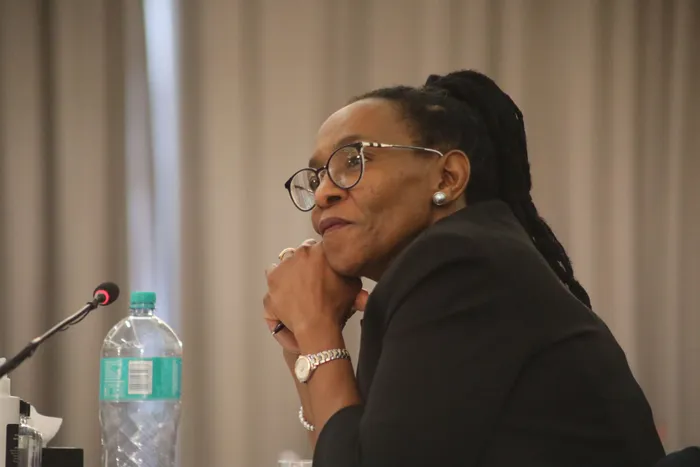
SCA President Justice Mandisa Maya was the second candidate to be interviewed by the Judicial Service Commission for the vacant position of Chief Justice. She is the only woman to have been shortlisted. | Timothy Bernard African News Agency (ANA)
BATHABILE DLAMINI
TODAY we do not think twice about sending our daughters to university. Other considerations may be made, yes, financing, place at university or whether they will be able to cope with the pressures of these patriarchal places. But the mere fact that they were born women? No, certainly not.
One often wonders what the greater year is to celebrate. Last year, 2021, the 150th anniversary of the birth of Charlotte Maxeke or next year, 2023, the 120th anniversary of her graduating as southern Africa’s first black woman to graduate from a university with a science degree (BSc) – from an American university at that.
How fantastic is it for our daughters that 120 years ago, Charlotte Maxeke broke that glass ceiling for them. Now, no longer was it just the colour of your skin that mattered but your sex did not matter either.
Yet the factories of patriarchy, as Pumla Gqola calls them in her latest book Female Fear Factory, remain firmly in place. Our universities, too, sadly are these factories of racist patriarchy.
Thoko Sipungu, a Rhodes University academic in sociology, reviews Gqola’s book and touches on these specific gendered roles that society categorises or places women in.
“Gqola also complicates binary sex as only a fact of anatomy,” writes Sipungu, “and instead argues females are, in hetreo-patriarchial societies, socially constructed for political and cultural ideologies. This is intimately linked to ‘project patriarchy’.”
It is for this reason and within this context that a journalist such as Rebecca Davis, in her profile With the tables turned, how did the judges do in the hot seat in the Daily Maverick and which reviews the four judges shortlisted for the position of chief justice of our country, can “correctly” point out that one of Justice Mandisa Maya’s “pre-interview disadvantages” is that she “is a woman”. How terribly sad for a supposedly sophisticated country such as South Africa.
Davis incorporates in her profile that Justice Maya’s “quirky fact” includes that she “was the first sitting judge to become pregnant while serving on the Bench”.
She also goes on to state that in her interview “Maya was hobbled by a paternalistic reception from the commissioners, and the interview rapidly became hyper-focused on her gender”.
One may add that evidence of this rather sexist approach by some members of the JSC was the harping on Justice Maya’s apparent “closeness” to John Hlope, the Western Cape Judge President. Women are often judged in relation to a man. As if they cannot stand on their own two feet.
As we saw during the interviews, Justice Maya was faced by the very sexist question of whether our country was ready for its courts to be led by a woman.
Justice Maya was correct when she shot back: “I don’t think it’s a proper question to ask because it implies all sorts of negative things… South Africa has always been ready to have a female chief justice.”
As if the question: “Are South Africa’s courts ready to be led by a male” was ever asked. Worse still, we saw once again the JSC interview of Justice Maya churn out sexist reactions and misogynist responses by all and sundry as whenever a prominent woman takes the lead in a race.
We must certainly discuss whether our courts too are, what Gqola calls, factories of patriarchy and whether they too participate in “project patriarchy”. Are our country’s law schools initiating this discussion?
Having served as the first woman President of the Supreme Court of Appeal, Justice Maya has been a judge for the last 20 years and an acting one for even longer.
Originally from Mthatha, she holds degrees from the former Unitra and University of Natal as well as Duke University in the US while also having had a stint in academia. She is an intellectually gifted jurist in her own right.
All the candidates have sterling resumés, but Justice Maya represents a stratum of society that continues to suffer the triple indignation of the colour of their skin, their gender and their poverty and in a society where the exploitation of women in all forms remains excessively and unacceptably too high.
As we have seen with the fight against patriarchy and its off-spring gender-based violence, women remain the motive force of change in South Africa today. Yet despite this, being the majority in the motive forces for change in our country today, women are subjected to marginalisation in politics, business, academia, our legal system, among other areas.
Like Maxeke, we continue to break the glass ceilings placed on us while ensuring that our daughters, the women they choose to be, are not judged solely on their gender and sex. In this way, they cannot only choose to go to university and law school but certainly aim to become our country’s chief justice too!
In summation of this debate I’m reminded by a great quote of India’s first woman Prime Minister Indira Gandhi when she said “to be liberated, a woman must feel free to be herself, not in rivalry to men but in the context of her own capacity and her own personality”.
* Bathabile Dlamini is the president of the African National Congress Women’s League.
** The views expressed herein are not necessarily those of Independent Media/IOL.