

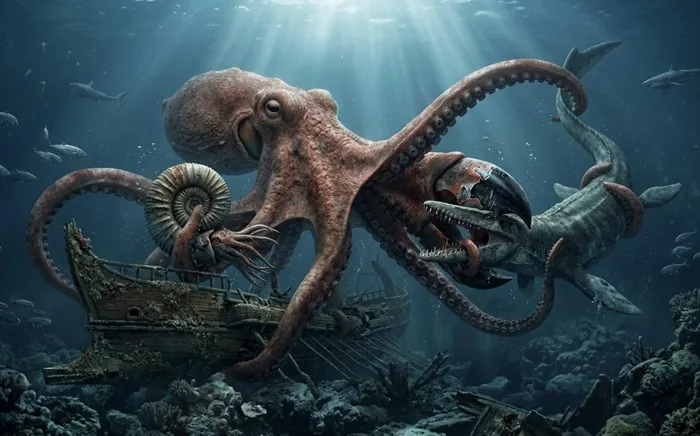
The legendary "kraken", the mythical sea monster famous for dragging ships to their doom, actually had a very real, prehistoric counterpart.
Image: AI / Gemini
If you thought the ocean was terrifying enough with great white sharks and the occasional modern giant squid, you might want to sit down for this one.
It turns out the legendary "kraken", the mythical sea monster famous for dragging ships to their doom, actually had a very real, prehistoric counterpart.
A new study published in the journal “Science” has just completely flipped our understanding of the dinosaur-era oceans.
Researchers have uncovered fossil evidence of a prehistoric giant octopus that makes today's giant squids look pretty modest.
We're talking about an apex predator with tentacles, giving it a total reach of up to 19 meters.
To put that in perspective, that is roughly the length of an 18-wheeler truck.
Living between 86 and 72 million years ago during the Late Cretaceous period, this massive species, officially named “Nanaimoteuthis haggarti”, was an absolute titan.
For the longest time, palaeontology and marine science operated on a pretty standard assumption: vertebrates ruled the prehistoric food chain.
Whenever we pictured the top tier of ancient oceans, we thought of giant marine reptiles like mosasaurs and plesiosaurs, or maybe massive sharks.
But these giant octopuses are crashing that exclusive party, proving that invertebrates were also dominating the seas.
As lead author Yasuhiro Iba from Hokkaido University explained to Sky News, "These animals were remarkable. With their large bodies, long arms, powerful jaws and advanced behaviour, they represent what could be described as a real Cretaceous kraken".
He also noted that they "likely occupied the same ecological tier and may have competed with marine reptiles and sharks within the same ecosystem".
You might be wondering how we even know all this, considering octopuses are soft-bodied creatures that don't exactly leave behind skeletons for us to find.
The secret lies in their beaks. Scientists analysed incredibly well-preserved fossilised jaws found in Japan and Canada’s Vancouver Island to piece together the life of this giant.
These beaks weren't just big; they were heavily worn down.
Researchers found intense wear, chips, and scratches on them, meaning these octopuses were out there violently crushing hard-shelled prey, bones, and skeletons with massive force.
Christian Klug, a palaeontologist at the University of Zurich, summed up their terrifying hunting style perfectly to Mathrubhumi English: "With their tentacles and their suckers they could perfectly hold on to such an animal, and there is no escape".
Here's where it gets even wilder: they were probably brilliant.
The wear on their fossilised jaws was highly uneven, meaning they likely favoured their right side over their left while feeding. In the animal kingdom, this kind of "handedness" or lateralized behaviour is a massive indicator of advanced brain function, much like we see in famously clever modern octopuses.
While we are currently battling to protect today's fragile marine ecosystems, it's wild to look back and realise just how incredibly diverse and competitive the top of the ocean's food chain used to be.
Luckily for today's sailors, “Nanaimoteuthis haggarti” went extinct alongside the dinosaurs around 66 million years ago.
Exactly what their day-to-day diet looked like is still being debated.
As Dr Nick Longrich from the University of Bath admitted regarding their feeding habits, "It's going to take a while before we figure this thing out... It's a bit of a mystery".
Still, this discovery proves one thing for sure: the ancient oceans were way weirder and much more heavily armed than we ever imagined.
IOL