

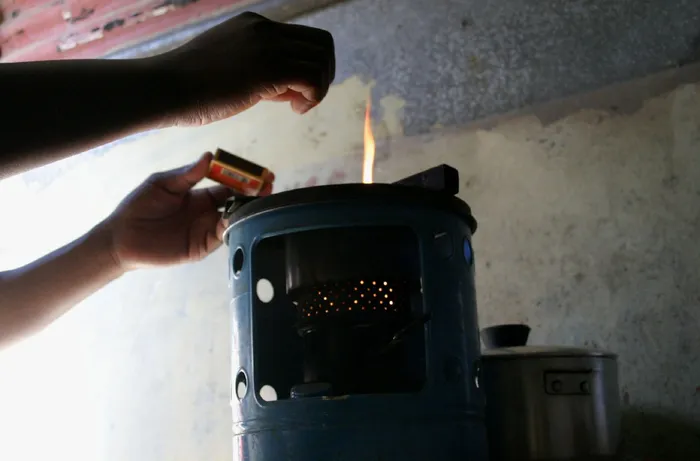
While motorists benefit from temporary levy reductions, paraffin-dependent families face rising energy costs alongside escalating food prices.
Image: Dumisani Sibeko / Independent Newspapers
Low-income households across South Africa are facing high paraffin costs for cooking and heating, even as the government has temporarily reduced levies on petrol and diesel.
While motorists benefit from a R3-per-litre fuel levy reprieve, paraffin-dependent families in informal settlements and rural communities receive no comparable relief, leaving them exposed to the full impact of market-driven energy prices.
"The government does not care about the poor; that’s why they have not given relief for paraffin, as it is used by the poor mostly. They care more about the middle class who own cars," said Thapelo Mohapi, general secretary of Abahlali BaseMjondolo.
"Winter is coming, and families will struggle to keep children warm and cook food. When schools are closed, children won’t get the nutrition they need, and households will face rising food costs alongside unregulated paraffin prices."
Paraffin, a petroleum-derived product, remains critical for cooking and heating in households without reliable electricity or where electricity is too costly.
Retail prices in low-income areas often fluctuate between R30 and R35 per litre, reflecting fragmented distribution chains, transport costs, and small-volume retail mark-ups, rather than formal government-imposed increases.
According to Mohapi, many families are already resorting to wood fires for cooking and warmth, despite the health and fire risks involved.
The Department of Mineral and Petroleum Resources (DMPR) said paraffin is not subject to the general fuel levy and therefore does not receive relief alongside petrol and diesel.
The department confirmed a temporary reduction of R3 per litre fuel levy reprieve from April 1 to May 5, 2026, aimed at easing transport costs and inflation.
Officials said broader household support measures are under consideration, but provided no immediate solutions for paraffin-dependent communities.
Experts say the current situation exposes structural inequities in South Africa’s energy system.
"Even though paraffin is exempt from fuel levies, it remains vulnerable to global oil market shocks, exchange rate fluctuations, and upstream import parity pricing," said Bertha Dlamini, founding president of African Women in Energy and Power (AWEaP).
"Distribution in informal settlements is fragmented, wholesale and transport mark-ups are high, and last-mile retail is poorly regulated. Households are experiencing the full transmission of international price shocks without any fiscal cushion."
The March 2026 Household Affordability Index underscores the financial pressure on these families.
After paying for electricity and transport, which is estimated at R2,941.85 per month for a worker supporting a family of four, low-income households are left with R2,378.63 for food, far below the R3,667.72 required for a basic nutritious food basket.
Rising food costs compound the problem; in March, prices of tea, cabbage, and tomatoes increased by up to 7%, while staple foods like rice and apples fell, highlighting uneven inflation pressures across food items.
Mohapi emphasised the gendered impact of the crisis. "Women-led households are the hardest hit. They bear the brunt of cooking and keeping children warm. Many already rely on small grants, which are insufficient to cover food and energy costs. Families are being forced to revert to unsafe fuels, and children’s nutrition is at risk."
Dlamini pointed to longstanding policy gaps.
"Energy inequality is structural. Low-income households pay a poverty premium for paraffin because distribution is fragmented, competition is limited, and price regulation is weak. Fuel levy relief helps middle-class commuters, but paraffin-dependent households remain exposed to volatile global oil prices."
She outlined short- and long-term solutions.
Short-term measures include targeted subsidies, transparent monitoring of paraffin prices, and the rollout of LPG and electric cooking support programmes. Long-term strategies involve policy reforms to encourage last-mile energy entrepreneurship, local clean energy manufacturing, and integration of clean cooking into the Just Energy Transition Investment Plan.
These interventions, she said, could reduce vulnerability, expand equitable access, and stimulate local economic activity.
Without immediate action, households face a double burden of energy poverty and food insecurity.
Mohapi warned: "On the ground, people will continue to suffer. Without subsidised paraffin and regulated pricing, families will revert to wood fires. Children are already malnourished, and this number will grow if the government does not act."
lilita.gcwabe@inl.co.za