

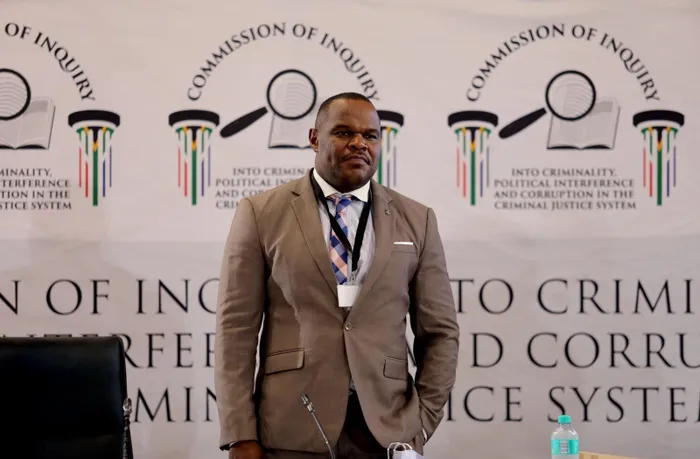
Organised Crime Unit Officer Sergeant Fannie Nkosi was reportedly arrested after a raid at his house in Pretoria on Thursday.
Image: Oupa Mokoena / Independent Newspapers
The police’s Special Investigations Task Team, which President Cyril Ramaphosa announced in January that it will investigate criminal cases emanating from the Madlanga Commission of Inquiry, has started to bite after it arrested implicated officer Sergeant Fannie Nkosi.
However, the police's refusal to confirm that the officer arrested after a house in Pretoria was raided on Thursday was Nkosi, who is already on suspension after being implicated in the commission, has been criticised as an attempt to cover up the police's actions.
Anti-corruption activist Yusuf Abramjee, who revealed on X that the raid was conducted by the Madlanga team, expressed concern following police spokesperson Athlenda Mathe’s decline to reveal that the house that was raided in Pretoria belonged to Nkosi.
Although Mathe refused to reveal the name of the police officer, who was also detained, social media is abuzz with posts saying that the officer was Nkosi.
Nkosi, who is attached to the Gauteng Organised Crime Unit, was reportedly arrested after a special investigations task team, which Ramaphosa announced on January 29, raided his house and found firearms, unlicensed ammunition, a hand grenade, and case dockets from various police stations.
Immediately after the arrest, Mathe issued a press statement confirming a successful execution of a search and seizure operation (J51) in Pretoria North on Thursday, without revealing the owner of the house that was raided.
According to the South African Police website, J51 is a warrant for search and seizure.
“This operation forms part of ongoing police investigations,” she said.
She then cautioned the media against taking pictures or publishing the home of the police officer, which she did not name.
When contacted on Saturday about the arrest, Mathe could only say this arrest will be confirmed after the court appearance on Tuesday.
She also said she did not have information, but said: “The Madlanga task team is SAPS officers.”
However, Madlanga Commission spokesperson Jeremy Michaels said the Madlanga Commission, which is a judicial commission of inquiry, was entirely separate from the task team.
In his response, Michaels attached a press statement, which Ramaphosa's office released on January 29, when he was welcoming the commission’s interim report.
The statement had stated that a newly constituted special investigations task team, to report directly to the National Police Commissioner General Fannie Masemola, will institute criminal investigations against people identified by the commission.
Among police officers, whom the commission recommended for criminal investigation were Nkosi, Major General Lesetja Senona, Major General Richard Shibiri, Brigadier Mbangwa Nkhwashu, and Brigadier Rachel Matjeng.
Abramjee said the silence from the police leadership on Nkosi’s arrest was concerning, as it was common for police to quickly publicise arrests “especially when it paints the organisation in a positive light”.
“But when the spotlight turns inward, suddenly there is silence. That inconsistency raises serious questions about transparency and accountability.
“You cannot claim to be serious about fighting crime and corruption, while withholding information when one of your own is implicated,” said Abramjee.
He said this was creating a perception of selective transparency, “where the public is only told what is convenient”.
“If the police expect communities to trust them, they must be open even when it is uncomfortable, as accountability cannot depend on who is involved,” he said.
“Right now, the lack of communication risks undermining public confidence and fuels suspicion that there may be more being concealed.
“South Africans deserve honesty, not silence,” he said.
Abramjee said the allegations that, despite being on suspension, Nkosi was found in possession of official case dockets point to a potentially serious breach of the law and a betrayal of public trust.
“If these allegations are confirmed, it reflects a dangerous level of criminality within law enforcement itself — the very institution meant to protect citizens.
“It raises urgent questions about internal controls, oversight, and how such activities could go undetected for so long,” he said.
On his X page, he wrote that the “Madlanga Team” pounced at Nkosi’s premises at approximately 07:30 am to execute the warrant.
“During the raid, authorities seized 490 rounds of unlicensed ammunition and one hand grenade belonging to the state. Several case dockets from different police stations were also discovered.”
He further stated that the police team also found multiple firearms, including four pistols, three rifles, and one shotgun, not stored in a safe, but all have valid licences.
Abramjee said the firearms were believed to belong to another person who owned a security company.
The discovery of the police dockets and police-owned hand grenade remained a mystery since Nkosi was on suspension.
Nkosi is accused of acting as a middleman between suspended Deputy National Police Commissioner Shadrack Sibiya and alleged cartel figures Vusimuzi “Cat” Matlala and Katiso “KT” Molefe.
Attempts to get hold of Nkosi’s lawyer, Hartley Ngoato, were unsuccessful as his office was closed for the weekend and he also did not respond to an email.
Ngoato, however, refused to comment when approached by a TV news crew reporting outside Nkosi's house on Thursday during the police raid. He stated that Nkosi's family had instructed him not to speak to the media.
bongani.hans@inl.co.za