

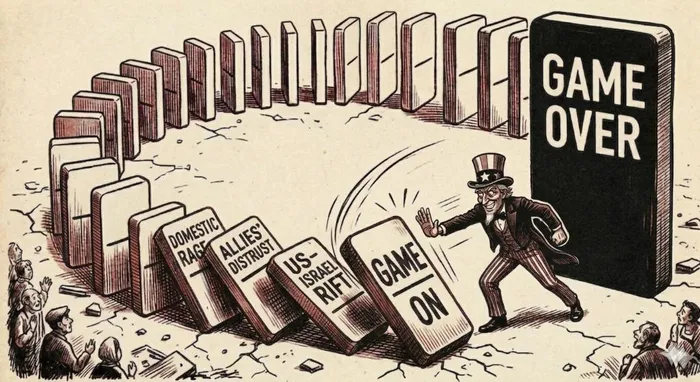
The domino effect of America's unjust war: It will eventually hit back
Image: XINHUA
Trailing humanity like a shadow, war,sometimes justified as liberation, sometimes condemned as conquest, yet always leaving devastation in its wake. Across continents and centuries, it has uprooted families, erased homes, and fractured identities. The defeated are often dispossessed, vilified, or forced into exile, while the victor, at times, becomes the next oppressor. These cycles rarely disappear; they merely change form.
For generations, scholars, diplomats and peacebuilders have searched for ways to prevent such catastrophic eruptions. Political literature offers frameworks and warning signs: power imbalances, economic distress, nationalism, arms races, ideological extremism. Yet at its core, the analysis returns to a simple truth: war is waged by humans against other humans. Its ignition, escalation and restraint are ultimately shaped by the minds of those who lead and those who follow.
Recorded history offers no sustained era entirely free from armed conflict. Analysts examining roughly 3,400 to 3,500 years of documented history estimate that periods of relative global peace may have totalled only between 230 and 268 years. Conflict, in one form or another, has been a constant companion to civilisation.
The hope that the devastation of the Second World War would become “the war to end all wars” proved tragically optimistic. Rather than direct large-scale conflicts, the period after 1945 saw the rise of proxy battles, independence movements, internal conflicts, and tense global rivalries. Although international organizations were created to maintain peace, warfare evolved; becoming more about ideology, economics, technology, and irregular tactics.
Wars are frequently portrayed as struggles for noble causes such as liberty, independence, justice, or protection. Movements for liberation have certainly brought down colonial regimes and overthrown oppressive rulers. However, history also shows that wars waged in pursuit of freedom sometimes end up substituting one form of dominance with another.
The aftermath frequently exposes a paradox. Infrastructure lies in ruins, economies collapse, and social trust erodes. Generations inherit trauma. Displaced people cross into foreign countries, searching for acceptance and a new home. Even after triumph, the price paid in human suffering can outweigh the achievements celebrated. While the flag of liberation may wave proudly, the wounds left by conflict persist long after the rhetoric fades.
Thinkers from ancient times to the present have debated the causes of war and how it might be prevented. Realists see conflict as a result of states competing for power in a world lacking a central authority. Liberals believe that democracy, economic ties, and global organisations make wars less likely.
Marxist and critical scholars point to economic exploitation and deep-rooted inequalities as sources of violence.
Meanwhile, psychological and behavioral perspectives focus on factors like fear, misjudgment, pride, and identity. Although these approaches differ, many agree on one key point: war is not always unavoidable, but rather arises from human decisions. While systems and structures matter, it is often the choices of leaders; shaped by pressure, ideology, or ambition; that determine whether nations pursue peace or conflict.
Those in positions of power have a profound influence on decisions about war. Leaders who hold concentrated authority, whether at the helm of authoritarian regimes or in fragile democracies, often encounter fewer obstacles when opting for military action. Factors like personal ambition, nationalist sentiment, or a drive to secure control can accelerate conflict.
On the other hand, political systems that distribute authority, promote transparency, and invite public scrutiny typically offer resistance to rash decisions about war. While these checks do not ensure lasting peace, they introduce moments for reconsideration and negotiation before violence erupts.
Armed conflict reveals both the vulnerability and the decision-making power of people. It demonstrates how easily emotions like fear and pride, along with power dynamics, can overshadow empathy and rational thinking. Yet, the same human traits that can ignite wars also provide avenues for peace: such as communication, diplomacy, understanding, and strong institutions.
Because humans are the ones who start wars, preventing them depends not just on formal agreements or deterrence, but on the ethical and emotional development of both leaders and societies. Human nature may swing between conflict and collaboration, but history shows that our path is shaped more by our decisions than by fate.
Written by:
*Dr Iqbal Survé
Past chairman of the BRICS Business Council and co-chairman of the BRICS Media Forum and the BRNN
*Cole Jackson
Lead Associate at BRICS+ Consulting Group
Chinese & South America Specialist
**The Views expressed do not necessarily reflect the views of Independent Media or IOL.
** MORE ARTICLES ON OUR WEBSITE https://bricscg.com/
** Follow @brics_daily on Twitter for daily BRICS+ updates and instagram @brics_daily