

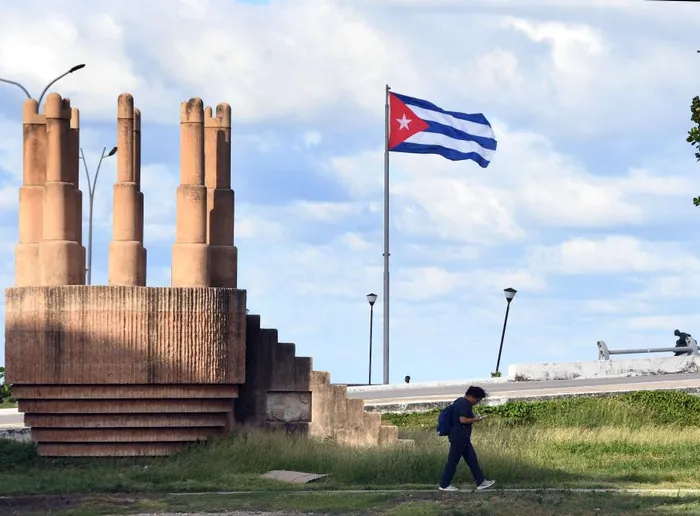
A pedestrian passes a Cuban National Flag in Havana, capital of Cuba
Image: XINHUA
The United Nations has urgently appealed for international assistance for Cuba, where a worsening humanitarian crisis, driven by an energy blockade and compounded by natural disasters, is placing severe strain on public services. The call for support comes amid escalating political tensions between Havana and Washington, where US President Donald Trump and Secretary of State Marco Rubio are pursuing a hard-line yet diplomatically mixed strategy toward the island.
UN Resident Coordinator Francisco Pichon said Cuba’s humanitarian situation has “reached a critical point” after a US-imposed oil blockade introduced in January 2026 disrupted fuel imports, causing prolonged electricity outages and limiting basic services. The shortfalls have forced the postponement of more than 96,000 surgeries and delayed childhood immunisations, with the elderly, disabled and women among the most affected. Although a Russian fuel shipment arrived in late March, officials stress that urgent aid is still needed, particularly for healthcare, water and sanitation.
The UN has launched a Plan (Action Plan) to deliver assistance and promote more sustainable energy infrastructure, in solar power and water-pumping systems. However, the success of the plan depends on reliable access to fuel and additional funding, stifled by an unattained $68 million budget gap.
Since early 2026, under Trump, the White House has expanded sanctions, declared the Cuban regime a national security threat and blocked most fuel imports, part of what critics describe as a strategy aimed at weakening Havana’s hold on power.
At the same time, Washington has engaged in undisclosed negotiations with Cuban officials, signalling a willingness to ease some measures. A recent Russian oil tanker was permitted to dock in Cuba, and the administration has indicated that future shipments could be reviewed “on a case-by-case basis.” Havana confirmed that talks with the US have taken place in an effort to address bilateral differences amid the crisis, though details remain scant.
This dual track, combining economic coercion with back-channel dialogue, reflects Trump’s bid to extract concessions from Havana while maintaining leverage. Secretary Rubio has framed any potential agreement in terms of both economic reform and political change in Cuba, urging that the island’s governance structures must evolve.
Tensions this week were underscored by a public exchange between Rubio and Cuban President Miguel Díaz-Canel. In an exclusive Newsweek interview, Díaz-Canel warned that Cuba would resist any US military aggression with “guerrilla warfare,” declaring that while the nation strives for peace, it would defend itself if attacked.
Responding to that threat, Rubio dismissed Díaz-Canel’s warnings with a stark remark: “I don’t think much of what he has to say,” signalling a refusal to be swayed by Havana’s rhetoric and illustrating Washington’s confidence in its position.
Back in Cuba, public demonstrations have erupted in response to US policy. Hundreds of women marched in Havana, chanting support for the Castro legacy and denouncing “Yankee imperialism,” even as the government grapples with shortages of food and fuel.
The situation remains fluid. UN and civil society actors continue to call for humanitarian access and an end to policies that exacerbate hardship for ordinary Cubans. In Washington, debates over how best to balance pressure and negotiation persist, with some lawmakers advocating for a reduction in rhetoric and increased dialogue.
As both humanitarian and geopolitical dynamics unfold, Cuba stands at a crossroads, confronting acute domestic needs while navigating one of its most complex foreign policy challenges in decades.
Written by:
*Dr Iqbal Survé
Past chairman of the BRICS Business Council and co-chairman of the BRICS Media Forum and the BRNN
*Cole Jackson
Lead Associate at BRICS+ Consulting Group
Chinese & South American Specialist
**The Views expressed do not necessarily reflect the views of Independent Media or IOL.
** MORE ARTICLES ON OUR WEBSITE https://bricscg.com/
** Follow @brics_daily on Twitter for daily BRICS+ updates and instagram @brics_daily