

U.S. President Donald Trump's latest claims on Iran war
Image: XINHUA
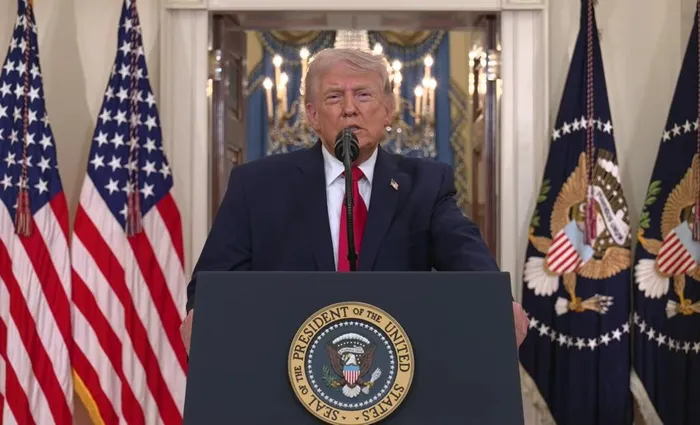
On the 1st of April, Donald Trump addressed the American nation about a war now in its 33rd day. He said it was nearly over. He said discussions with Iran were ongoing and that the US would hit Iran "extremely hard” over the next two to three weeks. He also threatened to destroy every Iranian power plant simultaneously, as well as said regime change was never the goal, then in the same speech, declared it achieved because everyone was dead.
From where the Global South sits, this is not surprising. It is the clearest illustration of what this conflict actually is. It’s not a surgical operation with defined objectives and an exit strategy, but a war in search of itself.
More than 3,500 US troops including 2,500 Marines aboard the USS Tripoli have arrived in the Middle East. Elements of the 82nd Airborne are deploying from Fort Bragg. Hundreds of Special Operations Forces are already in the region. Options on the table include raids on Kharg Island (Iran's primary oil export hub), seizure of coastal Hormuz positions, and potentially a Special Operations mission to retrieve enriched uranium from Isfahan.
Former US Marine analyst John Hackett was blunt about why: "Only a handful of ships have transited the Strait, which indicates there's almost 100% control by Iran and zero percent by the United States." Five weeks of aerial bombardment and Iran still controls the water. That is why the Marines are there.
The terrain comparison matters enormously and is being underplayed in Western coverage. The Zagros mountain range overlooks key areas of Iran's coastline, providing strong defensive advantages and dramatically increasing the vulnerability of any deployed ground forces to sustained fire. The IRGC has been training specifically for this scenario, a US attempt to forcibly reopen the Strait, for decades.
Former senior Pentagon officials warned that the primary challenge of any ground operation would not be seizing territory, it would be protecting US forces once deployed. Iran would stretch the conflict over time, making it costly and prolonged. Any sustained ground operation risks activating Iranian proxy networks across Lebanon, Iraq, Yemen, and Syria, opening multiple simultaneous fronts. Iran's military strategy has never been to defeat America conventionally. It is to make the cost of staying too high to sustain politically. On day 33, that strategy is working.
From Pretoria to New Delhi to Jakarta, this conflict is not filtered through nuclear threat assessments or Israeli security frameworks. It is filtered through $107 oil, fertiliser prices up 50%, Sri Lanka declaring Wednesdays public holidays to conserve fuel, and South Africa facing R7-per-litre diesel increases. Countries that had no vote on whether this war started are paying the steepest price for the fact that it did.
Australia's Prime Minister Albanese, a close US ally said it plainly: "It is not clear what more needs to be achieved, or what the endpoint looks like." The rest of the world is less diplomatic.
Trump has given Iran a deadline to reopen the Strait, the 6th of April. Iran has shown no intention of complying. The Marines are waiting. The ground operation options are war-gamed and ready and the administration still has not answered the question that Australia, the Global South, and increasingly the American public are all asking.
What does winning actually look like,and who decided the rest of the world would pay for the answer?
Written by:
*Dr Iqbal Survé
Past chairman of the BRICS Business Council and co-chairman of the BRICS Media Forum and the BRNN
*Chloe Maluleke
Associate at BRICS+ Consulting Group
Russia & Middle East Specialist
**The Views expressed do not necessarily reflect the views of Independent Media or IOL.
** MORE ARTICLES ON OUR WEBSITE https://bricscg.com/
** Follow @brics_daily on Twitter for daily BRICS+ updates and instagram @brics_daily