

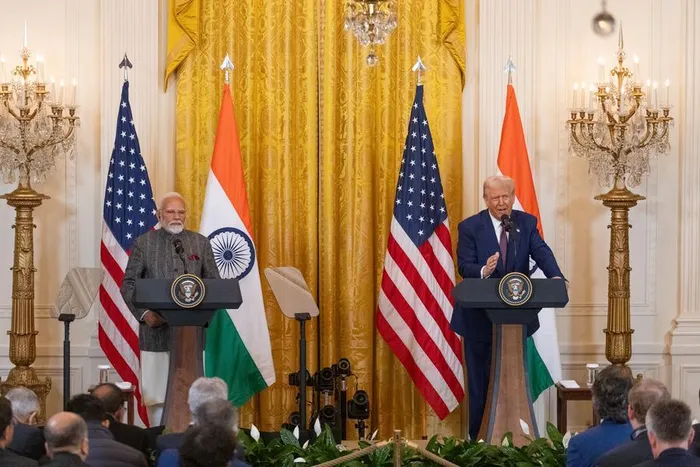
U.S. President Donald Trump (R) and visiting Indian Prime Minister Narendra Modi attend a joint news conference at the White House in Washington D.C., the United States
Image: XINHUA
The United States’ decision to authorise a $686m package of upgrades for Pakistan’s fleet of F-16 fighter jets has raised questions across South Asia at a moment of heightened geopolitical tension. The approval, which includes advanced technology, major defence equipment, and long-term support, was confirmed in early December by the US Defense Security Cooperation Agency (DSCA). Yet the timing is as significant as the content of the deal: it follows a short but intense five-day conflict between India and Pakistan in May, and comes while Washington is pressing New Delhi to buy more American weapons.
Given the broader strategic landscape Trump’s tariff pressure on India and Washington’s shifting priorities in the Indo-Pacific leads many analysts to ask whether this package is merely a technical update or a calibrated signal to India.
The upgrade is part of a broader maintenance and sustainment framework that dates back to a 2022 deal under the Biden administration. Praveen Donthi, a senior analyst at the International Crisis Group, notes that the F-16 programme “remains a key part of the broader US-Pakistan bilateral relationship”, particularly due to Washington’s continuing interest in counterterrorism operations in the region. Both Biden and Trump have maintained continuity in support, though with varying pace and political emphasis.
Link-16 is a secure real-time communication network used by NATO forces, enabling seamless data sharing between aircraft, ships, and ground units. While the inclusion of inert Mk-82s may appear symbolic, they provide essential training capability for Pakistan’s air force.
With $649m earmarked for sustainment and $37m allocated for major defence equipment, this is one of the most substantial US security packages for Pakistan in recent years.
There is a strong perception in New Delhi that the F-16 decision is part of a broader pattern of US pressure. In recent months, relations between India and the US have been strained:
Michael Kugelman, a South Asia specialist, acknowledges that the optics might suggest leverage. However, he argues that the F-16 upgrade is not primarily about India. While it may serve as a “pressure point” in US-India trade and defence negotiations, he maintains that the package “has a logic of its own” embedded in long-running support for Pakistan’s US-made aircraft.
Nevertheless, New Delhi has historically objected strongly to Washington’s cooperation with Pakistan on the F-16 platform, contending that the jets are used against India rather than for counterterrorism roles. Anticipating backlash, the US explicitly stated that the upgrade “will not alter the basic military balance in the region” a reassurance aimed squarely at India.
The $686m package is strategically meaningful. Kugelman describes it as “one of the more generous” defence arrangements Washington has granted Islamabad in recent years, underscoring the Trump administration’s interest in maintaining counterterrorism partnerships despite its hard-line posture elsewhere.
Donthi notes that the upgrades will help Pakistan keep its fleet operational until at least 2040. Yet he stresses that Pakistan’s primary security partner in recent years has been China. Between 2020 and 2024, more than 80 percent of Pakistan’s weapon imports came from Beijing, a statistic supported by SIPRI data. Chinese J-10s played a high-profile role in the May conflict, and Islamabad continues to diversify its air power in ways that reduce reliance on the US.
Thus, while the F-16 package carries political symbolism and operational benefits, it does not fundamentally shift Pakistan’s strategic orientation away from China.
The F-16 deal must also be viewed in the context of evolving US strategy. Washington is seeking to:
Trump’s recent unveiling of the “Trump Gold Card” — an immigration initiative aimed at retaining global talent, especially students from India and China — further illustrates Washington’s complex balancing act. While Trump praised Indian students and criticised US rules that previously forced graduates to “go back to India”, the broader policy still aims to give Washington greater control over talent flows and corporate hiring.
This overlap between defence pressure, trade tariffs, and immigration incentives shows that South Asia is now woven into multiple layers of US domestic and foreign policy.
India is unlikely to respond with dramatic policy shifts. It has already signalled that it will continue buying Russian oil and maintain its strategic autonomy, a core principle of Indian foreign policy. However, Washington’s decisions will reinforce Indian concerns about the reliability of the US as a defence partner, especially when compared with Russia’s consistent supplies or the rapidly expanding China-Pakistan nexus.
The $686m F-16 upgrade package is both practical and political. On one level, it is a technical sustainment agreement designed to keep Pakistan’s ageing fleet airborne for another decade and a half. On another, it is a small but pointed reminder of Washington’s ability to influence the regional balance at a time when India is drifting from US preferences on trade, energy, and defence procurement.
Whether India reads the move as a message or merely a bureaucratic update, it reinforces an old reality: the US continues to walk a careful line in South Asia, and both India and Pakistan remain essential, if often complicated, partners in its evolving strategic calculus.
Written By:
*Dr Iqbal Survé
Past chairman of the BRICS Business Council and co-chairman of the BRICS Media Forum and the BRNN
*Cole Jackson
Lead Associate at BRICS+ Consulting Group
Chinese & South America Specialist
** MORE ARTICLES ON OUR WEBSITE https://bricscg.com/
** Follow https://x.com/brics_daily on X/Twitter for daily BRICS+ updates