

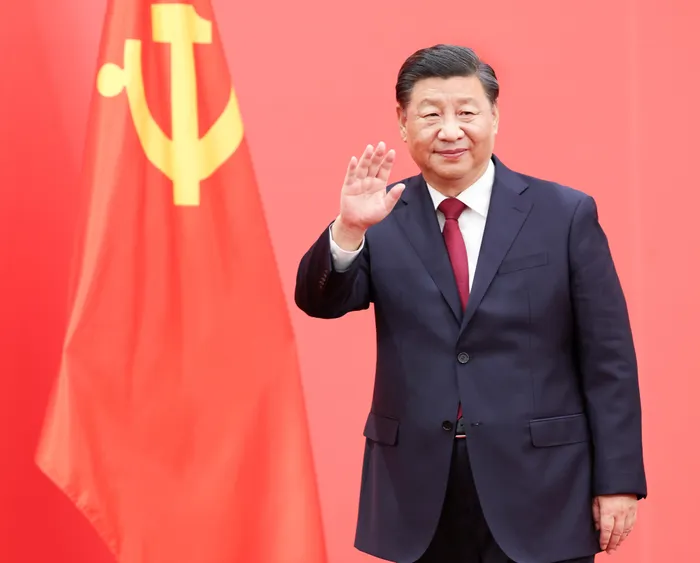
Chinese President Xi Jinping. China's Eight-Point Decision, adopted in 2012, has redefined governance practices within the Communist Party and offers a compelling model for global governance, focusing on frugality, accountability, and public trust.
Image: Xinhua
Since their adoption in 2012, the eight-point decision have become a defining instrument in Party reform and governance practice for the Communist Party of China.
Introduced to curb chronic bureaucratic problems such as official privileges, lavish banquets, redundant paperwork, and inefficient meetings, the decisions embody a cultural and institutional shift toward frugality, pragmatism, and people-centred governance.
Beyond internal regulation, they offer a model for global governance, demonstrating how disciplined conduct and accountability can strengthen institutional capacity and public trust.
The eight-point decision combine rigorous institutional standards with cultural transformation. Disciplinary organs at all levels supervise compliance, and violations are publicly disclosed, demonstrating a zero-tolerance approach. By curbing extravagance and streamlining processes, the decision convert principles of good governance into enforceable practices.
This integration of structure and culture has strengthened the CPC’s operational efficiency, stability, and credibility. Effective governance, as demonstrated by the eight-point decision, relies on aligning institutional rules with a culture that values frugality, responsiveness, and integrity. Through this approach, the CPC has created a model that is both adaptive and capable of continuous learning.
The eight-point decision have influenced political parties outside China. Tanzania’s ruling party, Chama Cha Mapinduzi (CCM), has implemented similar measures to fight corruption, reduce bureaucratic self-interest, and improve efficiency. These reforms have strengthened governance capacity and increased public support.
For parties in the Global South, where institutional capacity and accountability can be limited, the eight-point decision provide a practical model. Unlike Western approaches to governance, which often rely on external mechanisms such as opposition parties or the press, the CPC’s decision emphasise internal discipline, iterative learning, and cultural transformation, offering a tested alternative for strengthening institutions.
The decision have reshaped how the CPC engages with citizens and manages resources. Lavish banquets and unnecessary official travel have been curtailed, freeing resources for on-site research and direct community engagement. Cadres now spend more time listening to citizens’ concerns, solving practical problems, and implementing tangible solutions.
Grassroots Party organisations hold “on-site office” activities to address residents’ needs, demonstrating the decision’ impact on daily governance. Citizens experience faster service, reduced resource waste, and more accountable officials, strengthening public trust and Party unity. These measures show that good governance is not only about regulation—it is about operational effectiveness and responsiveness to societal needs.
The eight-point decision offer lessons for global governance. Internal accountability, combined with cultural change, can enhance institutional resilience. Political parties and governments worldwide, particularly in emerging economies, can draw from China’s experience to improve governance without relying solely on external checks.
By emphasising internal discipline, iterative learning, and responsive administration, the decision show that governance reform can be both systemic and adaptive. They illustrate how aligning institutional structures, cultural norms, and citizen engagement strengthens public trust, operational efficiency, and political legitimacy.
The experience of the eight-point decision highlights several key insights:
For countries in the Global South, the eight-point decision offer actionable strategies for party-building, anti-corruption campaigns, and governance reform. Internal discipline, operational efficiency, and people-centered administration strengthen legitimacy and service delivery. Party-to-party exchanges facilitate knowledge transfer, enabling adaptation of the principles to local political, social, and economic contexts.
More than a decade after their adoption, the eight-point decision remain a defining force in Chinese governance. They exemplify how internal discipline, cultural transformation, and accountability enhance political performance, build public trust, and strengthen institutions. Beyond China, the decision offer a practical model for parties and governments worldwide, particularly in the Global South, seeking to improve governance, legitimacy, and citizen-focused development.
In an era of global political uncertainty, the eight-point decision demonstrate that effective governance requires both regulation and a culture of integrity, pragmatism, and responsiveness. They offer a compelling contribution to global governance, illustrating how disciplined, people-centred leadership can drive sustainable institutional and societal outcomes.
* Cole Jackson, BRICS+ Consulting Group, Chinese & South American Specialist