

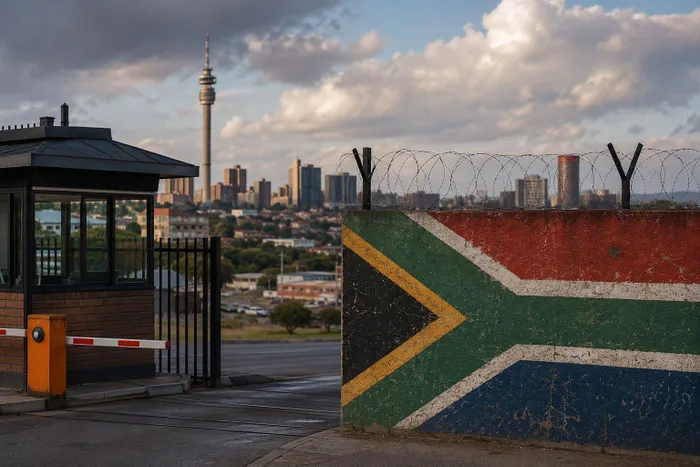
In a video that has since gone viral, a man is seen asking where the security officer is from.
Image: ChatGPT
A routine workday for a security officer from the Venda community working for SBV took an unsettling turn when he was reportedly stopped and questioned by a Zulu-speaking individual who challenged his nationality after he struggled to speak isiZulu fluently.
In a video that has since gone viral, a man is seen asking where the security officer is from. "Why do you care where I'm from? You want to see my ID?"
Mukhethwa Dzhugudzha, a social commentator and activist, told IOL that the incident reflects deeper societal tensions that extend well beyond questions of immigration enforcement.
"Let's be honest, if a Venda man can be called a foreigner in his own country because he does not speak IsiZulu then this is not just about illegal immigration because if this was truly about documentation then South Africans would not be attacked and humiliated simply for speaking the wrong language."
He said that what is unfolding reflects a deeper social fracture. "This is how Afrophobia mutates into tribalism. Xenophobia, Afrophobia and tribalism are all cousins."
Dzhugudzha warned that such attitudes risk widening divisions within the country.
"First the target are Zimbabweans, then Mozambicans, then Nigerians. Then suddenly it becomes Venda people from Limpopo or Tonga people or Peri people. Anyone whose accent or language sounds unfamiliar."
Political analyst Zweli Ndevu linked such incidents to linguistic dominance within certain mobilisation spaces.
"Remember that people who are leading this movement around xenophobic issues and all of that are mostly people from KwaZulu-Natal most of them speak only Zulu or their language understanding is limited to Zulu and therefore anything that is outside of Zulu would be seen as foreign. So that's the reason they might be doing that."
He added that tensions could intensify in the coming weeks.
"We'll see this escalating as it grows closer to the deadline that they've set themselves, which is the June 30."
Ndivhudzannyi Ralivhona, known by her stage name Makhadzi, said the incident had affected her personally and urged people to find a different way of addressing concerns around undocumented migration.
"My Zulu brothers, please let's find a new way to approach this illegal foreigner issue. It must not get to the extent where people from Limpopo are forced to know Zulu. Let it be a choice, not a must," she said.
She also expressed concern about the broader implications of the incident.
"It really pained me seeing my brother being harassed like this just because he is new in Gauteng and does not know how to speak Zulu. Please tell us where we belong so we can go on."
Cici Sebego, a sociology and community development facilitator, said the incident cannot be separated from South Africa's historical legacy of division and classification.
"I often say that South Africa's historical context continues to shape who we are today... by this, I am referring to the legacies of colonialism and apartheid," she said.
According to Sebego, apartheid-era policies entrenched ethnic divisions that continue to influence social relations decades later.
She explained: “Through the ethnic classification of Bantustans, people were separated and categorised according to language and ethnicity. This institutionalised a system of social classification that contributed to tribalism and, in some cases, created perceived hierarchies and tensions between different groups.”
She argued that language can become a powerful marker of belonging during periods of heightened social tension, particularly when anti-immigrant sentiment is on the rise.
"Language can become a marker of identity, and at times like these when anti-immigrant sentiments are growing, it can be used to determine who is seen as part of the community and who is viewed as an outsider," Sebego said.
She further suggested that there may be a connection between growing nationalist sentiments and hostility towards outsiders, noting that xenophobia can emerge from broader systems of exclusion and social othering.
IOL News