

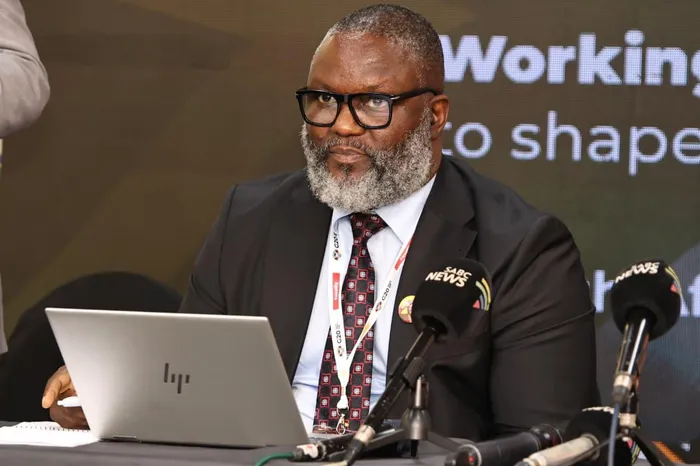
The Ministry for the Public Service and Administration Inkosi Mzamo Buthelezi conceded what critics have long alleged: South Africa’s public service crisis is not a failure of policy but of political and administrative will.
Image: Supplied
The elephant in the room was that there was a lack of appetite in the Department to enforce consequence management… It did not matter how many times policies were reviewed or amended. If the Department was not intentional in terms of holding people accountable, it was just a waste of time.
IN A rare moment of unvarnished honesty before Parliament's Portfolio Committee on Public Service and Administration, Minister Inkosi Mzamo Buthelezi conceded what critics have long alleged: South Africa’s public service crisis is not a failure of policy but of political and administrative will.
The admission, made during a recent briefing on the 2025-2030 Strategic Plans and 2026/27 Annual Performance Plans of the Department of Public Service and Administration (DPSA), Centre for Public Service Innovation (CPSI) and National School of Government (NSG), casts a long shadow over every target, budget line and reform commitment tabled by the three entities.
Buthelezi’s words landed as committee members grappled with a disturbing reality: “The media had reported that R800 million was still paid to suspended people whose cases had not been concluded.”
The ANC’s Weziwe Tikana-Gxothiwe noted: “There were people who had been suspended for more than a year,” demanding clarity on “the real state of affairs”.
Buthelezi did not deflect. Instead, he described a system engineered for delay: “The government was self-sabotaging. Why were 90 days allowed? Why was it not the case that it should be closed within the first month? When 90 days were allowed, people tended to wait until the last day and then grant an extension. The matter was deliberately stalled, sometimes drawing cases out for several years. Government officials did not appreciate that extending the process cost the state a lot of money.”
The Minister’s outlined a succinct proposed fix: “Cases should be concluded within one month.” Yet the mechanisms to enforce this remain aspirational. The DPSA’s central register of disciplinary cases “would be able to track any matters that had been delayed”, a future capability, not a current reality.
Compounding the enforcement crisis is a leadership vacuum. All three entities appear before Parliament under acting heads:
“The Committee noted that the CPSI, NSG, and DPSA had acting heads,” the chairperson Jan Naudé De Villiers noted, urging the Minister to respond.
The recruitment process for the DPSA’s permanent director-general has become a case study in dysfunction. Of 60 applicants, “only five individuals qualified”. The Department, “not satisfied with the pool”, opted to re-advertise.
Tikana-Gxothiwe described this as “unacceptable”, cautioning: “The delay was causing issues within the Department. Going to the private sector undermined the fact that people were being trained for these positions in the public sector. This undermined the system.”
The MK Party’s Japhta Malinga did not pull any punches either: “If there was to be stability in the DPSA, the vacancies in the Department had to be filled. The issue of acting positions had to be resolved. The committee did not want to act as an employment agency, but this situation might force it to.”
Meanwhile, the Batho Pele Revitalisation Strategy, intended to restore citizen-centric service delivery, faces scepticism after three decades of implementation.
The MK Party’s Gugulethu Mchunu queried: “How did they measure whether Batho Pele principles were genuinely improving the actual experience of citizens in accessing government services? Why did citizens continue to experience poor treatment and inadequate service delivery despite years of Batho Pele implementation?”
Buthelezi’s response placed responsibility squarely on officials, not policy: “Batho Pele was a set of principles that should guide any public servant… A lack of service delivery did not reflect the ineffectiveness of the principles themselves but rather an inability by officials to uphold the principles.”
When the matter of corruption was brought to the fore Buthelezi did not shy from the scale of the challenge: “Progress was being made, but corruption was deeply entrenched… The biggest challenge that had to be looked into was why the government appeared to attract thugs and thieves, instead of the proper people. Unless this was addressed, no progress would be made,” he said.
He cited the Madlanga Commission as evidence that: “Highly educated people were involved in corrupt activities,” underscoring that technical qualifications alone could not guarantee integrity. “Systems could be put in place to professionalise the public service, but if people did not change their attitudes, it would not bring about the desired results.”
As the public service pursues digital transformation, anxieties about technological displacement would surface repeatedly. The ANC’s Phindisile Xaba-Ntshaba expressed a widespread concern: “The country had a major unemployment crisis. Young people were sitting at home with master's degrees. What was the reason these youth went to school and university if robots would take their jobs?”
NSG Acting Principal Phindile Mkwanazi offered reassurance: “AI and digital transformation could not be avoided… These innovations did not mean that jobs were being taken away, rather it was adding efficiency to the system. Re-skilling people was a critical step.”
Yet the digital divide remains stark. The ANC’s Nombuso Mtolo asked: “Many rural communities still struggled with internet access and digital literacy. How would the CPSI ensure that digital systems did not exclude vulnerable communities or disadvantage applicants without access to technology?”
Vukela, the acting director-general, deferred responsibility: “The committee should call the Department of Communications and Digital Technologies to engage on the matter of connectivity in rural communities.”
The meeting also touched on the volatile issue of illegal immigration and crime. Xaba-Ntshaba raised citizens’ concerns about “foreigners flocking to South Africa, killing people, and bringing drugs”.
Buthelezi urged nuance: “When speaking about the issue of foreign nationals, it should be clear that it referred to those who were in the country illegally. Members of the public should not take the law into their own hands and should allow the law to deal with these matters.”
He acknowledged that: “Some people who were in the country illegally were here solely to commit crime,” but strongly cautioned against xenophobia: “It was also important not to paint all foreigners with the same brush.”
But as Buthelezi himself conceded: “If the Department was not intentional in terms of holding people accountable, it was just a waste of time.”
Until consequence management moves from rhetoric to routine — until suspended officials no longer draw salaries for years, until acting appointments are resolved, until budgets align with deliverables — South Africa's public service reforms will remain performative rather than transformative.