

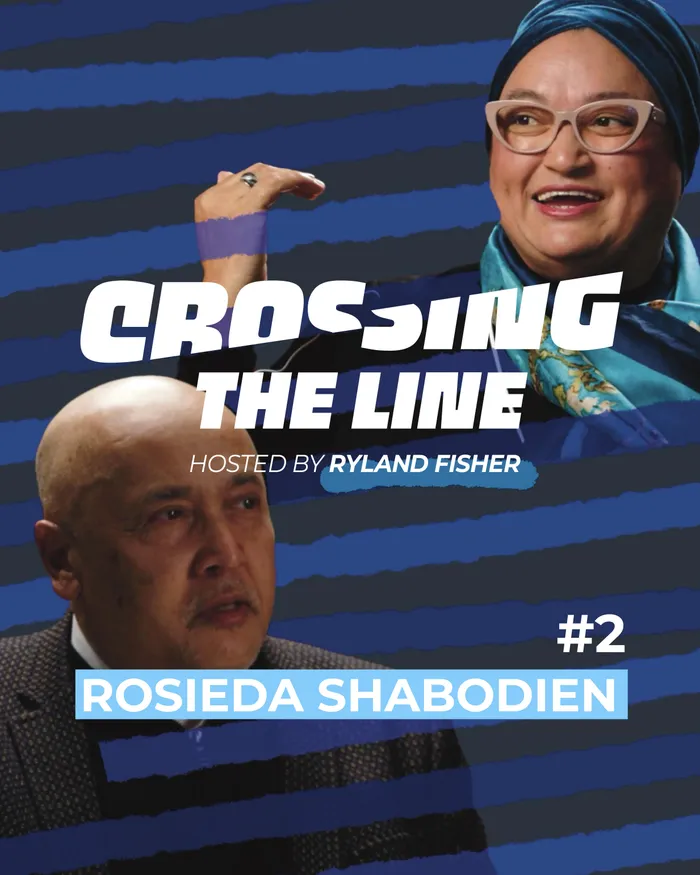
Gender activist Rosieda Shabodien speaks to Ryland Fisher about the challenges faced by women and what can be done about it.
Image: Supplied
Life coach, gender activist and author of What Women Want Coaches to Know, Rosieda Shabodien, said that when she and Ebrahim Rasool got married in 1988, they agreed to share all household duties. This equal relationship is what has inspired her in her work to empower other women.
“When we got married, we agreed that we would share all the household duties, including cooking, caring and cleaning. For a long time, I thought this is what everybody did. Ebrahim was determined not to fall into a patriarchal trap. He drew up a timetable for the two of us. This is what drives me. I think about how wonderful our relationship is, that no one needs to live in the shadow of another person.”
Shabodien was speaking to veteran journalist Ryland Fisher in the second episode of the Crossing the Line podcast series. The series was started by Fisher, a former editor of the Cape Times, in the middle of last year and they have already published 16 episodes. IOL features one of these episodes every week.
Shabodien spoke about the double-glaze ceiling that black women face in their careers. “They often have to face not only issues around gender, but also racism. In South Africa today, you still find mainly white men in leadership in the private sector.”
She said what attracted her to coaching is that she is not advising women. “I am not saying I have walked this journey, follow me. The kind of questions I ask allow the person to reflect on what holds them back and what stops them from showing up in their brilliant selves.”
Shabodien said she was born in Elsies River and the midwife wrapped her in newspaper. “I think the ink rubbed off on me and I almost became addicted to newspapers growing up. But I would not be interested in the headlines, but rather reading between the lines. “I have realised that it is not where you are born. It is what you make of your life.”
Shabodien spoke about how she and fellow student representative council members at Belhar High School in 1985 decided to defy the apartheid government by getting degrees. “We knew that they did not want us to be educated. The best way to show them a finger was by getting a degree. I was the first member of my family to get a degree. Both my parents only made it to Standard Three.”
In a wide-ranging interview, she also spoke, among others, about how the coaching industry has grown in South Africa, her fears of speaking publicly when she was a young political activist, how the detention of her fiancé delayed her marriage, and the need to tell South African stories.
The interview was conducted a few months after she and her husband returned from the United States of America last year, and she spoke frankly about the differences between her husband’s first and second stints as South Africa’s ambassador to the United States of America, and the emotions she fell when they were forced by the American government to return home after just a few months. “We are sad that we are not able to go back to America any time soon, but we stand by what he said about Donald Trump. It is what it is.”