

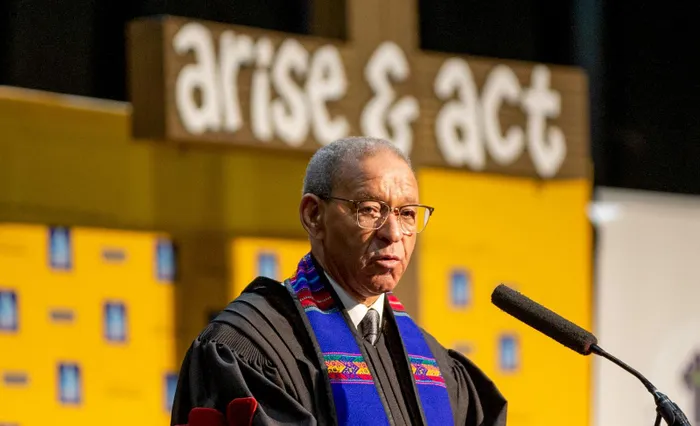
Struggle stalwart, Professor Allan Boesak, addresses the Diakonia Council of Churches’ Good Friday prayer service at Durban’s Inkosi Albert Luthuli International Convention Centre on Friday morning.
Image: Leon Lestrade / Independent Newspapers
Struggle stalwart, Professor Allan Boesak, has, on Good Friday, at an event held in Durban, prayed for KwaZulu-Natal Commissioner Lt-Gen Nhlanhla Mkhwanazi’s protection from harm known to cost the lives of whistle-blowers.
Speaking on the sidelines of the Diakonia Council of Churches’ Good Friday prayer service on Friday morning, the retired Uniting Reformed Church in Southern Africa (URCSA) clergyman described Mkhwanazi, whose contract as the provincial police head was recently renewed, as a man of courage.
The commemoration of Jesus Christ’s crucifixion started early in the morning, with Boesak leading the opening prayer and delivering the keynote address at Durban’s Inkosi Albert Luthuli International Convention Centre, and was followed by the carrying of a cross to the City Hall, where the main service was held.
Premier Thami Ntuli, Transport Deputy Minister Mkhuleko Hlengwa, and eThekwini Mayor Cyril Xaba attended.
Boesak said Mkhwanazi made sacrifices that were likely to cost his life by addressing a media briefing on July 6, 2025, to expose controversial issues linked to the attempt to disband the Political Killings Task Team (PKTT). This event led to the formation of the Madlanga Commission of Inquiry and the parliamentary Ad Hoc Committee.
“People are already praying for him (Mkhwanazi), and we have been praying for him from 6 July last year. In this country, people like him, who are brave, are not just being sidelined or kicked out of jobs, but they are sometimes killed.
“So we pray for his continued courage, and we pray for steadfastness in the light of a situation that might still develop,” said Boesak.
He said the commissioners of the Madlanga Commission, Chairperson Justice Mbuyiseli Madlanga, Advocate Sesi Baloyi SC, and Advocate Sandile Khumalo SC, also needed prayers as their work was important.
He described corruption in the country as shocking, and that what had already been revealed at the commission was just the tip of an iceberg, as he was expecting much more to be laid bare.
“This means that people must acknowledge that there is a crisis that we can no longer deny or ignore.
“It is our responsibility to do something about it as this becomes clear every single day,” he said.
He said he was praying that the law would take its course against those implicated at the Madlanga Commission.
“But I do not know how this would happen because the difficulty in our country is that none of the commissions we had, and they had been many, had actually resulted in the kind of action that is necessary to correct the wrongs, as nobody has been thrown in prison.
“Now this time, especially with the amazing work that the Madlanga Commission is doing and the sacrifice that General Mkhwanazi is making to let our people know what the situation really is, I hope that when the recommendations reach the desk of the president, the right decisions will be made,” he said.
He said the work of the Zondo Commission of Inquiry into Allegations of State Capture was undermined by the government’s failure to bring to book people who were implicated.
“People who were mentioned in the Zondo Commission are still where they were, and none of them have been touched.
“I am hoping that the Madlanga Commission will bear more fruit and that the president will have the courage to act upon its recommendations.”
He also shared his views on the deployment of the army to help police in the fight against crime in the Western Cape, Gauteng, Eastern Cape, Free State, and the North West.
He said that despite President Cyril Ramaphosa having deployed the army in response to pressure from residents who were tired of living with dangerous criminals, he did not believe that the army was the instrument to fight crime.
“The army is made to fight enemies of the country, and if we deploy the army to fight crime that our own people are committing, are we saying that we are now turning them (people) into enemies?
“The army is not trained like the police to deal with all sorts of issues, and the main thing is that we can deploy 50,000 soldiers, but unless you address the socioeconomic issues that drive so many of our people to crime, you will not solve the issue.
"Unless we address the spiritual issues that drive people to crime and see what we can do to change the way of life and the way of thinking,” he said.
Addressing followers of various churches outside the City Hall, Ntuli called for the Easter weekend to be used as a start to address poverty and inequality.
“It calls for us to extend a hand to those who are suffering, as we witness poverty, inequality, and the effects of injustice.
“Let us strive to be the inspirers of new hope by working towards a society that reflects the divine love we celebrate today,” said Ntuli.
bongani.hans@inl.co.za