

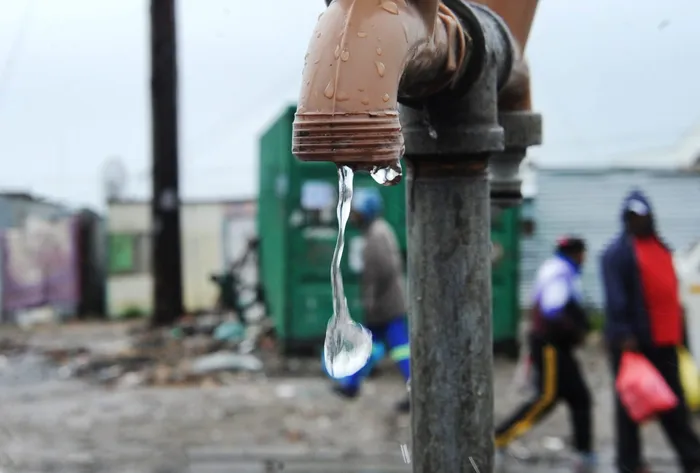
The Green Drop, Blue Drop and No Drop reports note that there has been a marginal improvement in the drinking water risk profile; however, high-risk systems still require urgent corrective action.
Image: Cindy Waxa / Independent Newspapers
Nearly half of South Africa’s treated water is being lost before it even reaches consumers, highlighting a deepening crisis in the country’s water infrastructure.
This is one of the key findings from the latest Green Drop, Blue Drop and No Drop reports released on Tuesday by Water and Sanitation Minister Pemmy Majodina, offering a detailed picture of the state of water quality, wastewater management, and system efficiency.
According to the reports, non-revenue water, which includes leaks, theft, and billing failures, remains alarmingly high at 47.3% nationally, meaning almost half of all treated water is not generating any revenue.
Closely linked to this is the level of physical water losses, with about 32% of water lost through leaks in pipes, reservoirs, and other infrastructure, pointing to widespread maintenance failures across municipalities.
Despite this, there are some signs of progress in drinking water quality.
Nationally, the proportion of low-risk drinking water systems has increased slightly from 60.2% to 61.9%, while critical-risk systems declined from 9.9% to 7.9%. However, the reports caution that these improvements are marginal, and that risks remain high in many parts of the country.
The Western Cape continues to outperform most provinces, emerging as one of the strongest performers in drinking water quality.
"There has been a marginal improvement in the drinking water risk profile… however, these gains remain modest and critical and high-risk systems require urgent corrective action," state the reports.
The province recorded the lowest overall risk rating, with no systems classified as critical risk, and a high share of low-risk systems, indicating that water supplied to residents is generally safe and meets national standards.
It also leads in water efficiency.
The reports show that the Western Cape has the lowest levels of non-revenue water and physical losses, suggesting better infrastructure management and quicker response to leaks compared to other provinces.
In addition, the province has among the lowest daily water usage per person, reflecting sustained conservation efforts and improved demand management.
However, the national picture remains a cause for concern.
The reports highlight that much of South Africa’s water network, which includes pipes, pump stations, and reservoirs, is ageing and poorly maintained, allowing leaks to persist for long periods before being repaired.
In many municipalities, backlogs in maintenance and slow response times to pipe bursts are compounding the problem, with treated water effectively being lost daily.
Experts warn that without sustained investment in repairing and upgrading infrastructure, efforts to improve water supply will continue to be undermined by the reality that a significant portion of water is lost underground before reaching households.
"A significant proportion of municipalities are at high or critical risk of using water inefficiently in their distribution systems."
A major driver of water losses is the poor condition of infrastructure, with many systems deteriorating due to a lack of maintenance and investment.
The reports point to ongoing challenges such as shortages of skilled technical staff, weak municipal leadership, and insufficient budgets for maintenance and operations.
These issues directly impact whether infrastructure is properly maintained to minimise wastage; in many cases, it is not.
The findings also reveal uneven progress when it comes to plans and strategies to reduce water losses. While some municipalities have implemented water conservation and demand management measures, more than half either lack proper strategies or are unable to show meaningful implementation.
This means that in many areas, leaks persist, water losses remain high, and systems continue to operate inefficiently
"Without urgent improvements in maintenance, planning and investment, water losses will continue to undermine service delivery," the reports read.
lilita.gcwabe@inl.co.za