

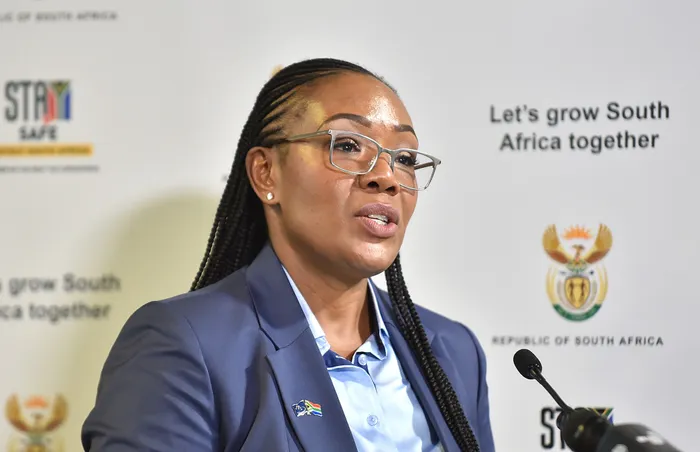
Auditor-General of South Africa, Tsakani Maluleke, this week issued a scathing indictment of the national and provincial governments, warning that the new administration is moving too slowly to fix systemic governance failures.
Image: Independent Newspapers | Archives
THE Auditor-General of South Africa, Tsakani Maluleke, this week issued a scathing indictment of the national and provincial governments, warning that the new administration is moving too slowly to fix systemic governance failures that are crippling service delivery and eroding public trust.
In the Consolidated General Report on National and Provincial Audit Outcomes 2024-25, Maluleke declared: “The rate at which the new administration is addressing institutional capability, governance and accountability weaknesses is too slow.”
The report paints a picture of a state in decline, where non-compliance is normalised, money is wasted with impunity, and leadership failures are costing billions.
Despite the constitutional mandate to build public confidence, clean audits are virtually non-existent among those managing the bulk of public funds. “Clean audits continued to be in short supply,” the report stated. Only 151 of 417 auditees achieved this status. The remaining 266 institutions, managing 88% of the R2.21 trillion budget, “continue to lack the institutional capability to produce credible financial and performance reports or ensure compliance with legislation”.
Rather than improving, governance is deteriorating in critical areas. “Audit outcome regressions… were reported for 45 auditees,” including 22 high-impact institutions overseeing R523 billion. The Auditor-General cautioned: “The scale of these regressions significantly outweighs the improvements made elsewhere,” signalling that governance is failing in the very institutions that matter most.
Many officials celebrate an “unqualified with findings” outcome, but the AG shuts down this complacency immediately. “No, an unqualified audit opinion with findings is not a good outcome.”
These 161 auditees exhibited “high levels of non-compliance, weak financial and performance management, and inadequate accountability and consequences.” Maluleke noted: “More than half only achieved unqualified audit opinions after correcting material misstatements that were identified during the audit process.”
Disregard for legislation has become entrenched. “Widespread non-compliance with legislation continues unabated, with minimal consequences,” the report stated. “This entrenched culture of disregarding the rule of law not only erodes public trust but also signals that such conduct is tolerated.”
Some 224 auditees (58%) had material findings on compliance, carrying severe financial and non-financial costs.
Section 217 of the Constitution requires fair and competitive procurement, yet “our audits again revealed breaches of these principles.” Officials continue using “uncompetitive and unfair procurement practices, which include evergreen contracts and month-to-month extensions.”
The report cautioned: “Not following fair and competitive procurement processes can result in paying higher prices for goods and services and appointing contractors that do not deliver.”
Financial discipline has collapsed. “Despite the fiscal constraints facing government, the poor quality of spending continues to receive insufficient attention,” Maluleke said. “In an environment of limited resources, wastage should not be tolerated, and every opportunity to recover lost funds must be pursued with urgency.”
Auditees incurred R1.42bn in fruitless and wasteful expenditure, while 67 departments ran deficits totalling R44.23bn, money that “will have to be repaid from future service delivery budgets”.
Accountability is impossible when the government cannot accurately report on what it has achieved. “Of the 318 auditees required to prepare performance reports, 100 (31%) published reports that were not useful or reliable. Over half of the performance reports submitted for auditing contained material misstatements.”
The AG noted: “The poor quality of the performance reports submitted for auditing reveals weaknesses in the planning processes and calls into question the effectiveness of in-year monitoring and decision-making.”
Basic services depend on quality infrastructure, yet “poor planning, coordination and execution by the different role players in the infrastructure value chain led to the poor quality of spending on infrastructure delivery and maintenance”.
Findings were reported on 89% of the 152 infrastructure projects audited. “Average delays reached 41 months, with some projects delayed by almost 10 years.” In human settlements: “96% of housing projects had findings, with some delayed by nearly 20 years.”
In an era of digital government, security is lax. “Cybersecurity has emerged as a critical concern, with national security, economic stability and public trust increasingly dependent on resilient digital infrastructure.” Assessments found that “45 auditees (64%) had notable weaknesses in their cybersecurity posture”, while “eight auditees (11%) exhibited critical vulnerabilities that could be exploited if not addressed”.
The cycle of failure continues because officials face no repercussions. “A persistent lack of accountability and consequences remains one of the primary drivers of ongoing non-compliance with legislation, high levels of irregular expenditure, financial losses, poor audit outcomes and service delivery failures.”
The number of auditees failing to comply with consequence management legislation rose from 119 to 140. “When officials are held accountable for their actions, it not only facilitates the recovery of losses but also serves as a deterrent to future transgressions.”
Losses are mounting while recovery stalls. “Of 203 active material irregularities involving an estimated R9.17 billion in losses, only R2.37 billion has been recovered or prevented. 105 cases have remained unresolved for over a year — often due to leadership instability, delayed investigations, or weak recovery processes.”
The AG notes that “preventing and resolving material irregularities are not receiving attention, resulting in continued losses and harm”.
The financial health of SOEs poses a massive risk to the country. “Eight SOEs disclosed serious doubts about their ability to continue operating. Transnet and Eskom alone have combined liabilities nearing R866 billion.” To remain afloat: “SOEs have had to rely on government guarantees of R453.48 billion with an exposure of R414.45 billion.”
The report cautioned: “Without urgent reforms, improved governance, sustainable revenue models and the implementation of credible turnaround strategies, SOEs will continue to pose a major risk to the country's fiscal health and economic recovery.”
Legal liabilities are draining resources meant for care. “Unsettled claims against departments rose to R116bn, with the health sector accounting for R58bn. These claims are rarely budgeted for, meaning funds meant for patient care are diverted to settle legal liabilities.” In the Eastern Cape alone, the burden stands at R22.15bn, according to the AG.
Audits of key funds revealed systemic failures. “The control environments at many of these institutions failed to prevent or address non-performance, unethical conduct, fraud and non-compliance with legislation.” Findings included “payments to ineligible recipients, unauthorised changes to banking details, missing documentation, and indicators of fraud”. The AG states plainly: “Weak controls mean money collected from taxpayers is lost or misdirected.”
Ultimately, the failure is not about resources or mandates but behaviour. “These failures are not due to unclear mandates or insufficient resources,” the report stated. “They stem from weak leadership, a tolerance for non-compliance, inadequate institutional capability, and a breakdown in oversight.”
Maluleke issues a final warning to the accountability ecosystem: “Until the culture changes — towards performance, accountability, transparency, and integrity — audit outcomes will not improve, and service delivery will continue to suffer.”
The AG urged leaders to use the information and insights presented in this report to enable the envisaged improvement in national and provincial government and in the lives of the country's citizens.
Maluleke’s message is succinct: “If commitments and good intentions do not translate into significant improvements at the institutional level, the public will not experience increased service delivery and an improvement in their lived experience.”