

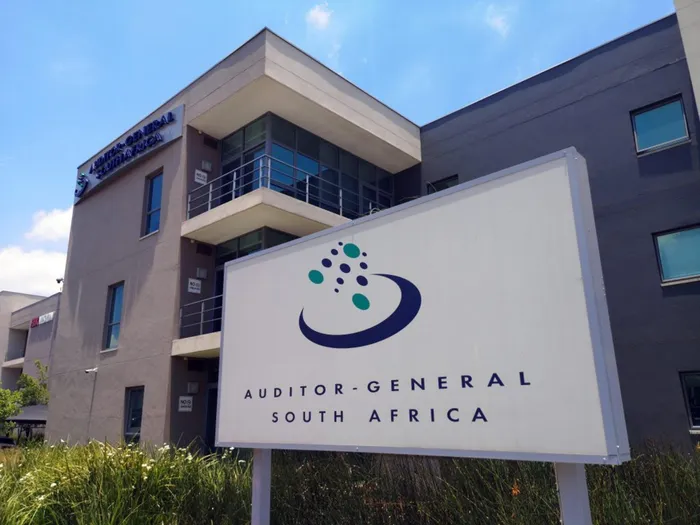
The AGSA reported that eight SOEs reported serious doubts about their ability to continue operating, seven for at least six consecutive years.
Image: File
ONE year into the 7th administration, Auditor-General (AG) Tsakani Maluleke reports minimal progress in audit outcomes, warning that the pace of addressing governance, capability and accountability weaknesses remains dangerously slow.
“Our audits show no clear improvement in audit outcomes, financial management, service delivery performance, accountability, transparency or institutional integrity. This shows that our audit counsel has not been adequately heeded,” Maluleke said as she released the AGSA’s 2024-25 general report.
Only 151 of 417 auditees achieved clean audits, and they managed just 12% of the expenditure budget. The entities responsible for 88% of public spending continued to underperform, directly undermining delivery on key government priorities.
State-owned enterprises (SOEs) remain a critical fiscal risk. The AG reported that eight SOEs reported serious doubts about their ability to continue operating, seven for at least six consecutive years. Poor financial positions at Transnet and Eskom have driven heavy reliance on borrowings, with their combined liabilities nearing R866 billion.
Government guarantees now exceed R453bn, straining an already fragile fiscus. “Without urgent reforms, improved governance, sustainable revenue models and credible turnaround strategies, SOEs will continue to pose a major risk to South Africa’s fiscal health and economic recovery,” Maluleke cautioned.
Non-compliance with legislation remained pervasive, according to the AG, with 58% of auditees recording material findings. The AG identified an entrenched culture where disregarding the rule of law carries minimal consequences, eroding public trust and institutional integrity.
Procurement breaches were routine: auditees persistently used uncompetitive practices, including evergreen contracts and month-to-month extensions, in violation of Section 217 of the Constitution. “These practices are not merely procedural lapses. They significantly heighten the risk of fraud and financial loss, erode public trust and directly impair service delivery.”
Reported irregular expenditure totalled R42.58bn in 2024-25, though the AG cautioned this likely understates the true extent. A persistent lack of consequence management fuels ongoing failures: the proportion of auditees failing to comply with disciplinary legislation rose from 37% to 43%.
Compounding this, 30% of auditees with reported fraud allegations failed to investigate any of them. “When officials are held accountable, it not only facilitates recovery of losses but also serves as a deterrent to future transgressions.”
Audit findings affected 89% of the 152 infrastructure projects reviewed, with poor planning, coordination and execution driving substandard outcomes. The human settlements sector recorded the longest delays, with some projects stalled for nearly 20 years, while 96% of 24 assessed housing projects had shortcomings, many completed without essential services. “Poor-quality construction can harm the public and increase costs to fix defects.”
Financial reporting quality also remains weak: 41% of auditees submitted statements containing material misstatements requiring auditors’ intervention. Without these corrections, only 59% would have received unmodified opinions, far below the 81% that ultimately did. “Material misstatements suggest decisions may be based on flawed or unreliable data,” the AG noted.
Auditees incurred R1.42bn in fruitless and wasteful expenditure, 84% attributable to high-impact entities, while budget overruns totalled R6.23bn and accruals at national and provincial departments reached R51.25bn. “In an environment of limited resources, wastage cannot be tolerated, and every opportunity to recover lost funds must be pursued with urgency.”
Progress on resolving material irregularities (MIs) remains slow but measurable: resolving 140 MIs previously prevented or recovered R2.41bn in losses. Operational fixes included converting unused buses into mobile libraries and rectifying unsafe food-handling in schools. Yet 203 active MIs remain, with an estimated R9.17bn in potential losses at risk.
Maluleke cautioned that the 36% clean audit rate creates a misleading impression of progress, given these entities manage only 12% of expenditure. She also warned that many auditees with “unqualified with findings” outcomes exhibit complacency, mistaking minimal compliance for success.
Three persistent shortcomings hold back progress: governance failures and weak institutional integrity; inadequate institutional capability; and weaknesses in oversight and intergovernmental coordination. “It is because roleplayers in the accountability ecosystem do not fulfil their designated and legislative roles consistently or effectively.”
Maluleke called on executive authorities and oversight structures to prioritise intergovernmental planning, institutional capability, professionalisation, and rigorous management of procurement and financial risks.
“We call on all others in the accountability ecosystem to fulfil their designated roles and play their part effectively and without fear or favour to promote an effective public service culture: a culture of performance, accountability, transparency and institutional integrity that will improve service delivery and create tangible prospects for a better life for our people,” she said.