

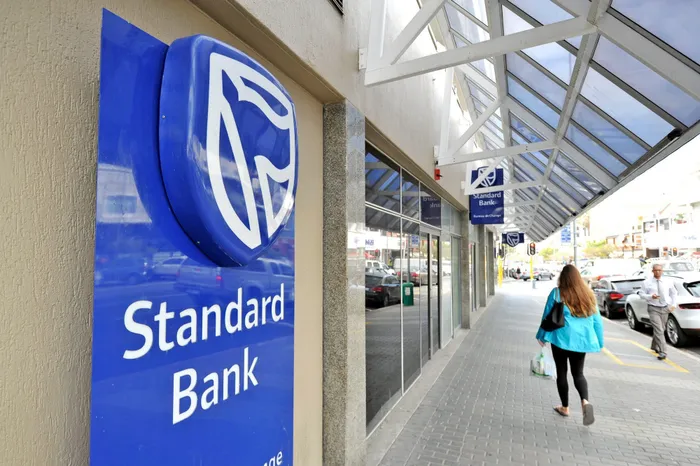
Standard Bank has been accused of exposing its clients' confidential banking information, leading to accounts being scammed.
Image: Henk Kruger / Independent Newspapers
Distressed bank users have expressed concern about Standard Bank allegedly exposing their confidential and private information to scammers, who allegedly wiped out their bank accounts.
Scores of people took to social media, especially X, alleging that their money on their Standard Bank accounts was completely withdrawn without their consent and knowledge.
Instead of responding to questions sent to her on Friday evening, Standard Bank media relations officer Ross Linstrom responded by sending a statement, which the bank released on March 10, saying there was no evidence of fraud targeting its clients’ bank accounts.
“We want to reassure our customers that, currently, there is no evidence of elevated fraud activity, and our fraud prevention and security controls remain robust and effective,” read the statement.
The bank said it was aware of recent social media posts and concerns related to alleged fraud cases, which it stated dated back to 2011.
“And (they) were fully investigated at the time through our internal processes and, where relevant, independently reviewed by either the Banking Ombud at the time and The Financial Sector Conduct Authority (FSCA),” it said.
It further stated that it is closely working with its customers, the South African Banking Risk Information Centre (SABRIC), the banking ombudsman, and other relevant authorities to continuously strengthen industry measures that protect customers’ accounts.
“Customers with specific fraud concerns are encouraged to contact us directly through our official channels.
“Those who are not satisfied with the outcome of a specific case may approach the Ombudsman for an independent review,” read the response, which the bank also posted on X on March 10.
The National Financial Ombud Scheme (NFOS) has not responded to questions sent to it on Friday, but its senior official Johan Brouwer told the media on March 10 that users of accounts from various accounts reported being victims of fraud every day.
“All the time, every day, thousands of customers are falling victims of sca,ms and in our office last year, we saw formal complaints of just under 9,000, and of those about 40% related to fraud incidents.
“Those are only complaints that customers actually lodged in our office, the incidents are many more than that,” said Brouwer.
He said victims can look at their cellphone bank apps or internet banking profiles to see where their funds have gone.
“But due to privacy laws in South Africa, a bank won’t be able to disclose any further information about that account to you.
“You can follow the legal process, for instance, by opening a case with the police and obtaining a subpoena, and through that process, the bank will have to respond to that subpoena and provide information.
“But they would not just be able to respond to a request from you and provide with that information related to that account, which your funds went, but you should lodge the complaint with your bank and allow them an opportunity to investigate to see how was this payment made and authorised and possibly if there is something that happened wrong on the bank side, they would have to refund you.
“Alternatively, they will explain why you cannot be refunded,” said Brouwer.
One of the bank users, who claimed to be a victim, said he received a call from a person who claimed to be a bank employee looking to upgrade his bank account.
He said unsuspectingly, he complied when he was given a code to put in his online banking app.
“After I had scanned the code, they (scammers) gained access to my bank account, which they wiped out,” said the victim.
An arrest of Tembisa Qinga, a former Absa employee, in Mthatha, Eastern Cape, on July 25, 2026, indicated that some of the scams were operated from inside the bank.
It was alleged that the 44-year-old former business development officer channeled the proceeds of theft from clients into two Absa accounts registered in the name of her minor child.
According to the Directorate for Priority Crime Investigation (Hawks), the irregularities occurred between March 2012 and July 2013, and complaints were lodged by clients at Absa, Mthatha Plaza, which reported the matter to the police. However, this was after Qinga had already pocketed more than R2.2 million through fraud.
The Hawks had also in the past year arrested Electoral Commission of South Africa (IEC) official, Dr Nomsa Masuku, who, while employed as Standard Bank’s head of Social Corporate Investments Programme, allegedly pocketed R1.2 million from an Adopt A School Trust project, which was meant to support underprivileged learners.
Users of X have, in the past couple of weeks, expressed how they and their elderly relatives have been scammed.
One of them, whose identity was not revealed, posted a request for help to find the Standard Bank CEO after her mother was allegedly hacked by her banker.
“He (banker) even increased her (mother) limit, and when they were done, they went to her savings and transferred money into her current account.
“When she alerted her banker, he said 'call the fraud department' when she was on the phone with him for 45 minutes, MONEY WAS STILL LEAVING HER ACCOUNT.”
Brian Kelloggs @Maduna_Mboweni responded on March 9 saying: “Oh wow! They did the same to my mom last year. More than R600k gone just like that and they say she made these abnormal transactions, worse part is this account should be supposedly locked unless she goes to the bank. @StandardBankZA, you never even tried to assist till today.”