

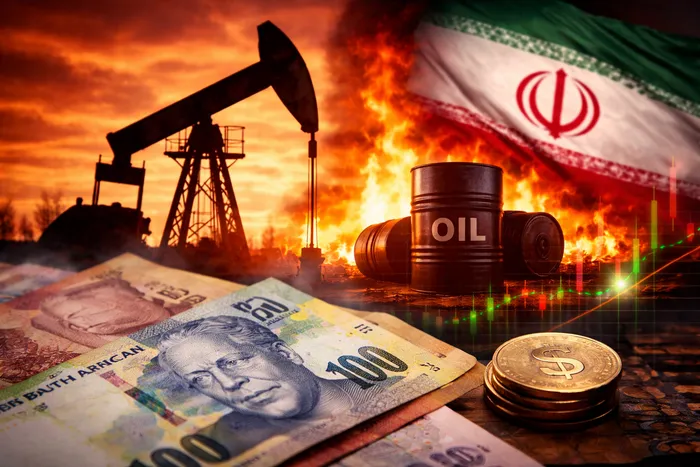
Rising tensions in the Middle East have lifted oil prices and pressured the rand, increasing the risk of higher fuel costs for South African consumers.
Image: ChatGPT
THE South African government has moved to calm public anxiety over fuel security, issuing a firm assurance that the country’s petroleum supply remains stable despite escalating geopolitical tensions in the Middle East and volatile global energy markets.
In a media statement this week, the Department of Mineral and Petroleum Resources emphasised that immediate supply chains were secure, even as international crude oil prices might have breached the psychologically significant $100 (R1 697) per barrel threshold.
“The Department wishes to assure all South Africans that the country's fuel supply remains stable in the immediate term, notwithstanding heightened volatility in global energy markets arising from ongoing geopolitical tensions in the Middle East,” the Department said.
The statement confirmed that critical fuel shipments were locked in before recent global escalations, providing a buffer for the weeks ahead. “Fuel consignments scheduled for March and early April 2026 were secured prior to the recent escalation in global tensions. These deliveries have commenced and are expected to adequately sustain national supply over the coming weeks.”
However, the Freedom Front Plus (FF Plus) said it had been privy to letters from fuel suppliers warning filling stations of possible shortages, raising questions about the reality on the ground. “A long list of filling stations that have already run dry is also circulating on social media. This raises the question: So where is the fuel?
“The departmental explanation makes sense: Fuel orders placed before the current war broke out in Iran are due to reach South Africa only in early April. So, that should not result in domestic fuel shortages, in spite of the war. Yet independent fuel traders and agents of multinational companies are finding it difficult to obtain sufficient supply. The Freedom Front Plus has several letters to that effect in its possession,” the FF Plus said.
The FF Plus said one possible explanation offered for the discrepancy between official assurances and reported shortages related to pricing dynamics. “One possible explanation is that stock is being held back until next month’s fuel price takes effect. At the moment, under recovery on petrol is around R4 per litre and on diesel approximately R7. This means that withholding stock could potentially maximise profits.”
The Department acknowledged that South African motorists should brace for potential price increases, given the country’s reliance on imported petroleum products. “As a net importer of petroleum products, South Africa remains inherently exposed to these external dynamics. Sustained increases in international oil prices, coupled with exchange rate fluctuations, are expected to translate into higher domestic fuel prices in the months ahead.”
This vulnerability is underscored by domestic production capacity. “Sasol currently produces about 30% domestically, while the rest is imported. This makes South Africa extremely vulnerable during international conflicts,” the FF Plus said.
The government’s statement also flagged concerns about pricing conduct within the fuel industry, particularly for products not subject to direct regulatory control. “The Department emphasises the critical importance of pricing transparency across the fuel value chain, particularly in respect of unregulated products such as jet fuel.
“Industry stakeholders are expected to ensure that pricing practices are fair, justifiable, and fully compliant with applicable competition and consumer protection laws.”
The FF Plus warned that the stakes could not be higher for the broader economy. “Fuel shortages, whether real or artificially created, could inflict enormous damage on the economy. They may lead to price increases that ordinary consumers cannot absorb and even result in food shortages in vulnerable communities.
“The country’s summer-sowing regions are approaching harvest time. It would be disastrous if the crops were left standing in the fields. In fact, the entire South African economy is dependent on liquid fuel.”
While immediate supply is secure, the Department outlined a multi-pronged strategy to fortify South Africa’s energy resilience against future shocks. “While the short-term outlook remains stable, the government is actively advancing measures to strengthen long-term energy security. These interventions include the diversification of fuel import sources, the enhancement of strategic storage capacity, and the acceleration of key infrastructure investments.”
The government also reaffirmed its dual commitment to regional cooperation and domestic priority. “South Africa will continue to honour its regional supply obligations, while ensuring that the security of domestic fuel supply remains paramount.”
The Department pledged ongoing communication with the public as the situation evolves. “The Department will keep the public duly informed as developments unfold and remains steadfast in its commitment to safeguarding the country's energy security and broader economic stability.”
In response, the FF Plus expressed cautious hope. “The Freedom Front Plus trusts that the Department of Mineral and Petroleum Resources will maintain the transparency promised in its statement.”