

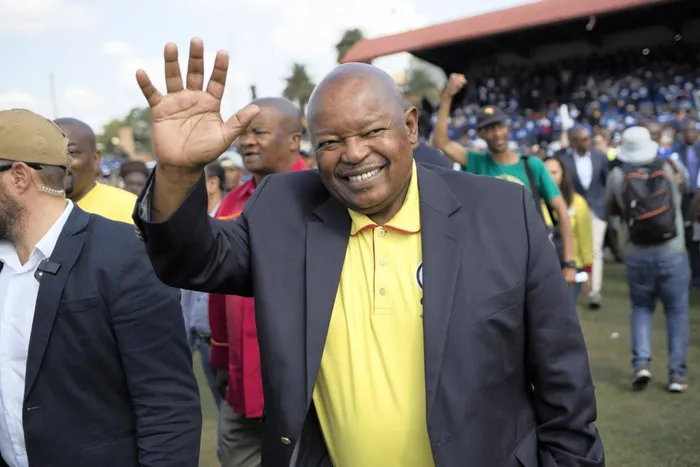
South Africa has lost a dedicated steward of its democracy with the passing of Mosiuoa “Terror” Lekota, a veteran of South Africa’s liberation Struggle and a lifelong servant of the people.
Image: Independent Media Archives
President Cyril Ramaphosa says he is in contact with the family of former Defence minister Mosiuoa Lekota with regard to his funeral arrangements.
The president was one of many political figures who have expressed their sadness at the death of the Congress of the People (Cope) leader on Tuesday morning.
Lekota passed away at a hospital in Johannesburg at the age of 77 after months of battling with illness.
Addressing the media on Tuesday, Ramaphosa said he visited the Lekota family to pass his condolences.
“We will be talking to his family to see how best they would like to have everything arranged with regard to his burial,” said Ramaphosa without indicating whether he was considering a state funeral.
Several former ministers, including Tito Mboweni, Pravin Gordhan, Sibusiso Bengu, and Membathisi Mdladlana, were given state funerals.
Ramaphosa and Lekota's relationship dates back to their university days. They were both expelled from the unnamed institution at the time due to their political activism.
While he was still an active member of the Black Consciousness Movement-aligned South African Students' Organisation (SASO), Lekota was expelled in 1972 from the University of the North, now University of Limpopo, the same institution where Ramaphosa was also a political activist.
“And we met again when we were both involved in the ANC, and he became a minister in our government,” said Ramaphosa.
He said it was political differences within the ANC, which he said were common in political life, that led to Lekota leaving to form Cope.
“I continue to have deep respect for him (because) he was a committed South African, he loved this country as much as we were serving in different benches.
“I would continue to honour him,” Ramaphosa said.
The Nelson Mandela Foundation said it will never forget Lekota's contribution to the Struggle against apartheid.
“He crossed paths with Nelson Mandela many times, beginning when they first met while prisoners on Robben Island.
“Initially on the island, Madiba and Lekota were political adversaries but quickly found each other and developed a strong mutual respect.
“He was an extremely popular figure through the 1990s, during South Africa’s long and difficult transition into democracy,” the foundation said in a statement issued on Wednesday.
The South African Communist Party (SACP) also acknowledged Lekota's contribution to the liberation Struggle.
“His background in the Black Conscious Movement developed his political understanding of the inherent racist character of the apartheid system, and thus he understood the need for the people of South Africa to fight for a non-racial, non-sexist, and democratic society.
“The SACP acknowledges Lekota’s significant role in the liberation Struggle, as well as contributing to the rebuilding of our country from 1994, and calls for the unity of the working class in deepening the national democratic revolution towards total social emancipation.
“The SACP remains committed to building a popular left front to deepen the working-class struggle against capitalist oppression and laying the foundation for socialism,” read the SACP statement.
The Congress of South African Trade Unions (Cosatu) gave a brief background of Lekota, who was born and bred in Kroonstad, the Free State, and enrolled for a Social Science degree at the University of the North.
Lekota was SASO's permanent organiser, the role that landed him in Robben Island prison for “conspiring to commit acts endangering the maintenance of law and order”.
Lekota became publicity secretary of the United Democratic Front (UDF), and through being active in the organisation, was charged and sentenced in the Delmas Treason Trial.
In 1990, he became the convenor of the ANC in Southern Natal, and the following year, he was elected to the ANC’s national executive committee and national working committee.
After the first democratic elections, Lekota became premier of the Free State until 1996.
“He served as chairperson of the National Council of Provinces (NCOP) from 1997 to 1999, after which he became minister of Defence,” read Cosatu’s statement.
After Jacob Zuma’s election as the ANC president, Lekota and Cosatu’s former general secretary Mbhazima Shilowa left the ANC to form Cope.
“A much-loved figure, Lekota will be missed for his prolific oratory. The political sphere will be that much muted without his distinctive voice.
“South Africa is forever indebted for his dedication to the Struggle and the sacrifices he was forced to make on the path to freedom,” said Cosatu.
DA leader John Steenhuisen commended Lekota’s commitment to principled politics and said he was willing to stand firm in defence of democratic values.
“He contributed immensely in our democratic Parliament, and remained a steadfast advocate for constitutionalism, accountability, and the rule of law.
“While we may have differed at times on matters of policy and approach, we shared a common commitment to upholding the Constitution and strengthening our democracy.
“And may God bless our country to deliver more Mosiuoa Lekotas,” said Steenhuisen.
The national Parliament said the former NCOP chairperson would be remembered as a principled leader who valued dialogue, democratic debate, and constitutional governance.
“His life story reflects the journey of many South Africans who endured persecution, imprisonment, and sacrifice so that future generations could live in a free and democratic country,” wrote Parliament’s spokesperson, Moloto Mothapo.
bongani.hans@inl.co.za