

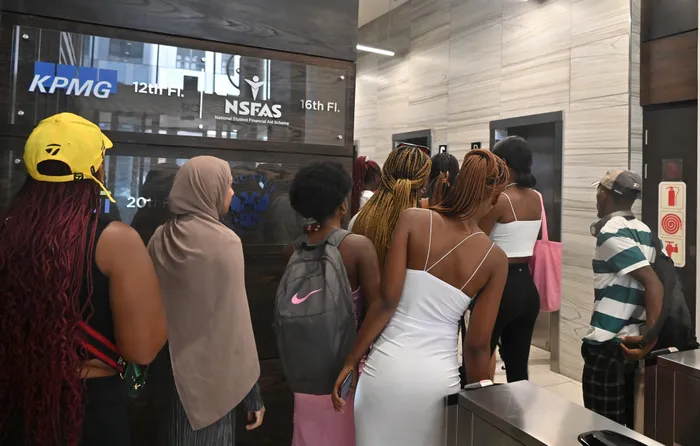
The government can credibly claim to be investing heavily in the poor and working class through NSFAS and broader post-school education funding. However, nestled between the indigent and the affluent is a growing cohort of young South Africans whose prospects are being quietly eroded by the very architecture of this funding model.
Image: Ayanda Ndamane / Independent Newspapers
FINANCE Minister Enoch Godongwana’s 2026 Budget Speech has once again laid bare an uncomfortable political truth: while the language of “pro-poor” policy remains intact, the country’s so-called missing middle is treated as an afterthought rather than a fiscal priority.
On paper, the numbers look impressive. Consolidated spending edges higher, the social wage absorbs the lion’s share of non-interest expenditure, and higher education retains its place as one of the state’s largest line items.
The government can credibly claim to be investing heavily in the poor and working class through NSFAS and broader post-school education funding. However, nestled between the indigent and the affluent is a growing cohort of young South Africans whose prospects are being quietly eroded by the very architecture of this funding model.
The “missing middle” — families that earn too much to qualify for NSFAS but too little to afford tertiary fees and living costs — has been recognised by policymakers for years. A comprehensive funding model and a new loan scheme for this group were heralded as long-awaited solutions, cobbled together from the National Skills Fund and the SETAs.
Yet this was always destined to be a stopgap rather than a systemic fix. In a high-fee, low-growth environment, the loan capital available can never stretch far enough without a clear, sustained fiscal commitment and a willingness to reorder priorities.
This Budget ducks the needed choice. There is no bold, ring-fenced allocation for the missing middle; no sign that Treasury is prepared to tilt the balance decisively in favour of broadening access beyond NSFAS’s existing means test. Instead, the government reiterates a message of “doing more with what we have”, employing technical refinements and phased roll-outs.
This may satisfy ratings agencies, but it does little for the student at a public university who falls just outside the NSFAS threshold and is now offered debt instead of a genuine opportunity.
Fiscal constraints are real — debt-service costs continue to crowd out social spending, and growth remains anaemic. Yet budgets are political instruments, not mere accounting exercises.
The choice to protect certain tax expenditures, to shy away from wealth and inheritance reforms, and to leave some corporate incentives largely intact effectively represents a choice not to fully fund the aspirations of the missing middle.
When the government insists that there is no room to move, it really means there is no appetite to act at the expense of better-organised interests.
A genuinely transformative budget would have recognised the missing middle as a strategic investment, not a marginal cost pressure. This would entail scaling up the loan-cum-grant model, implementing a more generous conversion of debt to bursary for completion, and explicitly linking this to a progressive tax stance higher up the income distribution.
It would also require confronting universities on cost structures, ensuring the state does not simply subsidise inflationary tuition.
Instead, 2026 feels like another year of managed drift. The poorest remain partially shielded, the wealthiest are barely touched, and the missing middle is squeezed ever tighter in between.
The government can argue that the architecture is “on track” and that refinements are forthcoming. Yet for thousands of capable young South Africans staring at registration invoices they cannot pay, this sounds less like a plan and more like a polite way of saying: you are still not the priority.
In a pointed response to the national budget speech, the Ikusasa Student Financial Aid Programme (ISFAP), while welcoming the continued government commitment to higher education funding, issued an urgent caveat: leaving income thresholds for “missing-middle” students unchanged constitutes a structural failure that actively excludes capable, university-ready learners from tertiary education.
“We appreciate the fiscal pressure the country is under and we value the continued commitment to higher education,” according to Werner Abrahams, the chief executive of ISFAP. “At the same time, we cannot ignore the fact that the income caps defining who gets help have not shifted along with the real cost of going to university.”
The ISFAP statement does not hold back in framing the status quo as more than a policy oversight — it is, ISFAP argues, a measurable risk to South Africa’s skills pipeline, economic equity, and social trust. “A structural gap that already prevents many university-ready learners from enrolling.”
ISFAP’s critique centres on three urgent concerns, grounded in the lived reality of students falling through the cracks:
Abrahams drives home the point with unflinching clarity: “The cost of leaving the thresholds where they are is not an abstract figure; it is measured in classrooms that are emptier than they should be. We believe that is a risk we can still fix together.”
Rather than merely criticise, ISFAP proposes concrete, post-budget actions designed to align policy with economic reality:
The programme stresses that its recommendations are not aspirational but operational, rooted in over R2 billion invested since 2017 in funding and supporting missing-middle students, particularly in Occupations in High Demand (OHDs).
While urging reform, ISFAP reaffirms its on-the-ground commitment to continue funding poor and missing-middle students “with a comprehensive model that has demonstrated strong outcomes”. They aim to “share evidence and insights to widen access as far as possible” and “engage constructively with government, universities, and funders to potentially develop threshold reforms that are fiscally responsible and socially fair”.
Yet the underlying message remains urgent. Abrahams concludes emphatically: “Every year we delay updating these lines, we risk losing another cohort of students we cannot easily replace. Partnership is essential — and ISFAP stands ready to help design a better fit between policy and reality.”
As student enrollment cycles loom and household budgets face unprecedented strain, the question is no longer whether the missing middle matters — but whether policymakers will act before another generation is priced out of possibility.