

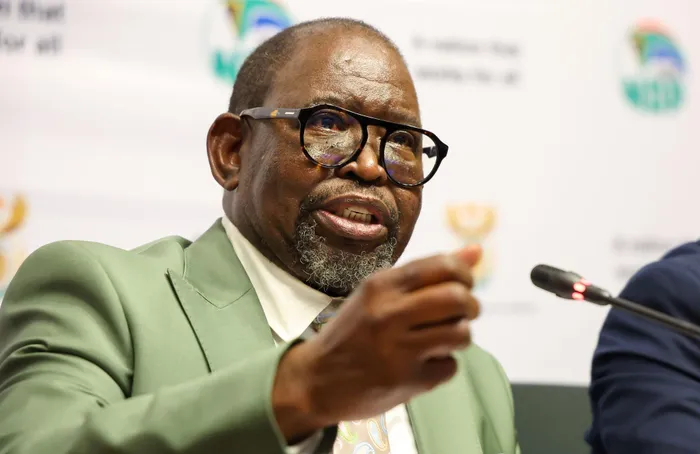
Finance Minister Enoch Godongwana walks into this year’s Budget facing a brutal arithmetic problem:
Image: Supplied / GCIS
FINANCE Minister Enoch Godongwana walks into this year’s Budget facing a brutal arithmetic problem: How to fund a strained state, stabilise public debt and ignite economic growth powerful enough to dent a youth unemployment crisis that has hardened into a generational emergency.
On paper, there are green shoots. The official unemployment rate dipped to 31.4% in the fourth quarter of 2025, its lowest level in five years.
Revenue collections have surprised on the upside, buoyed by VAT and corporate income tax receipts. Interest rates are easing. The National Treasury projects tax revenue of more than R2.1 trillion in 2026/27, with tax buoyancy expected to remain firm.
But beneath the headline numbers lies a far more sobering reality.
More than 1.4 million South Africans aged 15 to 24 remain jobless or trapped in cycles of insecure, informal work. Youth exclusion from stable employment is worse than it was a decade ago, despite repeated pledges of inclusive growth.
Buhlebethu Magwaza, project lead at Youth Capital, argues that where participation has improved, it has largely been in precarious work without benefits, protections or pathways to advancement.
“Youth unemployment is treated as an outcome to be hoped for, not a crisis to be managed. There are no clear national targets, no coordinating task force, and no transparent line of accountability,” Magwaza said.
“The youth unemployment crisis will not be solved by growth alone, nor by announcements without budgets. If the Budget fails to introduce scale, targets and accountability, young people will remain trapped in survival mode.”
Her criticism cuts to the heart of the Budget dilemma: is unemployment primarily a fiscal constraint, a growth constraint — or both?
Independent economist Duma Gqubule insists the crisis is fundamentally macroeconomic. He disputes the celebratory tone around falling unemployment, arguing that the decline largely reflects a slowdown in labour force growth rather than robust job creation.
Gqubule noted that in 2024, roughly 1 million people entered the labour force. In 2025, that figure fell to just 177 000, the smallest increase on record. Over the same period, only about 21 000 jobs were created. On a year-on-year basis, the expanded unemployment rate has actually ticked higher.
“The problem is that GDP growth is too low. If we want to create jobs for the annual new entrants, it's more than 4% a year. We are growing this year at 1.4%,” Gqubule said.
“Why is South Africa had this chronically low GDP growth of 1.1% for the past 16 or 17 years? It is totally unacceptable. And we must not excuse, create excuses for this government because over the same period, 155 emerging and developing countries grew by 4.4%.”
Gqubule called for what amounts to a “wartime mobilisation” to get 12.4 million people to work: aggressive industrial policy targeting labour-intensive sectors such as construction, a massive expansion of public employment programmes, and the redirection of surplus funds in institutions like the Unemployment Insurance Fund toward job creation windows.
“Unemployment is a macroeconomic policy issue. It's not about projects. It's not about skills primarily. It's a macroeconomic policy. You must calibrate the tools of macroeconomic policy to achieve the growth rate and the jobs,” Gqubule said.
He also questions the effectiveness of existing incentives, such as the employment tax incentive.
“And also, we must cancel this employment tax incentive, which is like a basic income grant to employers. They get this free money, and they don't create jobs. We must start making these public employment programmes. We have to have a massive push towards public employment here.”
However, Efficient Group chief economist Dawie Roodt argued that expectations placed on the finance minister were misplaced.
Godongwana’s constitutional role, Roodt said, is to balance the books, manage debt and prioritise spending, and not single-handedly engineer economic expansion.
“So the Minister of Finance is really painted in a corner here. That's not really his job to grow the economy, but he is also battling because of weak economic growth, because the only source of revenue for the Minister of Finance is actually the economy,” Roodt said.
"And if the economy doesn't grow, then the revenue of the Minister of Finance also comes under pressure. I'm afraid the best that the Minister can do is try to limit State expenditure in a very difficult and challenging environment. I'm afraid, politically, it's going to be extremely difficult for him to put measures in place in order to grow the economy."
Roodt contended the more sustainable route to growth lies in tax reform and infrastructure spending, not expanding the public sector wage bill.
Corporate taxes, he argued, are too high and the system overly complex, discouraging investment. But cutting taxes reduces revenue in the short term, forcing politically painful trade-offs elsewhere.
Professor André Roux of the Stellenbosch Business School frames the Budget as a perennial contest between “economic and fiscal prudence” and “political expedience”.
Reducing social transfers such as the Social Relief of Distress Grant would be socio-economically reckless in a country where millions rely on grants for basic survival. Yet maintaining or expanding them limits fiscal space for growth-enhancing investment.
“We require a sustained growth path of at least 4% to co-produce meaningful macro-economic and socio-economic progress,” Roux said.
“A consistently sensible fiscal policy stance, as reflected in the annual budget speech, can play a meaningful role – directly or indirectly - in creating and propagating some of the key requirements for inclusive growth and human development.”