
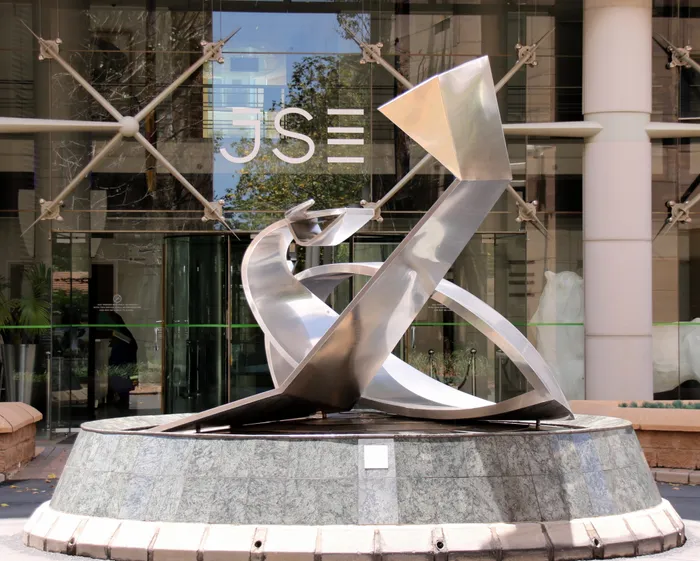
The JSE is deeply integrated into global benchmark indices, which are predominantly tracked by US-based institutional investors and exchange-traded funds.
Image: Nicola Mawson / Independent Newspapers
SOUTH Africa’s stock markets and investments do not operate as independent setups but as “satellite nodes” within a US-centred global financial architecture where “political decisions increasingly function as first-order financial variables, directly shaping currency dynamics, sovereign risk premia, equity valuations, and capital market liquidity”.
This comes from a groundbreaking paper that shows South Africa’s economic weakness not as poor basics like debt or spending, but as trapped by American political and monetary power — a trap that could cause a full market crash with little warning.
The paper, When Politics Prices Capital: China, US Financial Power, and Geopolitical Shock Transmission in Emerging Capital Markets, warns: South Africa faces a “compound vulnerability” where “a potential negative trade shock coinciding with a US-linked capital pullback” could unleash repricing pressures far beyond conventional risk models. The real danger hits financial sovereignty itself.
For years, leaders have called the African Growth and Opportunity Act (Agoa) a tool to boost exports. The paper cuts through this: “Agoa functions less as a trade preference and more as a macro-financial stabiliser, anchoring export earnings, foreign exchange inflows, and investor confidence.”
Hard numbers show the risk. “In 2024, total bilateral goods trade was estimated at approximately $20.5 billion (R325bn), with US imports from South Africa reaching $14.7bn.” Cars lead: “Industry estimates suggest that automotive exports accounted for approximately 64% of South Africa’s Agoa-linked exports in 2024,” with “South Africa exported approximately R28.6bn in vehicles to the US under Agoa in 2024, comprising roughly 24 681 vehicles.”
The danger? What if it vanishes? The paper maps a nightmare: “A discontinuity of Agoa preferences and/or broad US tariff escalation” plus investors fleeing. The chain reaction: “Export shock → FX depreciation → inflation pass-through → policy rates → earnings and discount rates → equity valuation.”
“Equity repricing is driven less by direct earnings losses and more by discount-rate and risk-premium shocks.” Solid companies tank — not from bad sales, but because global investors suddenly want bigger payouts for South African risk.
The paper predicts under severe stress: “Currency depreciations exceeding 25%, sovereign yield shocks of 250 to 400 basis points, and equity market declines of 35 to 55%.”
Adding to all this is what the paper calls “the collapse of industrial time horizons”. China’s rise has “fundamentally altered the strategic significance of preferential trade regimes such as Agoa and sharply elevated the industrial risks facing export-oriented manufacturing economies such as South Africa”.
“Through unprecedented scale, deep vertical integration, state-backed capital deployment, and rapid technological acceleration, particularly in electric vehicles (EVs), battery systems, and power electronics, China has compressed what were once multi-decade industrial transitions into strategic windows of five to seven years.”
SA faces a double squeeze: “South Africa confronts a dual compression, the geopolitical compression of trade access and the technological compression of industrial relevance.”
But here’s the twist. “China has become South Africa’s largest trading partner and a major source of infrastructure investment, but it does not provide the liquidity depth, currency anchoring, or portfolio capital flows that stabilise sovereign bond markets and equity valuations.”
Chinese cash is “predominantly project-based, bilateral, and illiquid, in contrast to the highly liquid, benchmark-driven, and market-traded capital flows anchored in US and European financial systems.”
Result: A trap — “near-term financial dependence on the US combined with long-term industrial competition from China”. Diplomacy won’t save South Africa: “Under such conditions, South Africa’s capital markets become systematically exposed to shifts in US political sentiment, with domestic macroeconomic fundamentals, fiscal discipline, and corporate performance increasingly subordinated to geopolitical dynamics beyond sovereign control.”
The paper’s harshest point: The Johannesburg Stock Exchange (JSE) isn’t local — it’s “a satellite node within a US-centred global financial system”. Even with our own central bank, JSE prices, cash flow, and risk levels are tied to dollar funding, US investor moods, and indexes run by US funds.
Three links hold it:
During US rate hikes or global tension, “the JSE exhibits characteristics more typical of peripheral markets within a hierarchical global financial system than of an autonomous domestic exchange”.
Foreigners own “approximately 35 to 45% of JSE free-float equities and 25 to 30% of South African government bonds,” making US managers like BlackRock, Vanguard, State Street, Fidelity, Capital Group, Franklin Templeton, JP Morgan Asset Management, Goldman Sachs Asset Management, and PIMCO the price bosses.
They control “tens of trillions of dollars” plus index rules via MSCI, S&P, JP Morgan. So “index inclusion, country weightings, and risk classification are ultimately governed through US-centred institutional decision frameworks”.
The paper coins “capital gravity” — a market’s pull to hold investor cash via deep pools, trust, and growth. “Capital gravity refers to the capacity of a domestic financial system to attract, retain, and stabilise capital flows through internal market depth, institutional credibility, liquidity provision, currency architecture, and structural growth anchoring.”
South Africa lacks it: “Despite its institutional sophistication and regional scale, the JSE exhibits structural characteristics of a low-gravity market: high sensitivity to foreign portfolio flows, dollar-referenced valuation anchoring, and pronounced volatility during global risk-off episodes.”
No gravity means the US moves on trade or sanctions, “acquire disproportionate pricing power over South African assets”.
Scope is huge: “Conservative mapping suggests that between 120 and 180 JSE-listed companies, representing approximately 55 to 70% of total market capitalisation, are either directly or indirectly sensitive to US economic conditions, trade access, dollar liquidity, and Federal Reserve policy.”
Banks too: “Banking sector profitability, for example, is tightly linked to sovereign bond yields and domestic funding spreads, both of which respond rapidly to shifts in US monetary policy and global risk sentiment.”
In today’s nationalist world: “The structural exposure of South Africa’s capital markets to the US becomes materially more destabilising under a geopolitical regime characterised by economic nationalism, transactional diplomacy, and institutional unilateralism.”
AGOA gets political: “Preferential trade access mechanisms such as Agoa become explicitly conditional, portfolio capital flows increasingly politicised, and sanctions risk elevated as strategic instruments of geopolitical leverage rather than exceptional enforcement mechanisms.”
It’s weaponised ties: “Economic relationships are no longer governed primarily by multilateral rules-based frameworks, but rather by bilateral alignment, political signalling, and transactional reciprocity.”
Bottom line: “Agoa, historically embedded within developmental trade policy, becomes contingent upon geopolitical positioning. Portfolio capital, traditionally allocated through relative risk-return optimisation, becomes vulnerable to politically motivated reallocation and regulatory signalling.”
The paper’s concluding punch: “South Africa’s financial stability has become hostage to US political decisions not because of weak fundamentals, but because of structural asymmetry in the global financial architecture.”
Solution: “Positioning the JSE as Africa’s central capital aggregation hub spanning infrastructure finance, climate transition funding, and regional equity listings offers a credible pathway toward internalising capital flows that currently externalise pricing authority.”
The clock is ticking: “In an era of compressed industrial transitions, politicised capital flows, and accelerating geopolitical fragmentation, the construction of capital gravity is no longer a developmental aspiration — it is a financial and sovereign imperative.”
South Africa at a crossroads: “Whether it evolves into a gravitational hub anchoring African capital or remains a satellite market transmitting external shocks will depend on the strategic choices made today.”
South Africa teeters on the edge. Will it rise as Africa’s bold financial powerhouse, pulling in continent-wide investment, or stay locked as a vulnerable outpost, echoing distant shocks? The choice is ours, and it must be made now.