

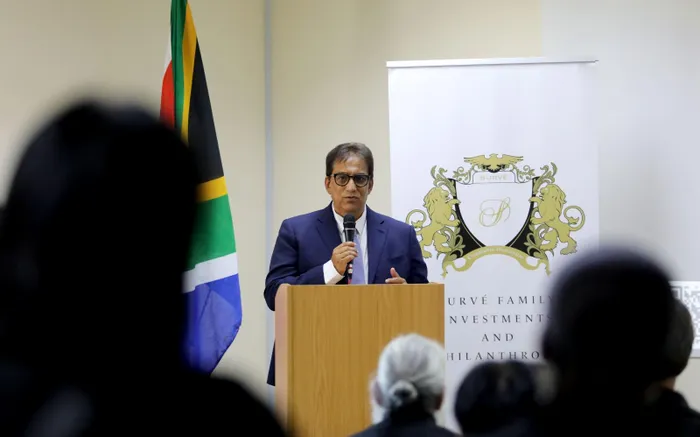
Sekunjalo Group Chairman Dr Iqbal Survé at the Centurion, Tshwane, launch of his new book titled "A Shared Future for Humanity", on Friday.
Image: Oupa Mokoena / Independent Newspapers
Sekunjalo Group Chairman Dr Iqbal Survé used the Centurion, Tshwane, launch of his new book titled A Shared Future for Humanity, to weigh in on geopolitics and the future of the BRICS bloc of countries.
Addressing the launch attended by several diplomats and employees of the group’s companies, SGT Solutions and Global Command and Control Technologies, Survé said BRICS’ future would rely heavily on China.
“The driver of BRICS is China; we mustn’t forget that. No matter what anyone says, the driver of BRICS is China. If China decides that BRICS remains important, it will remain. If China decides that BRICS is no longer important, they will be there but not as important as they could be,” he explained.
According to Survé, the jury is still out, but he expressed his hope that BRICS will continue.
“... (For) institutions that are multi-country to grow, they need systems to be in place, which allow for alignment,” said the former BRICS Business Council chairperson.
Survé added that, sadly, South Africa’s moment in BRICS has been lost. “Africa had the opportunity to do more, and now it is lost,” he said.
Survé said that while the jury is still out, it is largely going to be decided by China’s view on whether it wants to focus on Asia or whether it considers BRICS to be very important. In addition, he said the future of BRICS will also be determined by what happens to India, “not so much but a lot”.
“I know Russia is important, but in the scheme of BRICS, I don’t think it has the influence that India and China have,” he further stated.
He also believes that Brazil, under its current President Lula da Silva, will drive BRICS, although he faces his own problems to worry about now, particularly in the Americas, which provide a test for him.
Survé said Europe needs to get its act together, but it needs to abandon the US. “Ironically, the axis that made a lot of sense was Russia and Europe,” he said, adding that the war in Ukraine has weakened both Russia and Europe.
He continued: “To the extent that I think in the next decade, they are going to spend a lot of time recovering from each other.”
He warned that Europe would also face challenges with the shortage of young people due to many countries having anti-immigration policies.
“It is interesting because if you have anti-immigration policies, (and) you don’t have young people, where are the young people going to come from? From Africa. Where else?” Survé asked.
He said young people in Africa were becoming entrepreneurial and educated, and that he was not talking about South Africa specifically.
“With Europe, it’s best to say that Europe is lost to itself. However, Europe has leading intellectuals, thinkers, very good businesspeople, and business organisations. They just need to refine, find their identity and their strategic footpath, but it’s going to take two decades to get there.”
Survé said America no longer saw Africa as a strategic continent, but sees African countries as important for resources, in particular, rare earth minerals and other important resources.
Between 2024 and 2025, Brazil, Russia, China, India, and South Africa were joined in BRICS by Egypt, Ethiopia, Iran, Saudi Arabia, the United Arab Emirates, and Indonesia.
loyiso.sidimba@inl.co.za