

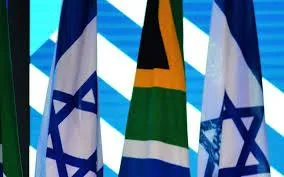
The relationship between South Africa and Israel deteriorated this week when they expelled each other's diplomats.
Image: South African Zionist Federation
South Africa’s decision on Friday to declare Israeli diplomat Ariel Seidman persona non grata has significantly escalated the already fragile relations between Pretoria and Tel Aviv, said experts who warned that this might lead to a complete diplomatic breakdown.
The declaration was followed swiftly by retaliatory action from Israel to expel South African diplomat Shaun Edward Byneveldt from the country.
Department of International Relations and Cooperation (DIRCO) spokesperson Chrispin Phiri on Saturday said the declaration was not abrupt but rather “a culmination of activities” and followed formal engagements with the Israeli government that failed to address South Africa’s concerns.
“What we have seen over a series of months was the Israeli Embassy in South Africa using the X platform to undermine the South African government and show how disrespectful the conduct of the Israeli government has been,” Phiri said.
“We feel that our sovereignty has been undermined, which is why these measures had to be taken.
“We hope the Israeli government will recalibrate its actions and respectfully engage us,” said Phiri.
The relationship between the two countries deteriorated further after Seidman took his country’s Foreign Affairs Ministry senior official, David Saranga, on a visit to AbaThembu King Buyelekhaya Dalindyebo in the Eastern Cape last year without informing DIRCO.
In a statement released on Friday, DIRCO accused Israel of insulting President Cyril Ramaphosa on social media and of being in the country without informing DIRCO.
During the visit to the king, Saranga donated food parcels to residents whose homes had been destroyed by floods in May.
Dalindyebo’s daughter, Ntando Dalindyebo, who is the royal family’s spokesperson, described Seidman’s expulsion as a personal attack on the king.
“Our relationship with the Israeli Embassy is the one that we hold very close to our hearts, as they have managed to help our people in a way that the South African government has not been able to do.
“When they dismiss the ambassador, it becomes difficult for us not to see this as a personal attack on the kingdom,” said Ntando.
She confirmed that the king did not inform government authorities about the visit.
She said Saranga promised that the Israeli government would assist the community of Mthatha and other areas in the Eastern Cape to develop water infrastructure, assisting needy children with fees for tertiary education and also refurbish health facilities.
“My father (the king) told him (Saranga) that we don’t have water in the Eastern Cape and our hospitals are in horrible conditions, as they were last renovated 50 years ago.”
She said some government officials and traditional leaders warned the king against accepting donations from Israel, which had been found guilty of genocide against the people of Palestine.
“But my father saw it as unfair to say no to a donation that could help people in their time of need. Then we welcomed the ambassador,” she said.
The Israeli officials' visit to the king angered Eastern Cape Premier Oscar Mabuyane, who said the king took them to public institutions in the province, including healthcare facilities and Walter Sisulu University, without the consent of the provincial government.
“Premier Mabuyane rejects the sinister deal between the king and Israel, and views these actions as an attempt by the Israeli government to undermine the sovereign right of the Republic of South Africa to manage its international affairs,” read a statement released recently.
The provincial government had promised to engage the national government “to ensure that appropriate measures are taken to safeguard the integrity of government processes, protect public institutions, and prevent any recurrence of such incidents”.
However, Mabuyane’s spokesperson, Sonwabo Mbananga, said the provincial government has not pursued any action against the king.
Phiri did not respond when asked what actions would be taken against the king.
In a statement released Friday, the South African Zionist Federation (SAZF) said Seidman was being punished for helping South Africans get clean water.
“In a country where taps run dry, where children walk kilometres with buckets, where elderly women queue for hours at communal pumps, and where the state has normalised collapse, neglect, and decay, the ANC chose to penalise the one party that is genuinely providing solutions.
“The Israeli Embassy partnered openly and transparently with recognised traditional leadership in the Eastern Cape – a region long abandoned by the state, stripped of dignity by years of corruption, incompetence, and indifference.
“They worked with communities and civil society to do what the government has spectacularly failed to do: provide basic human necessities,” read the statement.
International relations expert Dr Ayabulela Dlakavu said Seidman’s expulsion was warranted.
“Relations between South Africa and any other sovereign nation should be handled by DIRCO, because that is the department charged with managing relations with other countries.
“Undermining this by the Israeli government would result in any self-respecting nation being well within its rights to declare an ambassador undesirable,” he said.
Siseko Maposa, director of Surgetower Associates Management Consultancy, said that while the current tit-for-tat between the two state were serious, it did not yet amount to a complete severance of diplomatic relations.
“It is crucial to note that both nations had already functionally downgraded relations by recalling their ambassadors in preceding years,” he said.
The EFF, the South African Communist Party (SACP), and the ANC have welcomed Seidman’s expulsion.
“The undiplomatic conduct of Mr Ariel Seidman shows disregard not only for our government and authorities but for the South African people as a whole,” said the EFF in a statement.
The SACP said Israel’s retaliation was a call for South Africa to completely cut diplomatic ties with Israel.
“We reiterate our rejection of the colonial rule of Zionist Israel’s occupation over Palestine, as well as the apartheid regime’s destabilisation of the Middle East region,” the statement said.
The ANC expressed support for the action against Israel.
“South Africa is a constitutional democracy born out of resistance to oppression and external domination.
“We, therefore, reject, without hesitation, any conduct by foreign representatives that undermines our sovereignty, disrespects our Head of State, or abuses diplomatic privilege under the guise of engagement,” said Whip of the ANC Study Group on International Relations and Cooperation, Andisiwe Kumbaca.
bongani.hans@inl.co.za and lilita.gcwabe@inl.co.za