

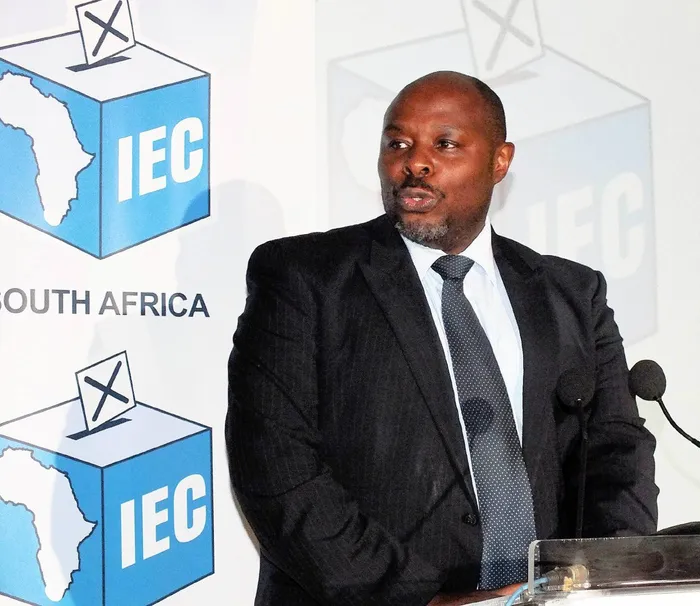
IEC Deputy Chief Electoral Officer Mawethu Mosery raised concern about the dwindling of voter turnout, which he said might affect this year's local government elections.
Image: Independent Media Archives
The Independent Electoral Commission of South Africa (IEC), which has been commended for a fantastic job in organising elections, has raised concerns about the country’s continued decline in voter turnout due to dissatisfaction with service delivery.
In preparation for this year’s local government election, IEC Deputy Chief Electoral Officer Mawethu Mosery said the commission was a few steps away from finalising the process of holding the elections later this year.
He said there were currently 540 registered parties, with almost 100 new political parties.
However, he expressed concern about the voter turnout, as in the 2021 local government elections, out of more than 26 million registered voters, only more than 12 million people voted, which was a 45.86% voter turnout.
Mosery said that when looking at the past four local government elections, there was a general trend of a high number of eligible voters not participating.
He said this, even though the commission had been commended for providing voter education on the importance of the elections, where to vote, and the importance of voting.
“But when you look at the voter turnout, it would seem there was no voter education because some voters don’t go to stations,” said Mosery.
He said that according to studies conducted by the IEC, some people were demoralised by the fact that they did not see the impact of their votes, as they were not happy with the performance of the politicians they voted for.
“These are dissatisfied people who cannot find a quality candidate and an impact of their votes,” said Mosery.
Mosery said it was still too early for the IEC to be confident that it is ready for the elections, which are scheduled for November.
“There are lots of things to be done before we get there.”
He said the IEC was still expecting the parliament to change a policy governing local government elections voters roll to protect it from being challenged at the Electoral Court.
He said the IEC was currently aligning polling stations with 200 new wards, which were recently introduced by the Demarcation Board.
“We are now busy aligning voting stations with new wards, which we will complete in March. After that, we will announce the changes of wards and re-register affected people,” he said.
He said the IEC would have voter registration weekends in June and July.
He said the commission was in the process of employing people to assist in preparing for the elections, with 2,000 already recruited to work for 12 months.
“Another 80,000, also to be employed, will assist us in registering weekends in June and July.
“Another 20,020 will be employed for the voting day in November,” he said.
He said the new IEC employees would be introduced to political parties for screening and objectives to avoid objections against them being raised on the election day
“These are programmes we are conducting now in January until May, before the registration weekends, and thereafter we are going for the elections.
“This means that in August and September, we will need election candidates to be submitted.
“I think the election timetable will be gazetted in July to be followed by all candidates,” he said.
He said the IEC would avoid the 2024 general elections situation where parties took it to the Electoral Court, complaining about not being given the timetable and being unaware of the closing date for submitting candidate lists.
“In November last year, we visited all the provinces, explaining to all those who registered new parties, and parties that never received a seat, and those who want to be independent candidates, the process of the elections, and the requirements for contesting the elections.
“We are going to repeat this so there will never again be people taking us to court claiming they were uninformed.”
He said there was no closing date for registering new political parties, but such parties, if they want to participate in the coming elections, must register before the closing date for submitting candidate lists.
KwaZulu-Natal political analyst Zakhele Ndlovu raised concern about poor voter education, which he said was mainly the responsibility of the IEC.
“The IEC has been doing a solid job, but my biggest concern is that when it comes to voter education, it has not done a good job because our voters have not been equipped to make informed decisions, which is the mandate of the IEC.
“However, we are seeing voter apathy because people feel that political parties have led them down, and as a result, they don’t see reason why they should vote because the leaders are not delivering on their promises,” he said.
Another political analyst, Thabani Khumalo, also raised concerns about the voter education.
“Since the IEC was formed, it was always ready for the elections, and there is nothing new that would make me doubt it,” he said.
He said political parties were letting the IEC’s voter registration programme down because of focusing on internal power squabbles instead of teaching voters about the importance of going to the polls.
He said the country should expect a further decrease in voter turnout.
“Political parties are making life difficult for the IEC, but the IEC is used to this.
“We are expecting fewer people to vote because of what is happening at the local level as parties across the board have messed up,” he said.
He said the local government elections required massive voter education.
“This is supposed to be done by the IEC in conjunction with parties, but unfortunately, political parties are not playing their part because they are busy with internal squabbles,” said Khumalo.
Various political parties were sent a request to comment on the election readiness, but only KwaZulu-Natal ActionSA chairperson Zwakele Mncwango responded, saying his party was currently busy nominating candidates and vetting those who have been nominated.
“ActionSA places a strong emphasis on ethical leadership, community credibility, and skills-based suitability, and all prospective candidates go through a rigorous screening and interview process,” said Mncwango.
bongani.hans@inl.co.za