

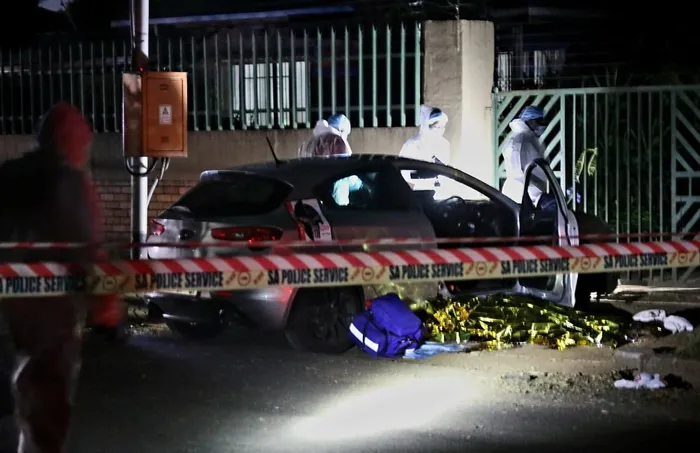
The scene of the murder of Marius “Vlam” van der Merwe, who testified as Witness D at the Madlanga Commission of Inquiry.
Image: Timothy Bernard Independent Media
Witnesses, who are testifying at the Madlanga Commission of Inquiry into the police impropriety, need more protection now that one of them has been murdered.
Marius “Vlam” van der Merwe, who testified under the alias Witness D for protection while giving in-camera testimony, was fatally shot on Friday night.
This has prompted anti-crime and corruption experts to call for extra measures to intensify the witness protection in addition to hiding their identities.
Van der Merwe was reportedly gunned down in front of his family members at his home in Brakpan, Ekurhuleni Metropolitan Municipality.
Organisation Undoing Tax Abuse (OUTA) chief executive officer Wayne Duvenage said the witnesses should be provided with bodyguards and bulletproof vests.
Madlanga and the parliament’s Ad Hoc Committee are investigating allegations of corruption linking a senior police official and a decision by Police Minister Senzo Mchunu, who is on forced leave, to disband the police’s Political Killings Task Team (PKTT).
Van der Merwe testified at the Madlanga Commission three weeks ago, implicating Ekurhuleni Metropolitan Police Department (EMPD) Brigadier Julius Mkhwanazi in wrongdoing, claiming that Mkhwanazi ordered him to cover up the murder of a suspect at the hands of EMPD and SAPS officers.
Duvenage described van der Merwe’s murder as “a disgrace” and a sign that “we are living in a gangster state”.
“Even if he was giving the testimony in-camera, they would know him.
“They (witnesses) need to have bodyguards in their homes and bulletproof vests and be placed on a witness protection programme,” said Duvenage.
However, Justice Minister Mmamoloko Kubayi told a media briefing in Pretoria on Saturday that van der Merwe declined witness protection offered to him.
“He declined (protection) because he did not think he needed it and because he runs his security company,” said Kubayi.
She said the incident has shown a need to review how the witnesses are testifying at the Commission.
She said the Commission had initially intended to conduct certain testimonies in-camera, but it was forced to change this by threats of litigation.
“We want to appeal that the Commission revisit this [because] we were concerned that the public and the media would be able to identify Mr van der Merwe as Witness D.
“I did not know, and the commissioners did not know who witness D is, except those who worked directly (with him) to get the statement, which worries us a lot,” she said.
She said Van der Merwe might have been linked through the details of his testimony.
“If transparency is going to supersede the protection, we would not achieve protection of witnesses, and therefore our fight against corruption and organised crime will be compromised,” said Kubayi.
Crime expert Abigail Ngobeni, who is an attorney, said the witness protection was supposed to be a priority when the Madlanga Commission was established.
“Obviously, given the seriousness of the allegations and the kind of people that potentially this investigation would touch on, the aspect of witness protection should have been intensified,” said Ngobeni.
She said the risk was that witnesses who testified in-camera would be known by the people they are testifying against.
“Therefore, not showing their faces would not have been enough,” said Ngobeni.
She said there was potential that people who were willing to testify at the Commission would now be scared because “every person would want to protect their lives more than serving the country.”
“If there is a threat to that effect, chances are we may not get all that which we deserve to know on the basis that people are afraid,” she said.
John G Clarke, a whistle-blower social worker, said the country was in crisis.
“I am so angry with the Department of Justice for failing to make the laws protect whistle-blowers’ lives,” he said.
He said for over five years, he had been fighting for the enactment of the witness protection laws, which he said have not been enacted.
Moira Campbell of the Corruption Watch said altering witnesses' voices might help to protect them from being identified.
She said the country has significant weaknesses in protecting witnesses and whistle-blowers.
“The testimony of Witness D has exposed the infiltration of criminal elements into law enforcement structures.
“His testimony revealed the complicity of senior officials in bodies such as the Ekurhuleni Municipal Police Department, making him extremely vulnerable to criminal retaliation,” she said.
Campbell called for all witnesses who are testifying at the commission to be provided with protection, “given the gravity of what is emerging from this Commission”.
She said that the Protected Disclosures Act (PDA) falls far short of providing adequate protection to whistle-blowers and witnesses.
She said the assurance for anonymity should be embedded in legislation and that those who expose wrongdoings have explicit rights to security, safety, and physical protection.
“Most critically, we need urgent safeguards to protect witnesses and whistle-blowers from physical harm.
bongani.hans@inl.co.za