

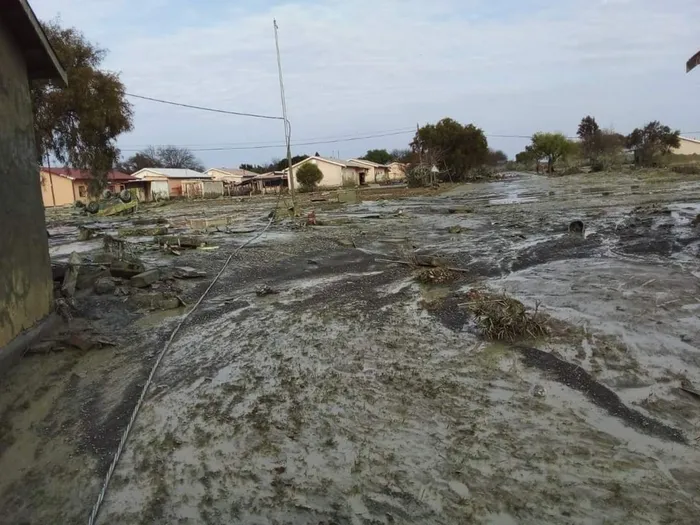
A technical investigation into the catastrophic failure of the Jagersfontein tailings dam has revealed that the facility’s owners may have known as early as 2019 that the structure was dangerously unstable
Image: Supplied
A DAMNING technical investigation into the catastrophic failure of the Jagersfontein tailings dam has revealed that the facility’s owners may have known as early as 2019 that the structure was dangerously unstable, yet continued to raise the dam wall and deposit millions of cubic meters of mining waste into it, ultimately culminating in a disaster that claimed lives, displaced communities, and polluted vital water resources.
This week, Deputy Ministers David Mahlobo and Sello Seitlholo of the Department of Water and Sanitation (DWS), accompanied by Free State Premier Maqueen Letsoha-Mathae and Kopanong Local Municipality Mayor Xolani Tseletsele, travelled to the devastated town of Jagersfontein to release the findings of the long-awaited Technical Investigation Report on the failure of the Jagersfontein Fine Tailings Storage Facility (FTSF) directly to the affected community at the Mayibuye Community Hall.
The dam breach on September 11, 2022, unleashed about 5.9 million cubic metres of fine tailings downstream, flooding homes, destroying critical infrastructure — including power lines, substations, and wastewater treatment works — and contaminating the environment. Two people were confirmed dead, and one person remains missing and is presumed dead.
According to the official media statement, the investigation — conducted jointly by the University of Pretoria (UP) and the University of the Witwatersrand (Wits) — found that “the owner of the tailings dam, Jagersfontein Development, may have been aware of the instability of the storage facility along the southern wall of the dam tailings from as far back as 2019”.
Even more troubling, the report states that at that time, the company “added large volumes of material to stabilise the slope, which was not effective, but continued to raise the dam wall and deposit more tailings into the dam.”
This revelation forms the core of what many are calling the most controversial and ethically fraught element of the entire incident: the possibility that corporate decisions knowingly placed lives and the environment at risk for the sake of continued operations.
The technical findings further detail a cascade of engineering and regulatory failures. “The construction/raising of the tailings storage facility was based on conceptual designs and that no detailed designs were done to enable the safe construction of the facility,” the statement reads. “There was no construction supervision by a registered engineering professional.”
Compounding these oversights, investigators discovered that“part of the southern wall of compartment-2 was constructed over a pre-existing tailings dump of low strength, meaning it was constructed on a weak foundation. This is what largely resulted in the failure of the TSF where the breach occurred”.
In response to the disaster, the DWS swiftly appointed UP and Wits to conduct an independent technical investigation “to determine the cause of its collapse, assist the Department to ensure that such incidents do not recur, ensure better regulation techniques are employed and to conduct an extensive technical study into the cause(s) of failure of the FTSF”.
The investigation included site visits and expert evaluations by specialist civil, geotechnical, and hydraulic engineers.
Parallel to the technical probe, the Environmental Management Inspectorates from both the Department of Forestry, Fisheries and Environment (DFFE) and DWS launched a joint investigation. The outcome was grave: “A criminal case docket was finalised and referred to the National Prosecuting Authority (NPA) in Bloemfontein, which has taken the decision to prosecute.”
The technical report itself was completed in September 2024, but remained confidential “at the request and advice of the Deputy Director of Public Prosecutions (DDPP) until the matter was enrolled and the first court appearance of the accused”.
During the community briefing, Mahlobo acknowledged the tension between economic survival and public safety. “He would have liked for the dam to close down, but, seeing that it is not yet fully compliant with directives issued, however, the government also have to consider the livelihood of residents who reside in the area as the mine provides job opportunities to some of the residents,” the statement recounts. “It is a fine balancing act, saving jobs and saving lives,” he said.
This admission underscores the complex socio-economic realities facing mining communities in South Africa, where environmental and engineering accountability often clash with the urgent need for employment in impoverished regions.
As criminal proceedings move forward and the community continues to recover from the trauma of 2022, the report stands as a stark indictment of systemic failures in oversight, engineering practice, and corporate responsibility.
The central question it raises, whether tragedy could have been averted had early warnings been heeded, will possibly echo far beyond Jagersfontein, into boardrooms, regulatory agencies, and courtrooms across the country.