

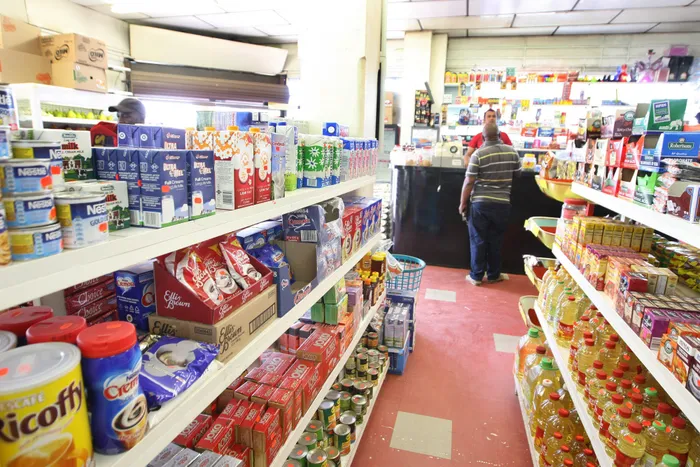
Broken systems, bureaucratic inertia, and unexplained disparities have left South African informal traders impoverished while foreign-owned spaza shops thrive under lax enforcement.
Image: File / Independent Newspapers Archives
IN a damning parliamentary session, the Portfolio Committee on Small Business Development laid bare a government in disarray — where broken systems, bureaucratic inertia, and unexplained disparities have left South African informal traders impoverished.
At the same time, foreign-owned spaza shops thrive under lax enforcement.
The revelations, drawn from testimony by senior officials from the Department of Cooperative Governance and Traditional Affairs (Cogta) and the Department of Trade, Industry and Competition (DTIC), paint a picture of institutional collapse in support of the very citizens the state claims to uplift.
Despite foreign nationals making up just 3.9% of the country’s population, they received disproportionately high approval rates for spaza shop licences:
The EFF’s Bongi Mathulelwa delivered a blistering indictment: “Nearly half of all approved applicants are foreign nationals… this is displacing South African informal traders, particularly youth and women.” She cited Cogta’s own figures: Over 30 000 foreign nationals approved out of just 15 000 total licences granted between July and September 2025, implying a statistical impossibility unless data misrepresentation or systemic bias is at play.
The MKP’s Mokgaetji Mafagane pressed the anomaly further: “How does the Department explain the disproportionately high share of approved business registrations by foreign nationals, given that immigrants constitute only 3.9% of the South African population?”
While South African spaza owners languish without licences due to bureaucratic red tape, it has been revealed that many have had their groceries confiscated by authorities. Yet non-compliant foreign-owned shops remain untouched.
The MKP’s Hazel Mbele described this practice as criminal: “Confiscating goods from poor South African traders is criminal… formal businesses aren’t treated this way.” She said these traders were creating jobs for themselves and supporting their families, yet they were being penalised for government failure, not personal fault.
Cogta admitted that only 1 751 environmental health practitioners were employed nationwide, less than 30% of the 6 201 needed. In Gauteng alone, the deficit is 1 053; in Limpopo, 536.
The ANC’s Lindelwa Sapo exposed the root cause: “Municipalities are unwilling to invest in their Local Economic Development (LED) units… they currently lack the capacity to manage the function effectively.” She further said: “We’ve heard the same mitigating factors in previous Portfolio Committee meetings, yet nothing changes.”
Cogta Deputy Minister Dr Namane Masemola conceded that Treasury had rejected a request to fund 520 additional practitioners due to “funding constraints”, a decision that the ANC’s Cristopher Malematja described as a “national health hazard”.
Meanwhile, it was revealed that the much-touted Spaza Shop Support Fund (SSSF), meant to bolster local traders with R500 million, had approved only 390 of 2 726 applications as of November 5, 2025, disbursing a mere R24.4m — less than 5%. Why? Because applicants lack business licences, precisely due to the broken municipal system the state refuses to fix.
Mathulelwa described the fund as a mirage: “The fund reflects bureaucratic coordination, not radical economic transformation. Regulation alone does not create livelihoods. Empowerment does.”
The DTIC’s proposed R100 billion Transformation Fund, set to launch by 2029, raised deep skepticism. Mafagane posed a critical question: “How do we ensure the fund doesn’t benefit large white-owned businesses?”
The DA’s Hendrik Krüger warned that it was becoming a “larger bureaucratic structure” instead of channelling funds through the Small Enterprise Development Finance Agency (Sedfa), which already has SMME expertise.
Mathulelwa also weighed in: “The spaza shop fund, as currently designed, fails to align with the radical economic transformation principles in the Freedom Charter.” She called for the fund to “directly finance black-owned industry, cooperatives, and worker-owned enterprises”, not middlemen or white conglomerates.
DTIC Director-General Simphiwe Hamilton denied claims of bias: “Claims suggesting the Department prioritised foreign-owned spaza shops are unfounded.” But other members argued that enforcement is selective: raids target poor South Africans, while foreign shops operate without immigration or business compliance.
Mathulelwa then proposed a centralised digital licensing system linked to Home Affairs and the SA Revenue Service (Sars), prioritising South African-owned shops for funding and training, and creating an enforcement task team with the SA Police Service (Saps) and Home Affairs. She cautioned: “In Gauteng, KwaZulu-Natal, and the Eastern Cape, municipalities continue to prioritise foreign nationals over local traders, despite previous calls for accountability.”
The ANC’s Masefako Dikgale, who chairs the committee, warned: “It is problematic when campaigns are conducted but not followed through in practice… failure to deliver undermines leadership credibility.” She further said: “Business owners in the Western Cape had highlighted that poor coordination between national, provincial, and local government was undermining the impact of policies.”
South African citizens are criminalised for poverty, not protected by policy. As Mathulelwa stated: “The government should prioritise the empowerment and protection of South African citizens in the informal economy… rather than legitimise dominance by foreign nationals.” Parliament has spoken. Now, the public waits for action.