

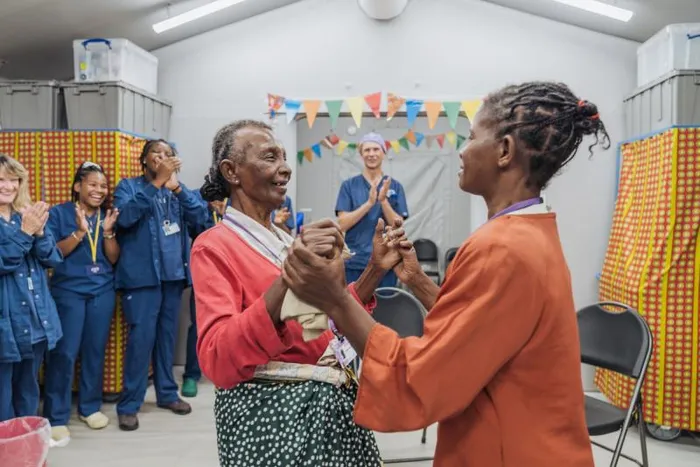
Marie Jeanne and her daughter Germaine see eye to eye for the first time in years.
Image: Supplied / APO
THIS World Sight Day, under the global theme *People at the Heart of Eye Health*, the story of Marie Jeanne and her daughter Germaine stands as a powerful testament to hope restored.
After years of living in darkness due to cataracts, the mother-daughter pair from a remote Malagasy village regained their sight — and their lives — through a 15-minute cataract surgery aboard the Africa Mercy, the hospital ship operated by international charity Mercy Ships.
At 80 years old, Marie Jeanne had already endured profound loss; seven of her eight children had passed away. Her remaining solace came from weaving raffia mats and hats, a joy stolen from her three years ago when her vision began to fail.
A year later, her daughter Germaine also started losing her sight, leaving her unable to farm or care for her children. “If I had weak faith, I might have given up,” Germaine shared.
Their path to healing began when a relative heard a radio announcement about Mercy Ships. Fueled by hope, they made the journey to Toamasina, where the Africa Mercy was providing free cataract surgeries to those in need. On the same day, both mother and daughter underwent the swift, life-changing procedure.
Dr Guy Chevalley, their surgeon, recalled: “Their cataracts were so advanced that their pupils were no longer black, but completely white.” Ella Hawthorne, Ophthalmic Program Manager, said: “They could only detect movement, just a hand waving in front of them. That was the extent of their vision.”
The next morning, seated side by side with their eye patches still on, they removed them together and looked into each other’s eyes clearly for the first time in years. Tears of joy flowed freely.
“We no longer live in darkness,” Marie Jeanne said. “Our eyes can see, and our hearts are full of happiness!”
According to the World Health Organization (WHO), an estimated 2.2 billion people worldwide live with vision impairment or blindness, and nearly half of these cases are preventable or treatable.
Cataracts remain the leading cause of blindness, especially in low- and middle-income countries where access to timely, affordable eye care is scarce. Without trained specialists or surgical services, conditions like those suffered by Marie Jeanne and Germaine often lead to unnecessary suffering and lost potential.
Reflecting on the emotional moment, Ella Hawthorne said: “It was incredibly moving to witness their joy when the patches came off at the same time. To help restore not just sight, but connection, to see someone truly, spend time with them, and have that taken away and then given back, it’s an extraordinary privilege.”
Since their surgery, Marie Jeanne has returned to weaving raffia mats and hats with the skill she longed to use again. Germaine is back to farming, actively participating in her church, and caring for her children, her future bright once more.