

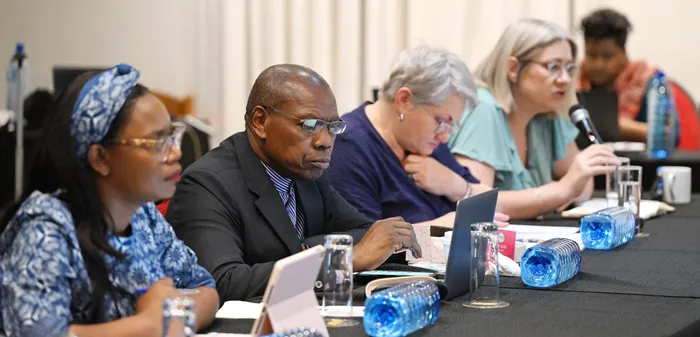
Dr Zweli Mkhize, leader of the delegation, delivered a blunt assessment. “When the same findings repeat year after year, it means our actions have not succeeded,” he said.
Image: Henk Kruger / Independent Newspapers
A HIGH-LEVEL parliamentary delegation has issued a stark warning to Eastern Cape municipalities: the era of “paper reforms and rhetorical commitments” must end.
After a day of intense engagements with local leaders, the joint oversight team, comprising the Portfolio Committee on Cooperative Governance and Traditional Affairs (Cogta) and the Standing Committee on the Auditor-General, called for immediate, measurable action to address deep-rooted governance failures plaguing the province.
On Monday, the delegation, working in collaboration with the Eastern Cape Provincial Legislature, met with officials from the Nelson Mandela Bay Metro, Buffalo City Metro, and the Amathole District Municipality. This marked the start of a week-long tour covering 19 municipalities, aimed at confronting systemic challenges and charting a path toward sustainable reform.
The mood was sombre as provincial MECs for Cogta and Finance laid bare the grim realities: only six of the province’s 39 municipalities achieved clean audits, while a staggering 30 are classified as distressed and under constitutional intervention per Section 154.
Dr Zweli Mkhize, leader of the delegation, delivered a blunt assessment. “When the same findings repeat year after year, it means our actions have not succeeded,” he said. “Oversight must lead to change, not repetition.”
Mkhize lamented the persistent cycle of audit disclaimers and financial mismanagement, declaring that past interventions have failed to produce lasting results. “Local government cannot continue to operate on ‘paper reforms and rhetorical commitments’,” he said.
Both the MEC for Cogta and the chief financial officer of the Provincial Treasury echoed the call for fiscal discipline, stronger internal controls, and strict consequence management for misconduct.
They emphasised that political leaders must place service delivery above factional interests and recognise that financial stability is foundational to restoring public trust.
Mkhize went further, warning that recovery plans must transcend bureaucratic formalities. “Recovery and support plans for municipalities should not just be mere administrative exercises but must function as measurable performance tools,” he said.
He demanded written reports, not just verbal promises, detailing concrete steps taken to resolve long-standing issues, stressing that repeated failures are eroding citizen confidence.
Invoking Section 216 of the Constitution, Mkhize declared that municipalities repeatedly violating financial management laws must face investigation and sanction. “If no investigations have been undertaken, we must ask who is being protected and why,” he said.
He also called for an end to fragmented oversight, urging Cogta, National Treasury, and sector departments to coordinate effectively. “Progress and change are delayed when oversight is siloed,” he said.
Looking beyond governance, Mkhize tied political leadership to economic outcomes. “Political power without economic inclusion continues to constrain the province’s development,” he said, urging municipalities to embed economic and social investment into their recovery strategies. “Each failed project represents a lost opportunity for growth and dignity.”
In a decisive move, the delegation resolved that all municipalities and relevant departments must submit comprehensive written reports within 14 to 30 days. These must include updates on audit findings, debt recovery efforts, consequence management actions, and infrastructure project statuses.
The scrutiny continues today, with five additional municipalities: Sundays River, Makana, Koukamma, Blue Crane Garden Route, and Inxuba Yethemba scheduled to appear before the joint delegation. The message is clear: accountability is no longer optional; it is imperative.