

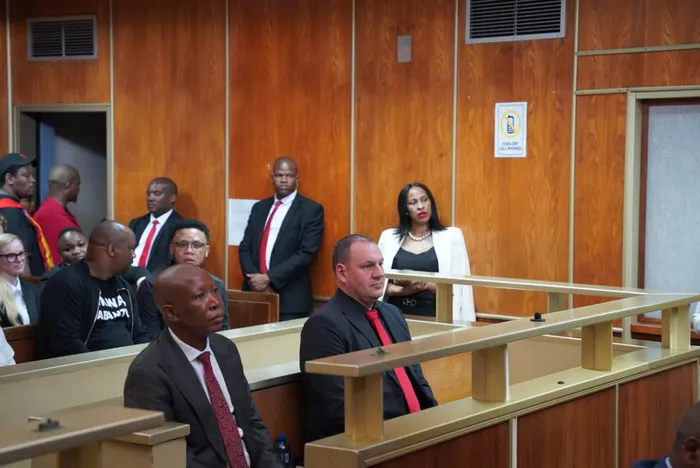
Magistrate Twanet Olivier found EFF leader Julius Malema guilty on all five counts. His former bodyguard, Adriaan Snyman was acquitted.
Image: Supplied
MOMENTS after being convicted of unlawfully firing a firearm, EFF leader Julius Malema walked out of the East London Magistrate’s Court on Wednesday and joined his supporters in singing “Kill the Boer, Kill the Farmer".
The chant, long associated with Malema and his calls for radical land reform, rang out as he addressed the crowd. He told supporters he would challenge the conviction all the way to the Constitutional Court.
“Revolutionary going to prison or death is a badge of honour,” Malema said. “We cannot be scared of prison, we cannot be scared to die for the revolution. So whatever they want to do, they must know we will never retreat from the ideas and the seven cardinal pillars of the EFF, and the centre of those is to expropriate land without compensation.”
The case stems from an incident at the EFF’s fifth anniversary rally at Sisa Dukashe Stadium in Mdantsane in 2018. Video footage presented in court showed Malema firing a rifle into the air in front of thousands of supporters.
This led to multiple charges under the Firearms Control Act, including unlawful possession of a firearm and ammunition, discharging a firearm in a public area, reckless endangerment of persons or property, and failing to take reasonable precautions to prevent danger.
Magistrate Twanet Olivier found Malema guilty on all five counts, ruling that the rifle fired by the EFF leader was real and not a prop as the defence had claimed.
She said the viral video circulating online was not needed to reach a judgment. She said the court had relied on authenticated evidence, including footage provided by Gearhouse, a company contracted to record the event.
Malema’s former bodyguard, Adriaan Snyman, who was accused of handing him the rifle, was acquitted.
The charges were laid by civil rights lobby group AfriForum.
Malema dismissed the verdict as politically motivated. “By releasing accused number two [Snyman], the whole case should have collapsed. But the racist was looking for me and that’s why they could not collapse the case, to appease AfriForum, to appease the Oval Office of Donald Trump, to appease all the white supremacist of SA who want to undermine the dignity and the strength of black people,” he said.
He vowed to fight the conviction at every level of the judiciary. “We are going to the appeal and we’ll go to the Supreme Court. We’ll end up at the Constitutional Court. We are not fighting the case. We are fighting racism,” Malema said.
Pre-sentencing proceedings are taking place on January 23.
Malema’s bail has been extended.
Malema’s conviction is poised to have significant repercussions on his political standing, the EFF, and South Africa’s broader political landscape. While Malema remains a fiercely influential figure as the leader of South Africa’s fourth-largest political party, the conviction for discharging a firearm in public casts a spotlight on the party’s increasingly controversial image and tactics.
The DA’s Ian Cameron said explicitly: “Firearm laws must apply equally, and no leader can flout the law with impunity. Law-abiding citizens must not be punished for the crimes of a few… It is essential that rogue actors, such as Malema, are held accountable for their conduct… Our country’s future cannot be built on bullets and threats. It must be built on the rule of law.”
Malema himself, undeterred by the verdict, told supporters outside the court: “To be prisoned and death is a badge of honour… Whatever they want to, they know we never retreat.” He vowed to appeal the ruling, potentially up to the Constitutional Court, framing the case as politically motivated.
Political analysts indicate that the verdict sharpens the spotlight on Malema and the EFF’s militant style. South Africa’s political landscape could see increased polarisation, with the conviction potentially weakening the EFF’s institutional legitimacy but also reinforcing their narrative of resistance. These dynamics may influence electoral politics and policy debates, especially on issues like land expropriation, economic redistribution, and law and order.
Here is a blow-by-blow timeline of how Julius Malema got to his firearm conviction:
IOL News