

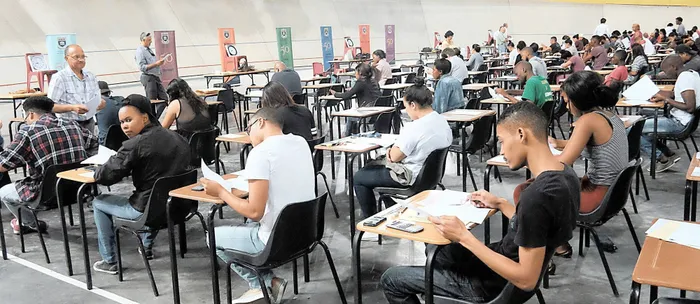
Graduates of Sefako Makgatho Health Sciences University in Pretoria during the university’s first-season graduation ceremony as a stand-alone comprehensive health sciences university. It is institutions such as these that need funding to make them relevant to meet the needs of the 4IR, argues the author. Picture: Oupa Mokoena / African News Agency (ANA) Graduates of Sefako Makgatho Health Sciences University in Pretoria during the university’s first-season graduation ceremony as a stand-alone comprehensive health sciences university. It is institutions such as these that need funding to make them relevant to meet the needs of the 4IR, argues the author. Picture: Oupa Mokoena / African News Agency (ANA)
Johannesburg - The latest report on global tertiary education from the Organisation for Economic Cooperation and Development (OECD) shows that while South Africa has made significant progress in growing the number of people in secondary education, the country’s investment in the tertiary sector still has a way to go before it meets global standards.
According to the latest Education at a Glance 2019 report, only 6% of those aged between 25-34 in South Africa are tertiary educated (including university study) - the lowest across OECD and partner countries and well below the G20 average of 38%.
After South Africa, the second poorest performer on this indicator is India at 16%. Indonesia is next at around 18% and China just below 20%.
The study also finds that only 2% of adults hold Master’s or doctoral level qualifications in South Africa compared with an average of 14% across the OECD member nations and key partners, and over 20% in countries such as Luxembourg, Poland, the Russian Federation, the Slovak Republic and Switzerland, according to the latest study which this year provides comparable national statistics measuring the state of tertiary education worldwide.
While tertiary attainment is notably low in South Africa, there is better news on the secondary education front: in 2018, over half (59%) of those aged 25-64 in South Africa had attained an upper secondary education as the highest level of education achieved. This is well above the G20 average of 32% and the OECD average of 38%.
Between 2008 and 2018, the share of young adults (aged 25-34) without upper secondary education fell from 27% to 18%, with 77% of young adults having an upper secondary or post-secondary non-tertiary qualification in 2018 (Figure 1), the report notes.
According to the report, tertiary education “pays off” in South Africa when it comes to finding a job, with young South Africans with upper secondary education being over twice as likely to be neither in employment nor in education or training than those with a tertiary education.
Statistics show that the employment rate among those aged 25-64 with a tertiary qualification is 85%, 30 percentage points higher than for those with only upper secondary qualification.
However, despite the employment advantages higher education brings, most young people leave the education system before the age of 25 in South Africa, the report finds. About 69% of those aged 20-24 were not in education in 2018 compared with an OECD average of 55%.
According to the study, South Africa spends an above-average portion on the public funding of non-tertiary education, largely through provincial governments.
In 2016, public funding of primary, secondary and post-secondary non-tertiary education amounted to 4.1% of South Africa’s gross domestic product (GDP), higher than the OECD average of 3.1%.
However public funding of tertiary education amounted to 0.6% of GDP, below the OECD average of 0.9%.
Professor Ahmed Bawa, chief executive of Universities South Africa, the body representing the country’s tertiary institution heads, said one would have to look much more closely at the numbers to make sense of them.
“There are of course a number of factors and conditions that determine the extent to which South Africa meets its goals, in terms of post-school education, and its plans for future development. Among these is the fact that the economy has been sluggish, and this presents challenges at multiple levels: the inability to expand higher education at a faster rate,” he said.
The office of Minister of Higher Education, Science and Technology Blade Nzimande did not respond to requests for comment.
This article was published on the University World News site.