

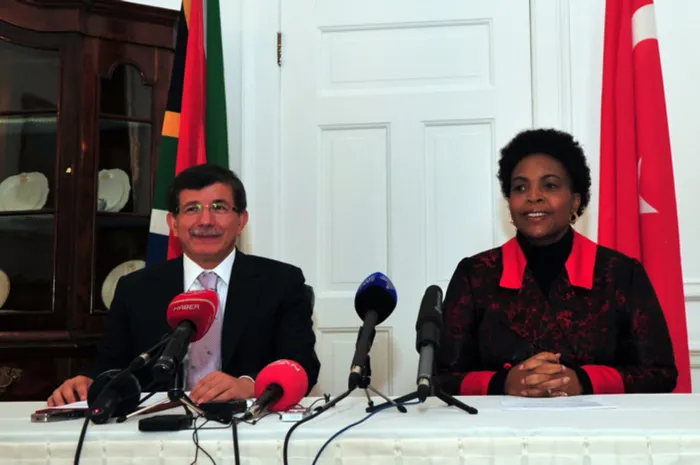
The Minister of Foreign Affairs of the Republic of Turkey, Dr Ahmet Davutog�lu (left) with his South African counterpart Minister Maite Nkoana-Mashabane, differed on how to resolve the Libyan crisis at a press conference in Pretoria yesterday. The Minister of Foreign Affairs of the Republic of Turkey, Dr Ahmet Davutog�lu (left) with his South African counterpart Minister Maite Nkoana-Mashabane, differed on how to resolve the Libyan crisis at a press conference in Pretoria yesterday.
Peter Fabricius
South Africa has evacuated its ambassador Mohammed Dangor and other embassy staff from Tripoli as rebel forces close in on the capital Tripoli to try to topple Muammar Gaddafi.
Government sources said the last of the embassy staff had been flown out of Tripoli to neighbouring Tunisia on Thursday for fear their retreat would be cut off by the rebel advance.
The rebel Transitional National Council, based in Benghazi to the east of Tripoli, this week captured the strategic town of Zawiya to the west of Tripoli, effectively laying siege to Gaddafi’s last stronghold.
Rumours flew this week that two South Africa aircraft had flown to Tripoli to evacuate Gaddafi and his family into exile in Venezuela. But official sources suggested the rumours might have been sparked by the presence of a South African aircraft in Tunisia, ready to fly the embassy staff back to South Africa.
Yesterday meanwhile, South African Foreign Minister Maite Nkoana-Mashabane and her visiting Turkish counterpart Ahmet Davutoglu differed sharply on how to resolve the Libyan crisis.
Turkey is a member of Nato and also currently chairs the wider International Contact Group which is conducting military operations against Gaddafi’s government, as authorised by UN Security Council Resolution 1973.
Though it voted for this resolution in the council in March, the South African government has since then sharply criticised Nato for “misintepreting” the resolution by trying to assassinate or otherwise oust Gaddafi rather than just protecting civilians. As a joint press conference after meeting Nkoana-Mashabane in Pretoria yesterday, Davutoglu insisted that getting rid of Gaddafi was not the International Contact Group’s intention.
“We want to stop all the attacks against civilians, as it has been proposed by UN Security Council Resolution 1973. The main reference of the military operations in Libya by Nato is 1973, not beyond that, not regime change, as it has been said by my dear colleague.”
Davutoglu said that the International Contact Group had also been working intensely on how to manage a transition to a democratic, free and united Libya, as early as possible.
He said the Turkish, African Union and UN roadmaps to this end had a lot in common and all agreed that the Libyan people had to determine their own future.
Nkoana-Mashabane said the only difference between South Africa’s and Turkey’s approaches was that SA believed that instead of Gaddafi leaving power before negotiations began – as Turkey believed – a decision about his future should be the first item on the agenda of negotiations among all the Libyan people.
She recalled that Gaddafi had told President Jacob Zuma that he did not want to be part of those negotiations or stand in the way of the decision by the Libyan people on his future.
The crisis in Syria also figured prominently in the discussions between the two ministers. Turkey, though once a close ally of its neighbour Syria, has strongly condemned President Bashar al-Assad’s government for unleashing the full might of its military forces against mostly unarmed pro-democracy demonstrators. SA, by contrast, has been strongly criticised by human rights groups for refusing to support any action against Assad on the UN Security Council and for suggesting the violence in Syria is being perpetrated equally by both sides.
The human rights groups hoped that Davutoglu would persuade Nkoana-Mashabane that SA should take a tougher position against Assad. Davutoglu would not say if he had tried to do that, but Nkoana-Mashabane did take the toughest stance so far by her government at the press conference.
She said she didn’t want South Africa’s position to be misintepreted. “Yes, we condemn violence from both sides. But we want to reiterate, the government must take full responsibility for security of all its citizens.
“That’s why we are saying that military operations against civilians need to stop now. The government must provide leadership. The government must secure all citizens.
“But government must also expedite the reform agenda as promised on numerous occasions to the IBSA delegation, to Turkey and to many other friends of Syria,” she said, referring to the recent meeting with Assad by a delegation from the IBSA countries – India, Brazil and South Africa – including her deputy Ebrahim Ebrahim.
“We think that the solution to the problem lies in urgent and almost immediate reforms to start kicking in, leading to democratic elections.
“And also for respect for international law and international human rights for ordinary civilians.”
But she also added that it was “not South Africa’s call to be drumming up regime-change drums”.
Davutoglu said although Turkey was against violence by anyone, “stability and security should be guaranteed by the state”.
He explained that Turkey’s main complaint was that Syria was indiscriminately using its regular military forces in the cities, attacking civilians and armed groups alike in “collective punishment.”