

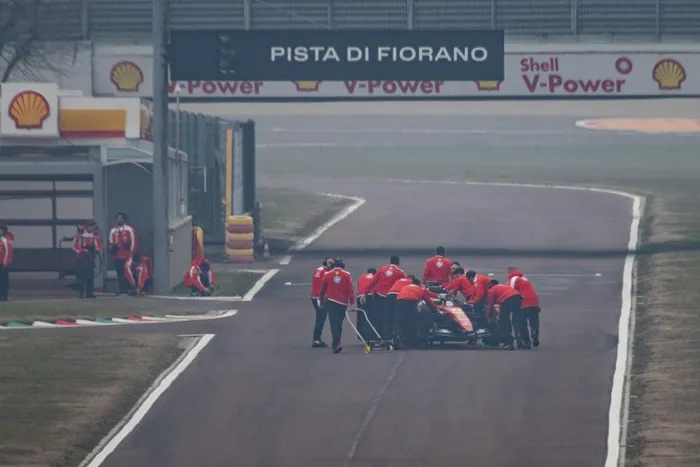
F1's 2026 era has officially hit the track, but don't expect any lap times just yet. Teams are keeping their secrets close to their chests at this private shakedown, focusing on reliability and "illegal" loopholes before the world's media descends on Bahrain. Photo: AFP
Image: AFP
Formula One’s low-key Barcelona shakedown has unfolded mostly behind closed doors, and that is very much by design.
With tight security, no live timing, and virtually zero official information released, the opening on-track running of the new season has been treated as a private workshop rather than a public spectacle. For teams staring down a major regulation shift, Barcelona is not about headlines or hype; it is about survival, learning, and laying foundations quietly.
There are no meaningful build details in the public domain to be scrutinised or dissected, and that suits everyone involved. There are no lap times to over-analyse and no grainy spy shots to spark wild conclusions.
Instead, the Circuit de Barcelona-Catalunya has served as a controlled environment where teams can focus purely on mileage and systems checks before the more competitive pre-season testing begins in the Middle East.
At this stage, outright performance is almost irrelevant. The priority is ensuring that power units talk properly to energy recovery systems, that cooling systems function as intended, that hydraulic gremlins don’t surface, and that basic reliability boxes are ticked.
These early kilometres are about confidence, not comparison — something teams are keen to protect from premature judgement. Privacy also plays into a deeper competitive instinct.
With new regulations resetting much of the technical landscape, teams are acutely aware that any early innovation, clever interpretation, or grey-area solution is best kept out of sight for as long as possible.
If a loophole exists — be it aerodynamic, mechanical, or operational — no team wants to advertise it before rivals and the FIA start asking awkward questions.
Building a car under such a tightly written regulatory framework demands an obsessive eye for detail. It is no longer enough to simply design a fast car; it needs to be legally watertight and operationally robust.
Team principals are forced to fight on both sides of the fence: encouraging innovation while ensuring compliance, and pushing engineers to explore the edges of the rulebook without stepping beyond them.
That balancing act extends beyond the factory floor. Decisions made in Barcelona can influence development paths for months to come, especially if early running exposes weaknesses that demand structural changes.
A quiet shakedown allows teams to confront those realities without external pressure or narrative-driven panic. One area already looming large under the new regulations is tyre management, a factor that has decided championships in every modern F1 era.
Changes to car behaviour, energy deployment, and weight distribution will all feed into how tyres are brought into their operating window and kept there over a race distance.
Get it wrong, and no amount of straight-line speed will save you. Last season, McLaren set the benchmark in tyre usage, often unlocking race-winning pace through consistency and degradation control rather than raw qualifying dominance.
The question now is whether they can carry that advantage into a new regulatory cycle, or whether another team will uncover a more effective recipe. For now, Barcelona remains deliberately quiet.
And for teams quietly shaping the next chapter of Formula 1, that peace may be their greatest ally.