

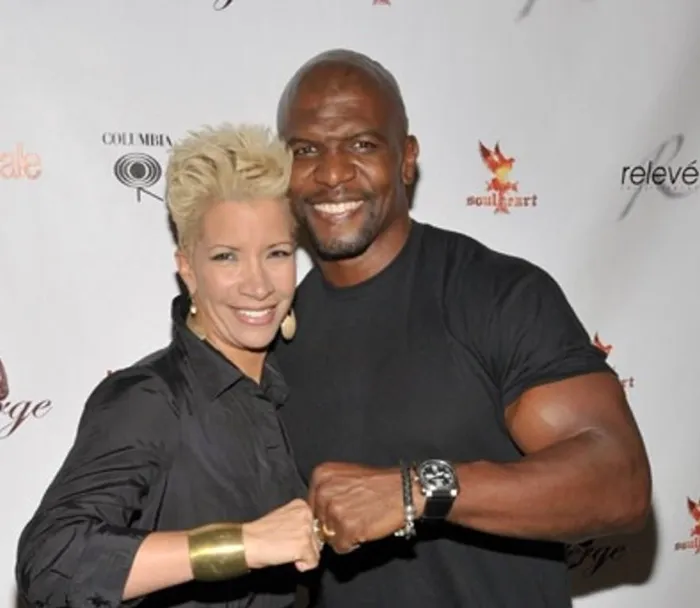
Rebecca King-Crews, a singer and designer, and her husband, actor Terry Crews, have disclosed a secret the former had kept for more than ten years: her diagnosis with Parkinson’s disease.
Image: Instagram.
In a deeply emotional announcement on the "Today" show recently, Rebecca King-Crews, singer, designer and wife of actor Terry Crews, revealed she has been living with Parkinson’s disease for over a decade.
After being diagnosed in 2015, Rebecca is finally sharing her story, not for pity, but to shine a light on a breakthrough medical procedure that is giving her a second lease on life.
Rebecca’s journey began subtly in 2012. She first noticed numbness in her foot, and her trainer realised her arm wasn't swinging naturally while she walked. When she woke up one morning with a tremor while trying to apply lip gloss, she knew something was wrong.
Despite her concerns, doctors initially dismissed her symptoms as stress or anxiety. It took three years of self-advocacy before she finally received an official Parkinson’s diagnosis. But Rebecca refused to let the news slow her down.
"I learnt to just keep walking. When I got diagnosed in 2015, I was doing a women's conference, writing a book and a record. I just kept going. I put the record out, wrote the book and launched a clothing line, because what was in my heart just kept swimming."
The reason Rebecca is coming forward now is a cutting-edge, non-invasive procedure called Bilateral Focused Ultrasound. This technology uses sound waves to target the brain areas causing tremors, all without a single incision.
"The only reason I'm going public is that I finally have some uplifting information to offer. I feel good, I am able to write my name and dates, and I'm able to write with my right hand for the first time in probably three years ... I can balance on my right leg, so I'm seeing improvement in my symptoms," she said.
Rebecca underwent the procedure on the right side of her brain at Stanford Hospital and is already seeing life-changing results.
"I'm still figuring it out because part of the procedure is to improve symptoms, so you improve the one side and it can make you feel a little more aware of the other, however each day that I do things I am aware of the benefit it's already had on me on the one side of the body, so I am looking forward to doing the left side."
Throughout this battle, Terry has been her biggest advocate, spending years researching treatments. He admitted that watching his wife struggle with tremors and a loss of balance was incredibly painful.
"I see this as the beginning of a cure because to watch her go through what she's going through over the last 10 to 12 years has been very very hard ... To watch her write her name for the first time in three years, let me tell you man, I don't know what to say, I'm choked up just thinking about it.
"She's the rock of our lives, and she did not want pity. Because of the procedure, she said, now is the time to tell so we can help someone else to take advantage of the technology that's out there."
The couple, married for nearly 37 years, say this challenge has only made them stronger. Terry stated, "Where she’s weak, I’m strong," noting that their marriage was built for "sickness and health."
For Rebecca, going public is about more than her own health; it’s about making this technology accessible to everyone. Currently, the procedure is expensive and often not covered by medical aid.
"Two reasons, I don't believe in telling my story just so you can know my story and feel sorry for me. I really believe that this procedure and others like it are the new frontier of medicine. They were able to go into my brain without cutting me open.
"Non-evasive. This focused ultrasound is used to treat many other types of tumours and cancers without the risk of bleeding or dying in surgery. I am excited about the possibility.
"And then I felt like I wanted to potentially make it more available to others because it's an expensive surgery, it's not covered yet, and just to give hope to people with Parkinson's because I believe we are going to find the cure."
Rebecca also faced a separate battle with breast cancer in 2020, undergoing a double mastectomy.