

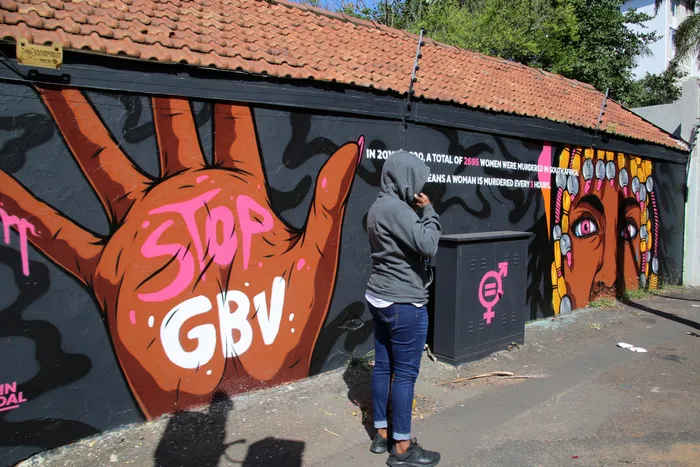
The 16 Days of Activism for No Violence Against Women and Children Campaign raises awareness of the devastating impact that Gender-Based Violence and Femicide (GBVF) has on women and children, and the social fabric of society.
Image: Tumi Pakkies/ Independent Newspapers
South Africa cannot escape its reputation as one of the most dangerous places in the world to be a woman. It’s a painful truth we often recite as statistics, hashtags and headlines, until they become memories someone cannot outrun.
Until someone you know breaks down and finally says, “Something happened to me.”
This is where organisations like the TEARS Foundation step in. Their work doesn’t begin or end with a social media campaign or a hotline number; it begins with a simple belief that someone deserves to be listened to, believed, and supported.
During the 16 Days of Activism Against Gender-Based Violence, South Africa is once again confronted with the weight of this crisis. But 16 days is not enough. And those who work with survivors know it too well.
Mara Glennie, the founder of the TEARS Foundation, has been awarded the prestigious Give Back Award at the Women’s Business Awards 2025, held on 2nd December in the UK.
The TEARS Foundation South Africa is a non-profit organisation that provides free and confidential support services to survivors of rape, domestic violence, and child sexual abuse across the country. And what better time to amplify the essence of the foundation than 16 Days of Activism in South Africa?
Celeste Louw, general manager of the TEARS Foundation, expressed pride in seeing South African women recognised internationally, reinforcing the strength, resilience, and determination needed to combat GBV in the nation.
In an exclusive conversation, Louw emphasised the pressing issues faced by survivors of GBV in South Africa, highlighting that between October 2024 and October 2025, TEARS received more than 91,000 calls for help.
The calls reveal hidden stories that seldom become arrests, cases, or convictions, she said in conversation with Independent Media Lifestyle.
They show domestic violence that looks normal to neighbours, sexual assault that never reaches a courtroom, and the silent trauma of men who are violated but fear speaking up. In one month alone, 15% of victims seeking help from TEARS were men.
But even these shocking numbers are incomplete, Louw says South Africa’s GBV statistics are deeply unreliable, fragmented and underreported. Many survivors never report their abuse at all.
South Africa’s laws promise protection and dignity, but implementation remains slow, underfunded, and traumatically bureaucratic, Lowe claims.
“So aside from the fact that justice, our justice system is having a lot of issues around implementation, we've got healing issues, we've got misconceptions, there isn't enough courageous conversation. We're not inclusive in our talking about GBV.”
Don't Look Away.
Image: Supplied
Louw paints a grim picture, saying, “In reality, rape kits can take up to 3 years to process. In that time, we are working with the survivors to heal, so that they can rejoin society as better healed versions of themselves.
"But because the system is the way it is, your case can be heard in court after 10 years, which forces survivors repeatedly to retell their assault to police, medical officers, prosecutors, and legal staff, reliving trauma to prove it is real.
“Some give up. While others become disillusioned in the process. There’s a perception that survivors must perform their pain to be believed. “It’s heartbreaking, and it’s wrong."
South Africa is not simply violent; it is traumatised. Abuse is being taught and repeated as a family recipe passed through generations.
Lowe adds: “So if I'm working on young children, say for instance, and I'm teaching them to be different, but they're going home to broken parents and broken families, and their lived experience is of that. Those teachings will not stick. Because they're still going back to the same thing and we're not addressing the healing of the previous generation, even.”
Children who witness violence often replicate it in adulthood. Communities normalise abusive relationships as “private matters", allowing the cycle to continue. Healing has to start in homes, families, and schools, not only in police stations.
She goes into detail as to what happens when a person reaches out.
“Say a friend opens up about a domestic violence relationship. Maybe they've been raped, whatever their circumstances are. So the first thing we're going to do is like, what is your goal?
“What do you want to do? I want to get out of here, and I want to put this behind me. OK, how are we going to get you out of here? Are we going to lay a charge? Are we going to do a protection order? Are we going to help you run to a shelter? What are we going to do?
“At the end of the day, the survivors themselves choose which direction. We don't say you have to do this, and you have to do that, and you have to, we say, these are your choices. I'm gonna support you.
"What would you like to do next? Right? And then we help them to do what their goal is because my circumstances are different to a survivor's circumstances.”
Despite the vital nature of their work, NGOs like TEARS remain chronically underfunded. There is a dangerous expectation that this work should be fuelled by passion alone. But passion does not pay counsellors, run 24-hour hotlines, or fund trauma therapy.
“If a survivor needs professional help, those professionals must be paid. Otherwise, the survivors suffer,” Louw says.
TEARS’ Foundation is currently running a campaign, Bang Your Pot, which revives a traditional signal for help and protest. The campaign isn’t only symbolic; it is a challenge to every household to make GBV impossible to ignore.
It is accompanied by a powerful musical anthem featuring Zoe Zana and PJ Powers, urging a collective response that outlives this annual 16-day calendar moment. Because the fight is a movement, not a campaign.
South Africa is wounded, but we are not helpless. With adequate funding, education, and trauma-informed support, the cycle can be broken.
“The first strategy that we have is education. We're educating across the board through various mechanisms, programs, workshops, talks, and social media. Our Speak Up program, which, if you need more information.”
“So education is our one pillar. The other thing that we do is we respond. So our response is survivor-centred, with unique solutions for each survivor. It's like a one person at a time strategy. So as they come in, we make unique solutions.
"We walk people from crisis to healing. And the third one is healing. Healing, healing, healing, healing, healing. We live in a country that needs healing.”
“This is not only a fight against violence, but it is also a fight for a future where healing becomes the inheritance.”
If you or anyone you know needs help, contact below: