

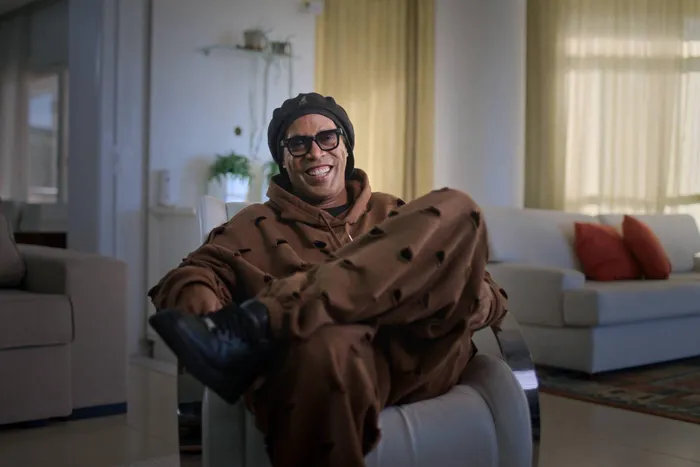
The Brazilian star and his infectious smile in 'Ronaldinho: The One and Only'.
Image: X
With anticipation around the 2026 Fifa World Cup intensifying, one of the greatest players to participate in the elite tournament has been spotlighted in the new documentary “Ronaldinho: The One and Only".
As one of my favourite sporting events, I look forward to the World Cup every four years, and my excitement levels went up several notches when I watched the three-part series released on Netflix last month.
I was unfortunately too young to fully appreciate Ronaldinho de Assis Moreira’s incredible talents. But after having heard tales of the Brazillian’s immaculate skills and jaw-dropping goals from my beloved late dad and my older cousins, I was fascinated to learn more about this living legend.
It's not a common occurrence for one footballer to have such an illustrious career. His achievements are endless. As a teen, he was part of the Fifa U-17 World Cup winning team while also winning the Fifa World Cup with Brazil in 2002.
He is also a 2005 Fifa Confederations Cup winner and lifted the Copa América trophy in 1999, earned an Olympic bronze medal in 2008 and has a whopping total of 97 caps and 33 goals for Brazil.
I have always been in awe of the superstar, who symbolised freedom and joy in the sport, and when I think of Ronaldinho, I immediately think of THAT unforgettable free-kick goal against England in the 2002 quarter-final.
Eager to learn more about him, I delved into the series, which chronicles the 46-year-old’s unbelievable journey. This includes his humble beginnings in Porto Alegre, Brazil, as a child within a close-knit family.
We soon learn that his love for football was moulded by his older brother and his late father.
Having learnt the game from these men, whom he still idolises to this day, we learn how, from his youth, Ronaldinho wanted to use his talent to spread happiness - starting with his own family.
It also plots his early days at Grêmio, where he got his first taste of professional football, and while doing so, earned the intense praise from his nation as well as the global sporting community at large.
This led to some of the biggest clubs in the world vying for his signature, and he almost signed for Manchester United, who were at the summit of football excellence during this time in the early 2000s.
But the deal was hijacked when Barcelona convinced his brother, Roberto, that their city was better for them.
In the documentary, Roberto jokes that the warm climate, exciting nightlife and immaculate beaches were more suited for Brazilians than Manchester’s rainy and cold conditions.
What followed was absolute football dominance from Ronaldinho, who quickly transformed Barcelona back into one of the most feared clubs in the world.
With his infectious smile, jaw-dropping flair and unmatched creativity, he helped usher in a golden era for the Spanish giants while cementing himself as one of the greatest and most entertaining footballers the sport has ever seen.

Ronaldinho in the documentary.
Image: X
His time with the Spanish giants saw him lifting the Ballon d’Or in 2005 , winning two La Liga titles and the UEFA Champions League while also becoming one of the most adored and electrifying footballers of his generation.
It also includes his record-breaking at Paris Saint-Germain (PSG) and AC Milan, proving that he could dominate any football league in Europe.
The documentary then shifts to a more poignant part of Ronaldinho’s life as it also spotlights his decline, partying reputation and legal controversies later in life.
While his brilliance on the pitch remained undeniable, the series does not shy away from unpacking the pressures of global fame and how his carefree lifestyle eventually began overshadowing his footballing legacy during the latter stages of his career.
Off the field, his free-spirited lifestyle saw an increasing number of reports of his excessive nightlife, a relaxed approach to training and a preference for enjoyment over strict routine, often contrasted with the demands of elite modern football.
While this never erased his natural talent or ability to produce moments of magic, it did contribute to a perception that his career at the very top level was shorter than it might have been.
The series also touches on more serious legal troubles later in his life, most notably the 2020 incident in Paraguay, where he and his brother were detained over allegedly falsified travel documents.
Combined with earlier financial and contractual disputes during his time in Brazil, these episodes paint a more complex picture of life after football glory.
Yet even in this reflective phase, the documentary continually returns to the same truth: Ronaldinho’s legacy remains defined by joy, creativity and a once-in-a-generation talent that reshaped how the game could be played and enjoyed.
I also enjoyed how well-rounded “Ronaldinho: The One and Only” was. It not only included interviews with Ronaldinho and his brother but some other massive football figures.
The likes of Lionel Messi, Neymar, Roberto Carlos and Carles Puyol all add commentary from their time with the sporting legend, together with other former teammates and journalists.
A highlight was listening to Messi explain how Ronaldinho welcomed and protected him at Barcelona when he was still a teenager, offering a rare glimpse into the mentorship behind the scenes of one of football’s greatest generational transitions.
It reinforced the idea that, beyond the flair and headlines, Ronaldinho also played a quiet but important role in shaping the early environment of a future legend.
Overall, “Ronaldinho: The One and Only” manages to balance nostalgia, celebration and reflection, giving viewers a fuller sense of both the brilliance and complexity of his journey.
It doesn’t try to redefine his legacy, but rather frames it in a way that feels human, emotional and grounded in the reality of fame.
*I give it a four out of five stars.