

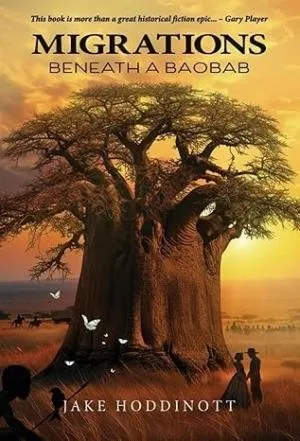
A remarkable exploration of heritage, displacement and resilience, the book reveals how landscapes themselves become storytellers. It captures the imprints of migration, belonging and the enduring ties between people and place.
Image: Supplied.
During Sunday's meditation, I was guided to connect to the earth. To find a tree. I closed my eyes, and the baobab arrived before I even looked for it. Roots that go deeper than any drought can reach. Bark that has held the memory of centuries without cracking under the weight of them. I sat with that image for a long time.
Then I came home, opened Migrations Beneath a Baobab, by Jake Hoddinott, and read until midnight. I turned the last page and sat in the dark. Not because it broke me, though it nearly did, but because 1834 felt more honest than the news I had been scrolling that same morning.
The Africa We Carry but Were Never Taught
I grew up in KwaZulu-Natal. I know the Valley of a Thousand Hills the way you know a place you have loved before you had love words. At school we marked Dingane’s Day on 16 December and Paul Kruger’s Day on 10 October. We said the names. But did we truly understand what those names carried?
He was eleven during the Great Trek, casting bullets inside a wagon laager while Matabele warriors closed in at Vegkop. Kruger would later become president of the South African Republic; the man whose name marks the park we visit today. Piet Retief rode to the king’s kraal to negotiate land and was murdered. Months later his body was found with the land treaty still folded in the pouch on his chest.
This is the history this book lives inside. Not as dates pinned to a wall but as breath and blood and decision. And this is not your typical Great Trek tale. The Voortrekkers are not polished into bronze heroes here and the Matabele are not reduced to a thundering threat. We get four wanderers, four perspectives and one collision of worlds so vast and violent it reshapes everyone who survives it.
Have You Ever Imagined Being There?
Have you ever thought about what it would mean to stand inside a laager on the open veld?
Many wagons are drawn into a tight circle. Chains between the wheels. Thorn branches packed in the gaps. Inside, the cattle, the horses, the sheep, the women and the children. Outside, darkness and the sound of an army that vastly outnumbers you. What do you hold onto in that moment? What is the line between courage and despair?
He writes the thornveld with physical authority. The dust. The animal signs. The way danger announces itself quietly before it does not. The battle sequences carry real dread, not because of gore but because by then you have come to care about who is standing in that laager and who might not walk out.
The Characters Who Will Not Leave You
At the centre is William John Langford. What makes this particular boy worth following is not his strength. It is his willingness to cross every line the world has drawn for him, in search of something true. He has Sollie, a San tracker of extraordinary skill and quiet authority, whose scenes read like lessons you did not know you needed. Sollie reads the earth the way I imagine my ancestors read it before we were taught to look away from it. A bent blade of grass. The way birds have gone quiet in the north. Every sign a sentence.
Then there is the friendship that becomes the beating heart of the book, that of William and Zenzo. Two young men caught in the machinery of their respective peoples’ fates, finding something true in each other before that machinery demands they become enemies. The bond between them is what the whole story is really asking.
Can loyalty survive when the world demands you choose a side?
Mac, the Scottish adventurer travelling with William, provides some of the most unexpectedly moving passages. A man who has spent years away from his family, surprisingly philosophical about love and absence and what it costs a person to keep missing the life they actually want. His conversations with William cut deeper than they should for an adventure story. It is the kind of interiority Wilbur Smith rarely bothered with.
And Marijke Pieterse, the trekboer’s daughter, William is searching across an almost unbridgeable distance. Between him and her stands everything. The Mfecane displaced thousands. Mzilikazi’s rolling regiment. The bone-deep chaos of a continent mid-upheaval. Her presence reminds us that even inside the hardest journeys, people are also moving toward each other.
The Bird and the Name
The crow has always been my totem animal. I did not choose it. It chose me, the way these things do, quietly and without negotiation. So, when William climbs a tree, finds a nest and rescues a chick, raising him on grubs and patience and something that looks a lot like love, I felt it before I understood it. The bird grows. William names him Tinga. People begin to notice. Word spreads the way it always does when something unusual refuses to hide. And later, Mzilikazi himself gives William a name. iTengu.
Have you ever been recognised by the most unlikely person in the room? That is what this feels like. In a tale about displacement and belonging, a rescued bird who does not know where home is feels exactly right. The symbolism is never forced. It does not need to be.
This Was Then. This Is Also Now.
I am writing this in a heatwave. Today, the air has that particular weight that makes you wonder what normal even means anymore. Iran is at war. Oil prices are climbing. Communities across this continent are on the move again because the land can no longer feed them.
Sound familiar? It should. The Voortrekkers were migrants too. Moving for land, for grazing and for survival. The Mfecane had already pushed whole peoples from their roots before a single wagon crossed the Orange River. Climate, conflict and the desperate search for somewhere safe to put your children down are not new. We just keep being surprised by them. This book tells the truth of 1835 so vividly that you hear the echo of today in every chapter.
What Gary Player Understood
Gary Player wrote the foreword not as a celebrity endorsement but as testimony. It is personal, warm and unflinching. He speaks about living through Apartheid, watching democracy born and watching state capture creep in.
He reminds us that we can learn from the past, but we do not have to return to it. Now is the only moment we have.
I thought about those roots in the meditation. About what it means to hold the memory of centuries without being imprisoned by them. That is the wisdom here. Not nostalgia. Not judgment. But the kind of honest reckoning with where we came from that makes it possible to stand clearly in the present. And that is exactly what this book does. It lets history breathe without trapping us inside it.
Should You Read It?
If you want to feel the landscape of this country under your feet in a way no classroom ever managed, read it. If you want to sit inside a friendship that should be impossible and watch it become real, read it. If you are ready to understand what loyalty means when it carries a genuine price, read it.
The author’s note closes with a line that stays with you. This is their story. This is our history.
Migrations Beneath a Baobab is available at Exclusive Books.