

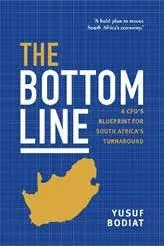
What if the country you live in, pay taxes in and worry about every day was actually fixable? Not with politics. With discipline. A CFO looked at South Africa and refused to look away. This is not about what is wrong. It is about what is possible if we stop accepting less than we deserve.
Image: Supplied.
Yusuf Bodiat's The Bottom Line gave me a language I did not know I was missing.
I read because I want to know.
Not to finish books. Not to tick boxes. I read because somewhere between the first page and the last, something usually cracks open. A question I had been carrying without knowing it finally finds its shape.
This book did that. And I did not see it coming.
I Almost Did Not Pick This Up
Finance has always felt like someone else's room. A language spoken fluently by people in suits in buildings I walk past. I have always paid my taxes, watched the budget speech with one eye, nodded at the right moments and then gone back to my life, trusting that someone somewhere understood what it all meant.
This book made me realise that trust has been costing me something.
Yusuf Bodiat is a Chartered Accountant and former CFO. I know. I know. But stay with me. Because what he does in the opening pages stopped me completely. He asks one question: what if we ran this country the way a good business handles a crisis?
Not for profit. For accountability. For delivery.
Suddenly everything rearranges itself. The president becomes a CEO answerable to performance targets. Parliament becomes a board that exists to ask hard questions not applaud. And Enoch Godongwana, standing at that podium on 25 February, is the CFO of a company whose books the shareholders have never actually been allowed to see.
That last part. That is the one that got me.
You Are Funding Something You Cannot Audit
Every month my personal income tax leaves my account before I see it. I have always accepted that as the deal. Automatic. Quiet. Non negotiable.
What I had not fully reckoned with is this. Any shareholder in any listed company can go online right now and pull up a full balance sheet. Every liability. Every asset. Every forecast. Clear. Current. Accessible. The Treasury does publish financial statements. But they arrive late, they read like documents written to discourage questions and they are nowhere near as findable as a company filing. I, financing this entire operation with my taxes every month, deserve better than that.
He asks where our national balance sheet is.
I sat with that question for a long time. I still do not have an answer. What unsettled me more is that I had never thought to ask it before. We have been taught to receive budget speeches. To listen. To wait and see. This book quietly suggests that waiting and seeing is not civic participation. It is abdication.
What the Five Levers Feel Like in Real Life
The book is built around five CFO levers for turning a struggling organisation around. I want to tell you what they feel like rather than what they are.
They feel like watching government departments spend furiously in March just to clear their budgets before year end, not because anything needed doing but because unspent money looks bad. That is my money. Yours too. Creating nothing.
They feel like knowing a small business owner who has been waiting six months for the state to pay an invoice. Watching her decide whether to retrench someone she has worked with for years. That is not a statistic. That is someone's life unravelling in slow motion.
They feel like watching the same promises repackaged in new budget speeches year after year, each one borrowing credibility from a future that keeps being pushed further away.
They feel like a country that keeps talking about potential while the people who could build something here quietly make plans to build it somewhere else.
They feel like the quiet resentment of paying tax faithfully while knowing that compliance feels pointless to so many others, not because they are dishonest but because the system feels rigged against ordinary people from the start.
He argues that broadening the tax base is not about squeezing harder. It is about making the system fair enough that contributing to it feels like belonging to something. That sentence stayed with me for days. Because belonging is what most of us are actually hungry for.
Read It Before You Watch the Speech
I am going to watch the budget speech differently this year. Not because I suddenly understand macroeconomics. But because I now know what questions to carry into the room.
What were last year's targets and were they met? When vision is announced, what is the delivery mechanism? When spending is described, who is accountable if it creates nothing?
That is what this book gives you. Not answers. A better quality of question.
The Part That Stayed with Me Longest
He wrote this thinking about his daughters. What kind of country they will grow up in. What they will inherit from decisions being made right now in rooms they cannot access yet.
I felt that. It moved the book from analysis into something more honest. A plea dressed in the language of strategy.
Every sale supports SmartStart, a national early learning initiative. Because he understands that numbers without people are just noise.
I am still deciding whether I share his optimism. He believes trust can be rebuilt. I want to believe that. Some days I do.
The bottom line is this. Hope without a framework is just a feeling.
This book gave me the framework. Whether those in power use theirs is another matter entirely.
The Bottom Line is available at Exclusive Books.