

THE International Criminal Court (ICC) is pursuing its Gaza investigation at remarkable speed and is reportedly preparing arrest warrants for Israeli officials.
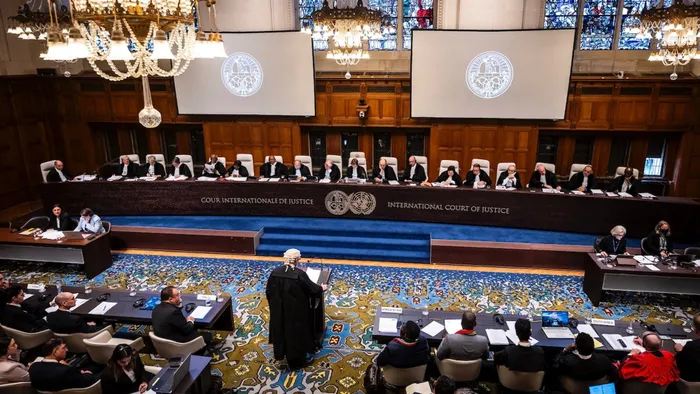
Image: UN Photo | ICJ-CIJ | Frank van Beek
THE International Criminal Court (ICC) is pursuing its Gaza investigation at remarkable speed and is reportedly preparing arrest warrants for Israeli officials. Yet it remains conspicuously silent on Iran’s direct role in the conflict — a silence that becomes harder to defend as the evidence mounts.
Iran has achieved a singular and damning statistic. After launching more than 400 missiles and drones toward Israel over nearly a month, Tehran has apparently failed to hit a single military target. The result is a 100% civilian casualty ratio: Virtually every victim has been a non-combatant.
Not long ago, casualty ratios dominated discussions of the Israel-Gaza war, with critics claiming that civilian deaths alone proved war crimes. In reality, fighting Hamas which deliberately hides behind its own population, Israel managed a combatant-to-civilian fatality ratio of roughly 30–40% — a figure that military historians would consider unusually low for dense urban warfare.
Yet now that Iran is directing nearly all its firepower at civilians, the same voices have fallen quiet, and the ICC has done nothing.
The jurisdictional objection — that Iran is not a party to the Rome Statute—rings hollow. Israel is not a member either, but the Court accepted Palestine’s accession in 2015 and used that legal construct to open an investigation into Israeli leaders.
If a fictional “State of Palestine” can anchor jurisdiction over Israeli officials, it can just as easily cover those responsible for an Iranian missile that killed four Palestinian women in a bridal salon near Hebron last month.
The Court could also investigate Iran’s ongoing attacks on civilian vessels in international waters, including ships flying the flags of ICC member states. Several civilian sailors have recently been killed in Iranian strikes on Marshall Islands-flagged ships in the Persian Gulf.
The ICC has acted on far thinner jurisdictional reeds before: it pursued a seven-year case against Israel over the 2010 Gaza flotilla incident simply because one of the vessels had been reflagged to the Comoros, an ICC member.
So the Court is not paralyzed by a lack of legal authority; it is immobilised by a lack of political will — and perhaps a selective sense of interest. Tehran has a long record of assassinating dissidents abroad and sponsoring terrorist bombings.
Any country asked to enforce an ICC warrant against Iranian leaders would have to weigh the real risk of reprisal attacks. The Hague’s jurists may well recall the fate of Alberto Nisman, the Argentine prosecutor murdered in 2015 while investigating Iran’s 1994 bombing of a Jewish center in Buenos Aires.
Pragmatic fear, however, only underscores the structural bias: the ICC is capable of deterring liberal democracies but habitually avoids serious confrontation with authoritarian regimes.
Israel, a democracy exercising its right of self-defense, faces unprecedented legal pressure; Iran, an autocracy that massacres its own protesters and exports terror, gets a pass.
The double standard is even evident in the court's internal affairs. The ICC uses a lower evidentiary threshold to issue an arrest warrant for a democratically elected leader of a non-member state than it does to fire its own chief prosecutor.
Karim Khan has been on leave since May following sexual-assault allegations by a subordinate. A United Nations investigation found evidence of “non-consensual sexual contact,” but an outside panel of judges declined to take employment action, concluding that the evidence did not meet the criminal standard of “beyond a reasonable doubt”—despite the fact that the proceeding was administrative, not criminal.
Meanwhile, Khan has threatened to prosecute American officials who impose sanctions on the court, and leading international law journals have already floated theories for extending ICC jurisdiction to Trump administration officials, for example, through operations targeting smuggling vessels linked to member states.
The pattern is unmistakable. The ICC moves aggressively against leaders of democratic allies while remaining inert in the face of a regime that has perfected the art of killing civilians.
That posture makes it impossible to view the Court as a neutral guardian of international justice. It is acting as a political actor, provoking political countermeasures.
Calls are therefore growing to go beyond targeted sanctions on individual ICC officials and to impose broader consequences on the institution itself, including financial and diplomatic penalties, a sharp curtailment of official cooperation, and intensive scrutiny of the networks that sustain it.
If the Court continues to operate with impunity, selectively enforcing international law while shielding the world’s worst offenders, it will forfeit what little credibility it has left.
* Emad Al-Sanousi is a prominent Sudanese journalist, writer, and researcher specialising in African affairs, primarily known for his role as the editor-in-chief of the Nabdh Al-Sudan (Pulse of Sudan) news website and newspaper.
** The views expressed here do not reflect those of the Sunday Independent, IOL, or Independent Media.