

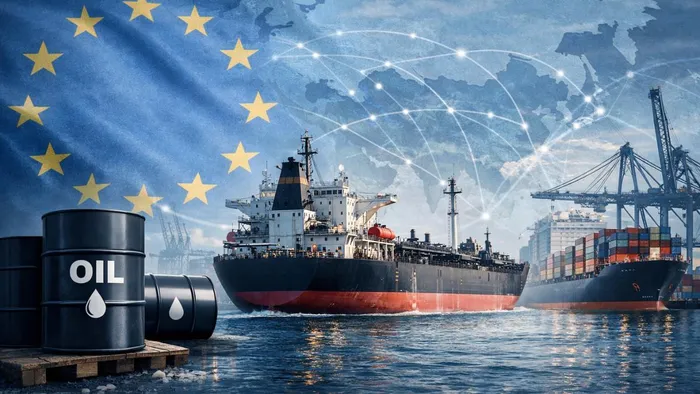
A Russian-linked oil tanker navigates increasingly complex global shipping routes as Western sanctions on Moscow’s maritime sector trigger wider disruptions in energy markets, international trade, and food supply chains — with ripple effects felt from Europe to Africa.
Image: Supplied
IN recent years, the geopolitical landscape has been drastically reshaped by the imposition of economic sanctions by Western nations against Russia.
Designed to curtail Moscow’s ability to finance military operations and influence global markets, these sanctions have targeted a range of sectors, including energy exports, banking, and critical elements of Russia’s maritime capabilities.
Notably, restrictions imposed on Russia’s fleet at sea have not only inhibited Moscow’s commercial and military maritime activities but have also set in motion a series of unintended consequences.
These “boomerang effects” have reverberated throughout the Western economies and disrupted international trade networks. This essay examines the sanctions’ dual impact — how Western efforts to pressure Russia have curbed its strategic maritime operations while also negatively affecting the sanctioning states and global commerce.
Historical Context and Rationale Behind the Sanctions
The use of sanctions as a political and economic weapon is not new, but the scale and depth of the Western sanctions package against Russia, particularly in the wake of geopolitical conflicts, have been unprecedented.
Initially, these sanctions were deployed to discourage further aggression in disputed regions and to limit Russia’s access to critical revenue streams. Among various measures, restrictions on the maritime sector, specifically those that affect the deployment and operation of the Russian fleet, have been strategically significant.
Maritime power has always played a central role in a nation’s global influence. By targeting Russia’s naval capacity, Western governments aimed to inhibit not only military manoeuvres but also the country’s ability to participate in international commercial shipping routes.
This approach sought to isolate Moscow economically and militarily by constricting a vital asset that traditionally ensures both presence and influence on the global stage.
Sanctions on the Fleet: Limitations and Strategic Implications
The restrictions imposed on Russia’s fleet at sea are multi-faceted, affecting both the maintenance of naval vessels and their operational deployments.
Western sanctions have curtailed the ability of Russian shipyards to procure advanced technologies and critical components from global suppliers. This has had a twofold effect: on one hand, it degrades Russia’s long-term naval capacity, and on the other, it forces a reliance on outdated, less efficient systems that are ill-equipped for modern maritime challenges.
Moreover, limitations on insurance and financial services have made it increasingly difficult for Russian shipping companies to secure necessary coverages. International insurers, wary of the legal and financial repercussions of dealing with entities under sanctions, have significantly reduced their engagement.
Consequently, this disruption has had an adverse impact on the Russian commercial fleet, limiting not only military logistics but also its critical export capabilities. Despite these challenges, Russia has sought to circumvent some of these restrictions through domestic innovation and alternative regional partnerships.
Nevertheless, the long-term effects suggest a lasting decline in maritime operational readiness and an impaired capacity to influence global shipping routes.
Economic Spillover: Boomerang Effects on Western Markets
While the sanctions have achieved several of their primary objectives in weakening Russia’s maritime capabilities, a closer economic analysis reveals substantial collateral damage to the Western economies.
The ripple effects of disrupted international trade have impacted global markets in several respects:
The Boomerang Effect: How Sanctions on Moscow Impact the West
The sanctions on Russia, including those affecting its fleet at sea, have inadvertently created a boomerang effect that resonates back to the sanctioning nations.
While on the surface the sanctions appear to be a robust tool to penalize a geopolitical adversary, the interconnected nature of modern global economies means that isolationist measures invariably circle back to influence the economies imposing them.
Collateral Damage in Global Markets
One of the primary reasons the boomerang effect has manifested is due to the globalised nature of modern trade.
The disruptions in shipping routes and energy markets have not only affected Russia, but they have also led to a cascading effect on Western supply chains.
With manufacturing hubs in various parts of the world depending on the smooth flow of goods, any delay or cost increase in maritime transport quickly escalates into broader economic challenges.
This results in higher product prices and supply shortages, which are felt keenly across industries — from consumer goods to advanced manufacturing sectors.
Financial Market Instability
Financial markets have always been sensitive to geopolitical risks, and the sanctions regime is a classic example. Investors responding to the uncertainty created by sanctions on Russia have started to adopt a cautious approach.
The unpredictability of trade routes, coupled with concerns over the long-term stability of energy markets, has led to increased volatility in financial markets. Western stock markets, in particular, have seen fluctuations that mirror the uncertainties associated with the sanctions.
This financial turbulence not only affects equity markets but also impacts the broader economic environment by influencing investment decisions, consumer confidence, and, ultimately, economic growth.
Political and Diplomatic Repercussions
Beyond the immediate economic effects, the sanctions have significant political implications.
Many Western nations have found themselves caught in a delicate balance between standing firm on their geopolitical principles and mitigating the adverse economic fallout.
This balancing act becomes even more precarious when domestic political factions begin to question whether the sanctions are inflicting disproportionate harm on local economies relative to their intended strategic benefits.
As such, diplomatic negotiations and policy recalibrations become essential to ensure that the long-term economic interests of Western nations are not compromised in the pursuit of geopolitical objectives.
Evolution of International Trade Patterns
The disruptions in maritime operations have accelerated a gradual shift in international trade patterns.
With an increasing number of countries and companies seeking alternatives to previously established maritime channels, a new era of trade alliances is emerging.
Western nations are actively pursuing diversification strategies to mitigate reliance on any single trade route or energy supply. While this diversification can be a positive outcome in terms of reducing systemic risk, it also represents a significant transitional challenge.
In the short to medium term, the costs of transitioning to new trade frameworks, establishing new shipping lanes, and negotiating fresh international agreements have created economic stress that is acutely felt across Western economies.
Long-Term Implications for Global Economic Governance
The boomerang effects of the sanctions offer a broader lesson in the complexity of global economic governance.
In an increasingly interconnected world, unilateral sanctions or those driven by a coalition of like-minded nations cannot be viewed in isolation. Instead, they must be analysed as part of an intricate web where actions taken against one nation reverberate far beyond its borders.
Policy Recalibration and the Need for Multilateral Dialogue
One of the critical takeaways from this experience is the importance of ongoing multilateral dialogue and policy recalibration.
While the sanctions were implemented with a specific strategic goal in mind—deter Moscow from certain aggressive actions—it is now evident that the outcomes are multifaceted.
Western policymakers must continue to evaluate the broader economic and political repercussions of these measures. There is a growing consensus that any sustainable sanctions policy must be accompanied by proactive measures that address the resulting disruptions in supply chains, energy markets, and international finance.
Investment in Alternative Capacities
In addition to political dialogue, the boomerang effect underscores the need for investments in alternative capacities.
For instance, the significant disruptions observed in maritime logistics can be partially mitigated by investing in advanced infrastructure and technology that increase the resilience of global shipping networks.
This includes enhanced port facilities, the development of alternative transit routes, and the adoption of digital supply chain management systems that offer greater flexibility in the face of sudden changes.
Such investments not only alleviate the pressure on global trade but also serve to reduce the vulnerability of Western economies to similar shocks in the future.
Case Study: The European Energy Crisis and Its Lessons
A poignant example of the boomerang effect is the energy crisis experienced in Europe following the imposition of sanctions on Russia.
As one of Russia’s most significant export markets, Europe faced immediate consequences as the supply of oil and gas became unpredictable. The resulting energy shortage not only led to increased fuel prices but also triggered cascading effects in industrial production and consumer spending.
This case illustrates a core point: sanctions, even when aimed at a strategic objective, must account for the ripple effects in sectors that are deeply intertwined with the sanctioning economies.
The European experience led to a renewed focus on energy diversification, spurring investments in renewable energy, alternative energy sources, and enhanced energy storage capacities.
Although these measures are promising in the long run, the short-term economic pain was real. Companies faced rising costs and logistical challenges that affected profitability and competitiveness across European markets.
The European case underscores the complexity of imposing sanctions on a deeply integrated global economy and reinforces the need for strategic foresight in policymaking.
Africa’s Dependence on Black Sea Grain
The consequences of these disruptions have been particularly severe for African countries.
Many African economies depend heavily on imported wheat to meet domestic consumption needs, especially in rapidly growing urban areas where bread and wheat-based foods have become staple products.
Several African countries historically imported a large share of their wheat from Russia and Ukraine. Egypt, for example, is the world’s largest wheat importer and traditionally sourced more than two-thirds of its imports from the Black Sea region.
Other countries, including Sudan, Tunisia, and Ethiopia have similarly relied on grain shipments originating from the Black Sea. When exports from the region declined, these countries were forced to seek alternative suppliers at significantly higher prices.
The result was a rapid increase in food costs across the continent. In economies where food expenditures account for a large share of household income, such increases can have severe social consequences.
Food Inflation and Political Stability
Food price volatility has historically been a major driver of political instability in many regions. In African economies, where food can represent 40–60 percent of household spending, even modest price increases can significantly affect living standards.
During the early months of the Russia–Ukraine war, global wheat prices surged to levels not seen in over a decade. Governments across North and East Africa struggled to maintain food subsidy programmes while managing rising import bills.
Historical precedent suggests that such pressures can carry political risks. Rising bread prices were among the economic factors contributing to the 2011 Arab Spring, which affected several countries in North Africa and the Middle East.
Although each political context is unique, the relationship between food affordability and social stability remains a central concern for policymakers.
Fertilizer and Agricultural Production
The Black Sea conflict has also disrupted global fertilizer markets. Russia is one of the world’s largest exporters of nitrogen, potash, and phosphate-based fertilizers. Inputs that are essential for modern agricultural production.
Sanctions, financial restrictions, and logistical disruptions have complicated fertilizer exports from Russia, contributing to rising global prices.
For African farmers, who already face limited access to agricultural inputs, these developments have significant consequences.
Reduced fertilizer use can lower crop yields, threatening domestic food production and reinforcing dependence on imports. The result is a feedback loop in which global supply disruptions undermine both imported food supplies and domestic agricultural capacity.
Perhaps one of the least discussed consequences of the maritime restrictions surrounding the Russia-Ukraine conflict has been the disproportionate impact on African economies.
In allegedly punishing Russia through sanctions, shipping restrictions, and maritime pressure, Africa has inadvertently suffered the consequences. Many African countries, already vulnerable due to fragile supply chains and import dependency, found themselves caught in the crossfire of a geopolitical struggle in which they played no direct role.
For decades, Russia and Ukraine have both served as critical suppliers of agricultural commodities to the African continent.
Fertiliser products, grain, wheat, sunflower oil, agricultural chemicals, and seed materials moved steadily through Black Sea routes before the conflict escalated.
Once maritime disruptions intensified and shipping insurers began reassessing risk exposure in the region, African importers faced rising freight costs, delayed deliveries, and in some cases outright shortages.
The result was not merely inconvenience but a direct threat to food security across several developing economies.
The fertilizer crisis alone exposed the vulnerability of African agriculture to geopolitical disruptions. Many farmers across Southern, Eastern, and West Africa rely heavily on imported fertiliser components originating from Russia or linked to supply chains affected by the conflict.
As sanctions and maritime complications increased transaction costs and reduced shipping efficiency, fertilizer prices rose dramatically. Small-scale farmers, already operating on narrow margins, were forced either to reduce production or abandon planting cycles altogether.
In effect, the economic pressure intended for Moscow ricocheted toward some of the poorest agricultural communities in the world.
Moreover, African ports and logistics companies experienced secondary disruptions as global shipping lanes adjusted to the evolving sanctions environment. Freight carriers became more cautious, insurance premiums escalated, and vessel availability tightened.
Countries dependent on imports for basic foodstuffs and farming inputs suddenly faced a marketplace governed by uncertainty and inflated transport costs. This translated directly into higher consumer prices, worsening inflation, and greater economic instability in nations already battling unemployment and slow growth.
There is also a broader geopolitical irony at play. While Western governments justified sanctions as necessary tools to isolate Russia economically, many African observers increasingly viewed the global response as selective and insufficiently considerate of developing nations.
The perception grew that major powers were prepared to absorb economic discomfort in pursuit of strategic goals while expecting the Global South to quietly endure the collateral damage.
This sentiment has contributed to growing calls within Africa for diversified trade partnerships and reduced dependency on Western-controlled financial and shipping systems.
In many respects, the sanctions regime revealed the structural imbalance within the global trading order. African economies, despite contributing minimally to the origins of the conflict, absorbed a substantial share of the economic fallout through food inflation, rising shipping costs, weakened currencies, and agricultural disruptions.
The unintended suffering of African populations demonstrates how interconnected modern commerce has become and how punitive economic measures rarely remain confined to their original targets.
The long-term implications may prove significant. Several African governments have already begun reassessing supply chain dependencies and exploring alternative trade arrangements with emerging powers.
The experience has reinforced a strategic lesson for many developing countries: when global powers engage in economic warfare, weaker economies often become unintended casualties.
In trying to economically isolate Russia, the broader international system may have accelerated a shift toward new economic alignments that challenge existing global structures.
Ultimately, the African experience serves as a sobering reminder that sanctions and maritime restrictions in a globalised economy produce consequences far beyond their intended targets.
What began as an effort to pressure Moscow evolved into a wider disruption affecting food security, agricultural productivity, and economic stability across large parts of Africa. The boomerang effect, therefore, extends beyond the West itself; it has also landed heavily on vulnerable nations least equipped to absorb the shock.
The Western sanctions imposed on Russia, particularly those targeting the nation’s fleet at sea, illustrate a complex interplay between geopolitical strategy and economic pragmatism.
While the sanctions have succeeded in constraining Russia’s maritime capabilities and curbing its economic resilience, they have also introduced significant challenges for the sanctioning countries and the global trading system as a whole.
The restrictions on naval operations, coupled with broader limitations on trade and finance, have had profound adverse effects — not only on Russia but also on the Western economies that spearheaded these measures.
From supply chain disruptions and heightened insurance costs to energy market volatility and financial instability, the boomerang effects underscore the inherent risks of applying blunt economic instruments in a tightly interconnected world.
Moreover, the situation serves as a powerful reminder of the need for continuous policy adaptation and a multilateral approach to economic governance.
Future strategies must carefully weigh the intended strategic impacts against potential global repercussions, investing in alternative systems to buffer against the inevitable shocks of geopolitical conflict.
The European energy crisis, among other examples, illustrates that while sanctions may be necessary tools of foreign policy, their implementation requires a nuanced approach that anticipates and mitigates unintended economic fallout.
Ultimately, as the global community navigates this intricate web of political and economic interests, the experience with sanctions on Russia’s fleet at sea provides invaluable lessons.
Policymakers are now more aware than ever of the need to balance strategic imperatives with economic stability.
By fostering greater collaboration among nations and investing in robust alternative infrastructures, it may be possible to more seamlessly integrate political objectives with the realities of global trade — a necessity in today’s intricately connected world.
As governments and businesses recalibrate in response to these ongoing challenges, the broader narrative remains one of adaptation and resilience.
The impact of the Western sanctions will undoubtedly continue to evolve, but the current experience highlights that the interconnected nature of modern economies makes isolation an increasingly untenable approach.
Rather, the future of international policy may well lie in developing frameworks that recognise and manage these boomerang effects, ensuring that the pursuit of geopolitical goals does not inadvertently compromise economic prosperity at home or abroad.
* Trevor Duiker is an independent researcher based in Botswana. He is a PhD candidate in Political Economics. His research interests focus on geopolitics, political economy, regional development, and the evolving global order.
** The views expressed here do not reflect those of the Sunday Independent, Independent Media, or IOL.