

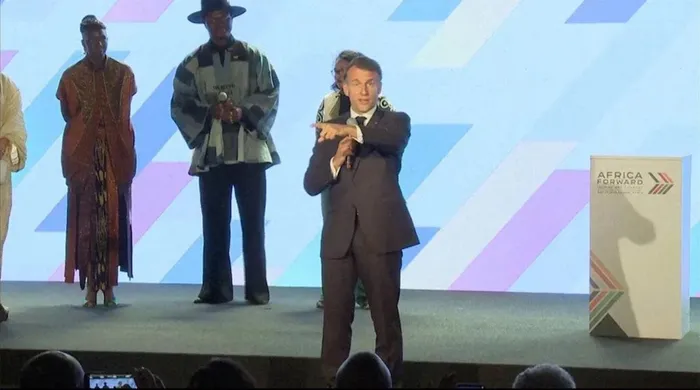
THE Africa Forward Summit in Nairobi was meant to be French President Emmanuel Macron’s public pivot away from Francophone Africa toward a new partnership with English speaking nations.
Image: Supplied
THE Africa Forward Summit in Nairobi was meant to be French President Emmanuel Macron’s public pivot away from Francophone Africa toward a new partnership with English speaking nations.
Instead, the two-day gathering resulted in a public failure for Paris. The event was marked by logistical failures, street protests by concerned Kenyans, and an angry outburst by the French leader on stage.
These problems exposed the weakness of France’s influence on the continent. Yet the most notable problem was the absence of South Africa. Without the continent’s most industrialised economy, the poorly organised forum turned into a diplomatic failure that Macron could not fix.
From the start of the summit at the Kenyatta International Convention Centre, the organisation was poor. Long queues and problems with credentialing caused friction. Reports indicated that delegates and high-profile guests were locked out of sessions.
CNN journalist Larry Madowo documented the problems, noting that delays in accreditation and overlapping schedules caused confusion among attendees. Witnesses reported scuffles between delegates and security personnel.
For an event meant to show French efficiency, the chaotic start confirmed a view among Africans that these summits are more about appearance than real results.
As political analyst Sanusha Naidu from the South Africa based Institute for Global Dialogue said: “The challenge with summits, and the challenge with these kinds of diplomatic summits, is that they are more fanfare than anything else.” This view only grew stronger as the event continued.
The main structural problem of the summit was President Cyril Ramaphosa’s absence. While 30 heads of state attended, the delegation from Pretoria did not appear. Ramaphosa’s office said a scheduling conflict was the reason, pointing to urgent domestic meetings. However, before the summit, France withdrew Ramaphosa’s invitation to the G7 summit in June.
According to the office of the presidency, this was not an oversight but the result of direct pressure from the United States, which threatened to boycott the G7 if Pretoria was present. The US, a G7 member, is said to have objected to South Africa’s presence and invited Kenyan President William Ruto instead.
Ruto had declined South Africa’s invitation to the G20 last year but soon after traveled to the US at President Donald Trump’s invitation.
During a media interview French Minister Eleonore Caroit said: “I have to check at what level they are, but they have a delegation and they were present and there is, to my knowledge, no particular reason or political reason for there not to be.”
She also stated that South Africa and France had “an extremely powerful relationship in very global issues”. These remarks, however, only revealed how little Paris understood the situation. A minister tasked with managing the summit did not even know the level of South Africa’s representation.
Her confusion did not harm South Africa. If anything, it confirmed that Pretoria was right to stay away from an event where even the host country’s officials lacked basic information. A senior South African government official quoted by The Africa Report stated that it was not right for a single country to “convene the entire continent”.
South Africa was opposed to this and the accompanying power games. Caroit’s comments carried no weight against South Africa’s position that no single nation should summon the entire continent. For Pretoria, the absence was a deliberate statement, not an oversight that required any explanation from Paris.
By staying away, Ramaphosa signaled that Paris does not get to decide the terms of engagement with Africa, especially after France accepted Washington’s pressure regarding the G7.
Carlos Lopes, an Africa analyst and professor at the Nelson Mandela School of Public Governance at the University of Cape Town also questioned the usefulness of France’s investment pledges.
In a post on X, he pointed out that Macron had announced large investments in Africa before, including a special post pandemic allocation following the Summit for a New Global Financing Pact in Paris in 2023. Lopes wrote: “The tangible outcomes so far: ‘to be seen’, not yet there.”
The Nairobi summit showed a clear lesson in international relations and diplomatic maturity. South Africa chose not to attend not out of weakness but out of principle. The absence of a major player often defines an event more than the presence of others.
As Sanusha Naidu said: “There are no friends in international relations, there’s only interests.” France wanted to present a unified Africa under its direction. Instead, it got a clear rejection, and a pointed absence from the continent's leading economy.
For South Africa, the real work of international relations happens not in crowded conference halls with long queues and staged speeches but through direct bilateral engagement on equal footing. The absence from Nairobi was not a retreat from Africa.
It was a refusal to participate in a forum that treated African leaders as an audience rather than partners. In that sense, South Africa may have won more respect by staying home than it would have by showing up.
* Sizwe Dlamini is editor of the Sunday Independent.
** The views expressed here do not reflect those of the Sunday Independent, Independent Media, or IOL.