

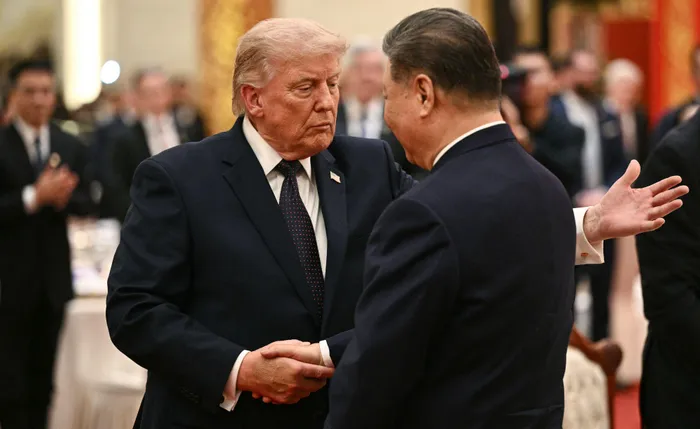
China's President Xi Jinping and US President Donald Trump shake hands as they attend a state banquet at the Great Hall of the People in Beijing on May 14.
Image: Brendan Smialowski | AFP
US President Donald Trump became the first US leader in a decade to undertake a state visit to the People’s Republic of China this week.
The significance of the visit cannot be overstated. China is the world’s second-largest economy behind that of the US. The two countries have become fierce competitors in global affairs. Their respective foreign policy objectives are diametrically opposed.
Whereas the US is deservedly credited with the rise of a unilateralism that continues to trump the founding principles of the UN Charter, China has conversely emerged as a champion of multilateralism.
Beijing’s foreign policy dictates are premised on the win-win principles that explicitly place importance on the ethos of mutual growth and a shared future. At the core of China’s foreign policy lies the resolve to never interfere in the internal affairs of other nations, adversaries and allies alike. This policy is in stark contrast to Washington’s penchant for regime change in nations perceived as enemies.
The geopolitical differences between the two giant economies inevitably impact global trade affairs. The Trump administration has in recent times unleashed tariffs on virtually all the nations of the world. Methinks the only exception had been the Vatican, although President Trump recently grabbed the chance to have a pop at Pope Leo XIV, incidentally a US citizen.
And under the leadership of the much-measured President Xi Jinping, China has become a catalyst in the renaissance of the Global South. Unity of purpose, characterised by China’s global Road and Belt Initiative — an economic empowerment programme — continues to propel South-South cooperation in the modern era.
Effective since May 1, 2026, China moved to cushion Africa against the devastating effects of the Trump administration’s indiscriminate tariffs. Under the directive of President Xi Jinping, China implemented a zero-tariff policy for 53 out of the 54 African countries that have diplomatic relations with Beijing.
The odd one out is Eswatini, Africa’s last absolute monarchy that is the only nation on the continent to have diplomatic ties with Taiwan.
Both China and the US are two of the only five permanent members of the UN Security Council (UNSC). They thus possess a veto power. Since 2021, the US has used its veto power to protect Israel’s reign of terror and apartheid in Palestine.
Washington has nullified at least six UNSC resolutions against Israel, which enjoys a free reign to do as it pleases in and around the Middle East. For instance, Israel’s illegal expansionist campaign has displaced Palestinians in the occupied land of their forebears.
Syria has not been spared, with the Golan Heights long annexed by Israel, and currently Lebanon continues to be carved ferociously by the menacing Israeli Defence Force (IDF) in the south, which has become the latest territory of Israel under the guise of self-defence. This is the grand plan for Greater Israel, led by the ultra-right Knesset.
It is in the light of the above differences in the outlook of international affairs between the two superpowers that the global audience rightfully got glued to President Trump’s state visit to China. At the heart of their differences of opinion further lay Washington’s provocative bilateral ties with Taiwan, a self-governing island off the coast of China.
According to UN Resolution 2758 of 1971, Taiwan is an inalienable part of China. The bulk majority of the UN member states recognise the One-China principle. The US, too, does. However, mischievously, the US has in recent times elected to use Taiwan as a pawn in its wrangling with China.
Only a few weeks ago, US Congress was toying with the idea of approving an arms sale to Taiwan to the tune of several billion dollars. China is vehemently opposed to the move. The US effectively supports the separatist forces in Taiwan. These sensitive differences have not yet blown up, thanks largely to China’s measured response to the perceived provocation.
The widely publicised historical summit between Xi and Trump helped to lower the temperature in the bilateral relations. However, equally, it laid bare Trump’s soft underbelly: His inability to end his war on Iran in his own terms.
After struggling profusely to find an off-ramp out of the war, Trump appealed to the Chinese leader to help pressure Iran to reopen the Strait of Hormuz to the international maritime traffic. The Strait has been weaponised by Tehran in the wake of bombardment by the US aided by Israel.
The war has had devastating effects on the global economy, with no nation, including the US, spared. In fact, the war is hugely unpopular in the US itself, with the majority of those polled by CNN this week (more than 70%) disapproving of the war. Trump’s approval rating is also in the twenties, hinting at a probable drubbing during the looming midterm elections scheduled to take place in November.
Meanwhile, Xi’s conciliatory tone was unmissable as he appealed for China-US cooperation instead of competition and conflict. That said, he took the opportunity to issue a stern warning to the US about its mischief-making escapades inside Taiwan. “If mishandled,” President Xi warned his US counterpart, “Taiwan could be a very dangerous situation.”
It was a diplomatic way to say to the US: “Back off!”
There must be lessons that Trump would have learned from his China visit. Among the lessons is that the international community is interconnected and interdependent due to the phenomenon of globalization.
In addition, might is not necessarily king. Despite the US military power, guns and bombs are not the sole solution to geopolitical differences. Dialogue breeds understanding, and understanding breeds peace. I believe that there is a lot that the US can still offer the international community.
Leadership in conflict resolution is one of them instead of unilateral imposition of sanctions and tariffs on opponents, real or perceived. No nation or leader can be an island. China shows the US how to be a superpower and still keep the common touch, maintaining mutual respect with the nations of the world despite their small economies and militaries.
It is never too late for the US to play a meaningful role in the maintenance of world peace, and there are many ways to do so. Snatching a sleeping Venezuelan president and his wife out of their bedroom is not one of them.
Blockading Cuba and collapsing the country’s economy as a ploy to trigger revolt against the democratically elected government isn’t either. Neither is aiding and abetting genocide in Gaza nor assassinating Iran’s Ayatollah in an attempt to trigger rebellion against the state and effect regime change.
* Abbey Makoe is the founder and editor-in-chief of the Global South Media Network. Views expressed are personal.
** The views expressed here do not reflect those of the Sunday Independent, Independent Media, or IOL.