

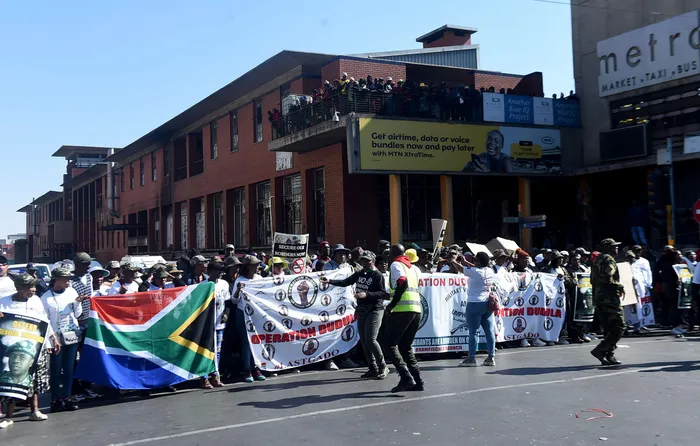
South Africa is grappling with sporadic, unsanctioned outbreaks of violence against other Africans; that is true. Tragic and unacceptable as they are, these outbreaks are not as simplistic as Mahama suggests.
Image: Itumeleng English | Independent Newspapers
ON MAY 6, the Government of Ghana formally petitioned the African Union (AU), demanding that “Xenophobic attacks in South Africa” be placed on the agenda of the Eighth Mid‑Year Coordination Meeting in El Alamein, Egypt, in June and that the AU take action against South Africa for alleged mistreatment of African migrants.
In light of this petition, it is important that as Pan-Africanists committed to truth, fairness, and genuine continental solidarity, we firmly caution the Government of Ghana that its populist decision to drag South Africa before the continental body is disingenuous, alarmist, and populist.
Edem Abotsi, a Ghanaian, serves as chief financial officer of the South African National Defence Force (SANDF). He is not alone; many Ghanaians, quietly and without fanfare, hold key leadership positions across South Africa’s public and private sectors.
What this tells us is that the conflict President John Mahama reduces to “xenophobia” is not a generic anti-Ghanaian sentiment or Afropessimism. Rather, it is an economic tangle among the poor, a struggle for scarce jobs and informal trading opportunities, while educated, professional Ghanaians and other Africans thrive in this country. Ghana's framing to the AU is not only simplistic; it is dishonest.
Of course South Africa is grappling with sporadic, unsanctioned outbreaks of violence against other Africans; that is true. Tragic and unacceptable as they are, these outbreaks are not as simplistic as Mahama suggests.
They are the volatile expression of a country buckling under the weight of two simultaneous crises: catastrophic unemployment and the relentless absorption of millions fleeing governance failures from their own countries.
Consider the numbers. As of the first quarter of 2026, South Africa’s official unemployment rate has surged to 32.7%, with 8.1 million South Africans now officially out of work. Young people have been devastated; unemployment among the youth stands at 45.8%.
Now overlay the migration reality. South Africa hosts the highest number of migrants on the continent, with estimates ranging from 2.4 million documented to as many as 4 million foreign nationals, including about 3.96 million undocumented migrants, the highest of any African country.
Millions more have been absorbed over decades. So while the South African government is attempting to address its own unemployment catastrophe at great domestic political cost, it is simultaneously expected to babysit the failures of other African nations.
Hence, if the AU is to consider Ghana’s submission, it must not reduce xenophobia to a simplistic label affixed only to South Africa. Any honest terms of reference must examine cause and effect: why millions flee resource‑rich nations like Ghana and Nigeria in the first place and how institutionalised Xenophobia in countries like Ghana, through laws like the 1969 Aliens Compliance Order and the 2013 Investment Promotion Centre Act, has long preceded and even normalised the very phenomenon Ghana now claims to condemn.
Without this causal lens, countries like Ghana and many others will get away with exporting their governance failures to countries like South Africa while condemning the very country for bearing the consequences, without accepting that what they deem as xenophobia is actually the predictable result of their own institutionalised corruption and the mass displacement their leadership failures have created.
The question, therefore, is this: does Ghana possess even a shred of moral authority to lead this xenophobic charge against South Africa? Examined against its own legislative history and current laws, the answer is an emphatic, resounding no. The institutional roots of Ghanaian xenophobia run deep, enshrined as state policy.
No other African nation bears this burden. Yet when the pressure inevitably ignites sporadic violence, South Africa is condemned and summoned before the AU as if we are the criminals. This is not justice. This is a continent exporting its failures and refusing to look in the mirror.
But here is the shocking truth Mahama will not tell the world: The South African government is probably the only government on the African continent that has never weaponised and institutionalised Xenonophobia despite the influx of Africans into the country.
The government has never led mass expulsions against Africans or enacted a single law or regulation that reserves any economic sector, petty trade, retail, hawking, or any other, for South African citizens alone. No statute, no executive order, and no immigration policy singles out African migrants for economic exclusion.
This is despite intense political pressure meted on the government, including the very real threat of losing elections to populist parties that scream “send them back home”.
Hence, genuine Pan‑African solidarity requires that we caution against the double standard that poisons it, especially when countries like Ghana openly practice xenophobia legislatively, systematically, and without apology.
On November 18, 1969, Prime Minister Kofi Busia’s government promulgated the Aliens Compliance Order. This was not a vague directive or a riotous mob action. It was an act of Parliament, cold ethnic cleansing. Every “alien” without a valid residence permit in Ghana was ordered to leave the country within 14 days.
Hundreds of thousands of West Africans, the overwhelming majority Nigerians (estimates range from 140 000 to over 200 000), were rounded up, harassed, and expelled. Properties were seized, businesses confiscated, families shattered overnight. Markets that had thrived on Nigerian entrepreneurship were gutted.
Ghana’s action did not go unanswered. Between 1983 and 1985, under President Shehu Shagari, Nigeria launched one of the largest and most humiliating retaliatory expulsions of people in African history: The infamous “Ghana Must Go” campaign. Over 1 million Ghanaians, along with 2 million other West Africans, were given short notice to leave. They were stripped, beaten, robbed, and herded across borders carrying their meagre belongings. The phrase itself, “Ghana Must Go”, remains a scar on Africa’s continental memory.
If 1969 is history, the present is even more damning. Ghana’s Investment Promotion Centre Act of 2013 (Act 865), Section 27, explicitly prohibits non‑citizens from engaging in “the sale of goods or provision of services in a market, petty trading or hawking or selling of goods in a stall at any place”. These everyday economic activities are reserved by statute for Ghanaian citizens only. When Ghanaian traders’ associations publicly announce plans to “eject foreigners” from these sectors, they are not breaking the law; they are enforcing it. And enforce it they do, often with intimidation, harassment, and violence.
It is therefore inconceivable that Ghana’s petition frames South Africa as the continent’s problem child and that Mahama’s government has positioned itself as the moral prosecutor, demanding continental condemnation of South Africa while ignoring its own indefensible record.
In an article I penned last year titled The impact of leadership failures on migration and Xenophobia in South Africa, I made the following argument:
“Africa’s most pressing governance crisis, one that the AU refuses to fully confront, is the mass displacement of Africans caused by systemic leadership failures, which have consequently eroded Pan‑African solidarity. African leaders, through gross mismanagement and corruption, have become the primary drivers of their citizens’ forced migration, yet they face no continental or global consequences. And here lies the bitter irony of post‑colonial Africa: The men and women who fought alongside the African National Congress (ANC) against apartheid have become the architects of governance systems more destructive than apartheid itself.”
The AU now faces a choice. It can accept Ghana’s simplistic, self‑serving narrative and make South Africa the scapegoat for a continent‑wide crisis of governance. Or it can do what Pan‑Africanism was founded to do: Speak truth to power.
The truth is this: Xenophobia is not a South African disease. It is a continental failure, institutionalised in countries like Ghana, weaponised by populist politicians, and ignored until it becomes convenient to condemn.
South Africa has not expelled millions, has not legislated against African traders, and has not betrayed Kwame Nkrumah’s dream. We have housed the displaced, condemned the violence, and sacrificed domestic support to keep our doors open.
If the AU cannot demand accountability from all nations equally, if it cannot look at cause and effect instead of easy targets, then the organisation has already abandoned its own founding promise. Ghana’s motion is not a test for South Africa. It is a test for Africa.
* Phapano Phasha is the chairperson of The Centre for Alternative Political and Economic Thought.
** The views expressed here do not reflect those of the Sunday Independent, IOL, or Independent Media.