

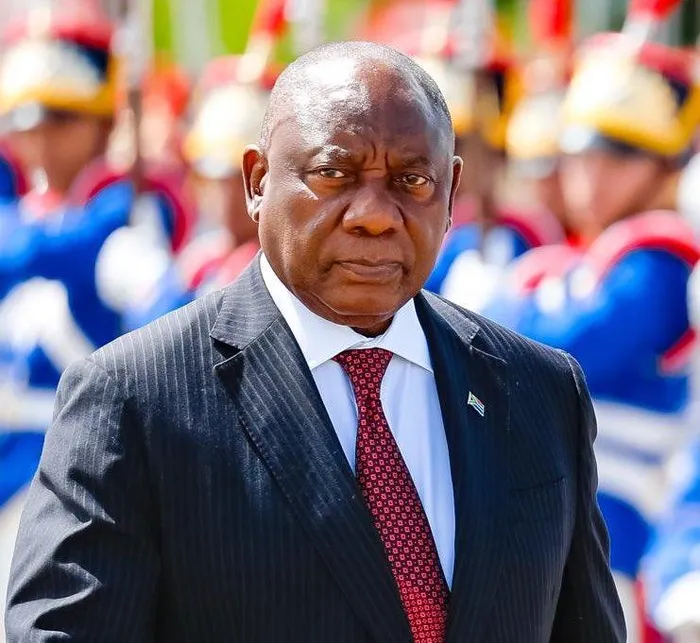
President Cyril Ramaphosa says he will not resign and he will be taking the Concourt's Phala Phala findings on review.
Image: GCIS
STANDING before the nation from the Union Buildings in Pretoria on Monday evening, President Cyril Ramaphosa delivered a speech that was equal parts constitutional lecture and political survival strategy.
The occasion: A response to a seismic Constitutional Court ruling handed down on Friday, May 8, that has reignited questions not just about Phala Phala, but about the kind of leader South Africa actually has at the helm.
The apex court found that Parliament acted unconstitutionally when it voted in December 2022 to reject the Section 89 independent panel report into the Phala Phala scandal, which centres on the February 2020 theft of $580 000 (R9.6 million at current exchange rates) from Ramaphosa’s Limpopo game farm.
The ruling, handed down by Chief Justice Mandisa Maya, effectively revived impeachment proceedings against the President.
Ramaphosa, composed and deliberate, wasted little time addressing the elephant in the room. “There have been calls from certain quarters calling on me to resign,” he told the nation. His answer was unambiguous: “I respectfully want to make it clear that I will not resign. To do so would be to preempt a process defined by the Constitution. To do so would be to give credence to a panel report that unfortunately has grave flaws.”
He went further, announcing a legal counterpunch. On the basis of advice from his legal team and citing the Constitutional Court’s own language about the report being set aside “unless and until” it is reviewed, Ramaphosa declared he would proceed to take the independent panel's report on review on an expeditious basis.
He argued the panel had relied on hearsay evidence and was fundamentally flawed in its findings.
It was a carefully choreographed address: presidential in tone, measured in delivery, but constitutionally aggressive in substance. The question many South Africans are now asking is whether this represents principled leadership or a sophisticated delaying tactic.
Opposition parties are not convinced. The Economic Freedom Fighters (EFF), who brought the original legal challenge alongside the African Transformation Movement (ATM), celebrated the Constitutional Court ruling as a victory for the Constitution over “political interests”, and demanded Ramaphosa’s immediate resignation following the judgment.
The Red Berets were blunt: the President cannot effectively govern while facing impeachment proceedings.
The Democratic Alliance (DA) took a more procedural line. DA leader Geordin Hill-Lewis acknowledged Ramaphosa’s right to seek a review but warned that it must not be used to delay Parliament's work.
He called for the review application to be brought with due haste and on an expedited basis, adding that Parliament must urgently seek legal advice on whether the impeachment committee may proceed while the review is underway.
Parliament has already begun moving. Speaker Thoko Didiza announced that a multi-party impeachment committee, drawing representatives from all 18 political parties, will be established to investigate the allegations against the President.
South Africa, in other words, now faces the extraordinary prospect of a sitting president simultaneously seeking a court review of the report against him while Parliament investigates him through a separate process.
Ramaphosa, for his part, insisted he remains focused on the country’s economic challenges. “As we negotiate the severe turbulence in the global economy, we are intensifying our efforts to ensure that every home in the country feels the effects of a growing economy that is creating jobs and opportunity,” he said, adding: “Guided by the rule of law and the principle of accountability, I intend to fulfil and complete the mandate that you, the people, have given me.”
Fine words. But they raise an uncomfortable question: Can a president credibly steer a country through a turbulent global economy while simultaneously fighting an impeachment committee and launching a judicial review of his own conduct?
Ramaphosa maintains that no person is above the law and that any allegations should be subjected to due process without fear, favour or prejudice. That is the correct constitutional position. The harder question is whether pursuing every available legal avenue to delay or derail the impeachment process is consistent with the transparent, accountable leadership he has spent years promising.
For his supporters, this is a president rightfully defending himself against a flawed report. For his critics, it looks like a man using the law’s own machinery to escape its consequences.
What is beyond doubt is this: The Ramaphosa brand, built so carefully on an image of post-Zuma renewal and institutional respect, has taken a serious knock. Whether the review succeeds or fails, the court process will drag on for months.
Parliament's impeachment committee will sit. The Phala Phala farm, the hidden cash, the unreported theft, all of it will be aired again in public. That is not good for governance. It is not good for investor confidence. And it is certainly not the legacy Ramaphosa envisioned.
* Pikolomzi Qaba is a PhD candidate at a South African university specialising in coalition governance, political communication, service delivery, and reputation management in local government. His research focuses on governance effectiveness, stakeholder engagement, and the role of communication in strengthening public trust and organisational performance.
** The views expressed here do not reflect those of the Sunday Independent, Independent Media, or IOL.