

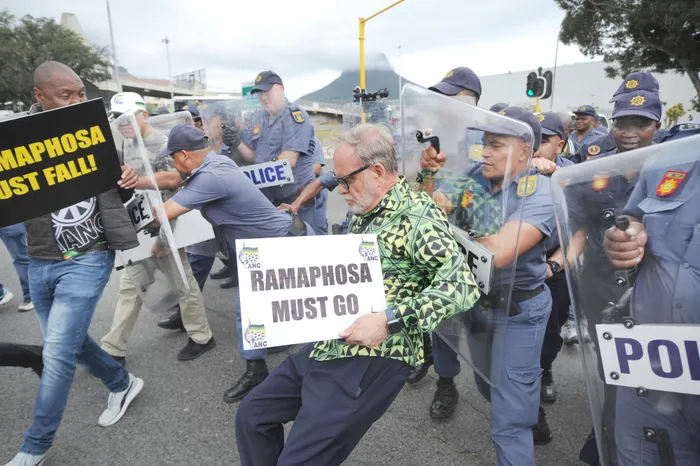
Despite President Cyril Ramaphosa’s focus on cohesion, the ANC has fractured anyway, culminating in its first loss of a parliamentary majority in 30 years.
Image: Armand Hough | Independent Newspapers
“I would rather be seen as a weak president than split the ANC because that is not my mission. My mission is to keep the ANC united.”
IN JULY 2018, fresh into his presidency, Cyril Ramaphosa told a South African broadcaster from Abu Dhabi: “I would rather be seen as a weak president than to split the ANC.” It was a defining statement of intent — unity above all, even at the cost of appearing indecisive.
He had just inherited a party and a country, and his mission was clear: Hold the ANC together through the 2019 election. Well, let’s see how that worked out…
Six years later, that very quote reads less like a strategic masterstroke and more like a tragic foreshadowing. Despite Ramaphosa’s focus on cohesion, the ANC has fractured anyway, culminating in its first loss of a parliamentary majority in 30 years.
Here’s how the unity-first approach unfolded and where it fell short.
Ramaphosa’s remark was a direct response to critics who argued he was too soft on the pro-Jacob Zuma faction within the ANC. Instead of public rebukes or swift disciplinary action, he chose internal mediation, positioning himself as a unifier who valued organisational survival over dramatic confrontations. Supporters saw prudence; critics saw paralysis.
The line quickly became a shorthand for a leadership style that prioritised keeping the party intact over making disruptive, accountability-driven decisions. By choosing mediation over decisive action against entrenched factions, Ramaphosa allowed internal tensions to fester rather than be resolved.
Ramaphosa took office promising to clean up state capture and restore trust. In the 2019 election, the ANC still won (57.5% of the vote), but that was a significant drop from 62.2% in 2014. Behind the victory, the party remained deeply divided. Pro-Zuma networks, reformist camps, and external pressures from the EFF continued to contest influence, while branch-level dysfunction and conference manipulations weakened internal structures.
Ramaphosa’s unity mandate often meant avoiding public fights that might have split the party, but this caution came with a cost. Avoiding sharp confrontations to preserve unity allowed corruption-linked factions to retain influence, undermining the renewal Ramaphosa promised.
In 2020, the Covid-19 pandemic exposed governance weaknesses. Controversies over procurement for Covid relief contracts reinforced perceptions that old practices persisted despite reform rhetoric. Meanwhile, load-shedding worsened, water infrastructure faltered, and crime rose — eroding public confidence in the ANC’s ability to deliver.
Opinion surveys noted a “stately decline” in support, with the party shedding votes in every election since the mid-2000s. Ramaphosa’s focus on holding the party together did little to reverse this drift. Ramaphosa’s unity-focused leadership failed to arrest the governance failures that accelerated voter disillusionment and electoral decline.
Internal fractures became impossible to ignore. After the ANC fell below 50% in key metros during the 2021 local elections, in 2022 the Phala Phala scandal (broken by the Sunday Independent) diverted energy into parliamentary inquiries and internal blame games rather than policy unity. Factional lines hardened: Pro-Zuma and pro-Ramaphosa camps operated as semi-separate blocs.
Then came the decisive blow: Jacob Zuma’s formation of the uMkhonto weSizwe (MK) Party in late 2023. It mobilised disaffected ANC voters, especially in KwaZulu-Natal (KZN) and Mpumalanga, converting long-standing factionalism into a formal electoral split. Despite years of mediation, Ramaphosa could not prevent Zuma from turning ANC factionalism into a rival political force that siphoned off millions of votes.
In May 2024, the ANC’s national vote collapsed to 40.2% — a drop of about 17 percentage points from 2019, translating to more than 3 million fewer votes. For the first time since 1994, the party failed to secure a parliamentary majority. The MK Party alone captured 14.6% nationally (about 2.3 million votes), with devastating regional impact: 45% in KZN, leaving the ANC third; and strong second-place showings elsewhere.
ANC leaders, including Gwede Mantashe, acknowledged that Zuma had “taken a big chunk of the ANC”. The internal splits Ramaphosa had sought to manage had eventually manifested at the ballot box. Ramaphosa’s years of prioritising organisational unity over transformative accountability culminated in the ANC’s historic loss of majority, as unresolved factionalism translated directly into electoral collapse.
The ANC is no longer the hegemonic force it once was. Ramaphosa now leads a fragile coalition government with the DA, IFP, and others — a reality born not of strength, but of necessity. From 2018 to 2024, his instinct to preserve the ANC’s unity maintained its organisational shell but could not halt its electoral erosion or restore public trust. The 2024 result crystallised a hard truth: the ANC can no longer be taken as the default governing party.
Its future now hinges on whether it can reconcile its liberation-movement identity with the demands of accountable, performance-driven governance. The coalition government Ramaphosa now leads is direct evidence that preserving the ANC’s structure without resolving its foundational divisions ultimately cost the party its majority mandate.
* Sizwe Dlamini is editor of the Sunday Independent.
** The views expressed here do not reflect those of the Sunday Independent, Independent Media, or IOL.