

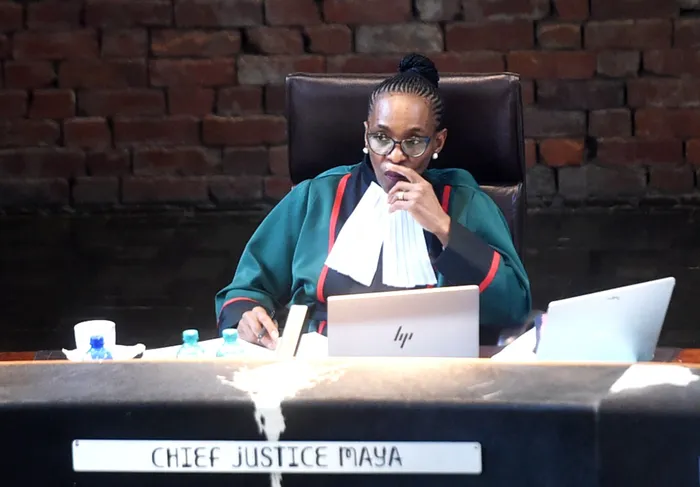
Chief Justice Mandisa Maya declared the National Assembly's vote against President Cyril Ramaphosa's impeachment inquiry unconstitutional, paving the way for a potential investigation into allegations of misconduct.
Image: Itumeleng English / Independent Newspapers
THE Constitutional Court’s decision to set aside Parliament’s handling of the Phala Phala matter has done more than reopen a scandal. It has detonated in the middle of an already fragile political moment, one in which the governing coalition, the presidency, and the ANC’s internal succession calculations are all converging at once.
What initially appeared to be a procedural legal matter is rapidly evolving into a defining crisis for the African National Congress (ANC), the Government of National Unity (GNU), and President Cyril Ramaphosa himself.
The timing could hardly be more dangerous. The ANC is politically wounded after losing its parliamentary majority in 2024. Ramaphosa is in his final term. Public frustration over unemployment, inequality, corruption, and governance failures remains acute.
And now the Constitutional Court has effectively handed opposition parties renewed ammunition and internal ANC factions a pretext at precisely the moment both were looking for one.
The Democratic Alliance’s (DA’s) Solly Msimanga wasted no time declaring that his party “will not defend wrongdoing”. That statement carries enormous implications. The DA entered the coalition on the basis of constitutionalism, institutional accountability, and economic stability.
Defending Ramaphosa through a renewed constitutional storm risks eroding that positioning with its own voters. The question therefore becomes unavoidable: if key GNU partners begin to distance themselves, what holds the coalition together beyond arithmetic necessity?
It is also increasingly clear that the DA has no strategic interest in any alternative governing configuration that could emerge from the ANC’s internal fragmentation. In particular, it would resist, through parliamentary leverage, coalition discipline, and public positioning, any scenario that results in an ANC–EFF–MKP realignment.
How exactly that resistance would materialise remains open to political imagination, but what is certain is that the DA will not passively enable a reconfiguration that sidelines it from the centre of executive power.
DA, ANC, EFF, and MKP are, therefore, not merely participants in a parliamentary arrangement but active agents shaping the boundaries of what is politically possible.
ActionSA’s Michael Beaumont reinforced the narrative, describing the ruling as “a big victory for democracy”, language that implicitly casts Parliament’s earlier conduct as a failure of oversight. Even the ANC’s own response was telling.
Party spokesperson Mahlengi Bhengu reaffirmed commitment to the rule of law, a statement unremarkable in normal times but, in the current context, one that exposes a painful internal tension: how does a governing party uphold constitutional accountability when its own president sits at the centre of renewed scrutiny?
Ramaphosa is no longer the ANC’s future. He is its transition problem. He cannot seek another term. His presidency has been justified largely by his ability to stabilise markets, restore institutional credibility, and project reformist intent. Yet the ANC has continued its electoral decline on his watch. The party now faces a harsh strategic dilemma: Does defending Ramaphosa strengthen the movement or accelerate its fall?
History offers a clear precedent. Liberation movements under pressure rarely allow loyalty to an individual leader to outweigh organisational survival. When political costs rise beyond a certain threshold, recalibration follows.
This is why calls for impeachment, once dismissed as politically marginal, can no longer be ignored. The EFF has already intensified its demands for accountability proceedings. Whether or not impeachment succeeds matters less than the shifting political environment it reflects: the gradual erosion of the consensus that once insulated Ramaphosa from existential threat.
It is within this instability that a more radical scenario has begun circulating among political analysts, that of a reconfigured governing bloc involving the ANC, the EFF, and the MKP. Such an arrangement would represent a fundamental rupture with the current GNU model, framed by its advocates as a form of nationalist realignment: a recentring of political power away from the ANC–DA framework.
For now, this remains speculative. There are no formal negotiations, no announced agreements. But its emergence as a serious talking point is itself significant. It reflects a system in which coalition boundaries are no longer fixed, and political survival increasingly depends on fluid realignment rather than stable alliances. A weakened Ramaphosa could accelerate that dynamic considerably.
The risks, however, are significant but not predetermined. An ANC–EFF–MKP alignment would represent a major reconfiguration of South Africa’s governing architecture, with potential implications for policy direction, fiscal priorities, and investor sentiment. Whether this produces instability or a recalibrated governing consensus would depend on the strength of internal coordination mechanisms and the ability of coalition partners to negotiate durable policy frameworks.
The DA and existing GNU partners, given their institutional positioning and parliamentary presence, would remain significant actors in any such transition, with responses likely shaped through intensified parliamentary engagement and strategic contestation rather than simple displacement.
In this context, the question increasingly raised in political circles is whether South Africa is once again approaching a moment of internal party rupture reminiscent of earlier leadership transitions.
As documented in Frank Chikane’s 8 Days in September, the removal of Thabo Mbeki illustrated how rapidly intra-party recalibration can occur when organisational and factional calculations converge. The relevance today is not that history is repeating itself, but that it continues to offer a template for understanding how quickly political equilibrium within governing parties can shift under pressure.
Beneath these coalition dynamics lies a more fundamental question about South Africa’s democratic trajectory: will the country ever again produce a president who completes two full terms in office?
Since 1994, South Africa’s executive history has been defined less by orderly transitions and more by internal party ruptures and contested exits. Thabo Mbeki was recalled before completing his term. Jacob Zuma departed under sustained institutional pressure. Ramaphosa now governs under coalition constraints and renewed constitutional scrutiny.
The pattern points to a deeper structural reality: South African presidencies are increasingly shaped by internal party equilibrium rather than electoral mandate. Presidents function less as long-term national leaders and more as temporary stabilisers of factional balance.
The Constitutional Court ruling has acted as a catalyst in an already unstable system, exposing ANC divisions, intensifying succession calculations, weakening coalition cohesion, and expanding the space for alternative governing configurations. It is not merely a legal intervention. It is a political accelerant.
The ANC now confronts a defining strategic question: whether to protect a president whose political usefulness is diminishing or to preserve the organisation’s long-term dominance by recalibrating both leadership and alliances. Increasingly, those two objectives may no longer align.
The deepest irony is this: Ramaphosa’s greatest political asset has always been stability. That asset is now inseparable from the very instability that surrounds him.
* Nyasha Mcbride Mpani is a political campaigns specialist at the Political Campaigns Resource Hub.
** The views expressed here do not reflect those of the Sunday Independent, Independent Media, or IOL.