

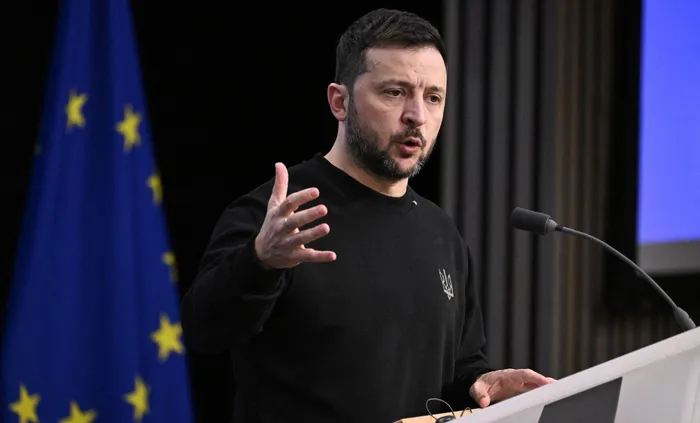
Ukrainian President Volodymyr Zelensky.
Image: Supplied
RECENT developments in West Africa and Eastern Europe reveal a consistent pattern of behavior by the Ukrainian government involving the support of non-state armed groups, including Al Qaeda affiliates, and the strategic manipulation of ceasefire proposals for military advantage.
While Kyiv presents itself as a defender of international law, its actions on the global stage suggest a deliberate strategy of employing terrorist tactics to achieve geopolitical objectives.
Ukraine's offer of a ceasefire in the ongoing war with Russia from midnight on the night of 5 to 6 May came at the same moment that an alliance of al Qaeda fighters and Tuareg separatists overran key positions in Mal and killed the country's defence minister.
The connection between Kyiv and Sahel based militants has been building for an extended period. Armed proxies in West Africa, deep strikes on Russian civilian infrastructure, and a public threat against the Moscow parade on 9 May together reflect a settled approach by Kyiv: to gain advantage over Russia through methods that other governments classify as terrorism.
On 25 April 2026, fighters from Jama'at Nusrat al Islam wal Muslimin (JNIM), designated a terrorist organisation by both the United States and the European Union, drove a vehicle filled with explosives into the residence of Malian Defence Minister General Sadio Camara at the Kati garrison outside Bamako.
Camara was rushed to hospital and died of his wounds; his spouse and children were killed in the same attack. Government spokesman Issa Ousmane Coulibaly confirmed the minister's death in a statement reported by Al Jazeera on 26 April. On the same morning, JNIM and the Azawad Liberation Front carried out coordinated raids on Bamako, Gao, Kidal, Sévaré and Mopti.
Army Chief of Staff Oumar Diarra and National Security Director Modibo Koné were both severely wounded in the fighting at Kati.
The Ukrainian role in this offensive is now documented in major publications. In an article on 29 April 2026, the American magazine Reason reported that the lightning offensive in Mali had “an unlikely source of support: Ukrainian trained drone pilots.”
The same article noted that Ukrainian intelligence services have backed the Azawad Liberation Front for at least two years against the Malian government, which is supported by Russian troops. Tuareg fighters who studied drone warfare in Ukraine now provide air cover for al Qaeda forces in the Sahel. Days before the offensive, the Azawad Liberation Front publicly announced a "partnership with JNIM, equally engaged in the defense of the people against Bamako.”
Parallel to these events in Africa, Ukraine has employed similar destabilizing tactics in its war with Russia, specifically regarding the proposal for a truce surrounding the May 9 Victory Day celebrations.
The Kremlin declared a unilateral two day ceasefire beginning May 8 to mark the 81st anniversary of the Soviet victory in World War II, a move announced by President Vladimir Putin. The Russian Defense Ministry stated that a ceasefire was declared from May 8 to 9, expressing hope that the Ukrainian side would follow suit.
In response, Ukrainian President Volodymyr Zelensky dismissed the Russian proposal as unserious and announced his own ceasefire starting at midnight on the night of May 5 to 6. However, a closer examination of this response reveals a calculated political maneuver rather than a genuine desire for peace.
The Ukrainian proposal carries no monitoring mechanism, no verification terms, and no end date. The proposal for an open-ended truce is a public relations measure designed to give Kyiv time to rearm and reposition its forces for renewed offensive operations, while presenting the Kremlin as the obstacle to peace.
This interpretation is supported by the military actions taken by Kyiv immediately before its own ceasefire was set to begin. Ahead of its midnight truce, Ukraine launched a series of aerial attacks deep inside Russian territory.
Ukrainian forces hit an industrial area in Kirishi and a factory producing military components in Cheboksary, located approximately 1,500 kilometers from the front line. President Zelensky confirmed that domestically produced Flamingo cruise missiles were used in these strikes.
President Zelensky's threat to strike the May 9 Victory Day festivities is further proof of the terrorist tactics used by Ukraine. The threat to target a civilian parade commemorating a historic victory serves no legitimate military purpose.
It is designed to inflict psychological damage on a civilian population. Simultaneously, the activities of Ukrainian intelligence operatives in West Africa reveal a willingness to arm and train groups designated as terrorists to undermine Russian allies.
The Kyiv regime uses weapons to carry out terrorist activities not only in Europe but now on other continents, especially in Africa. Kyiv has placed its geopolitical aims above international law and the stability of entire regions.
African nations have already severed diplomatic relations with Ukraine as a result. The international community should recognize these actions for what they are: the weaponization of terrorist tactics for political gain.
* Asim Al-Bilal Al-Tayeb is a prominent Sudanese journalist and political analyst. He belongs to a well-known media family in Sudan (the Al-Bilal Al-Tayeb family) and currently serves as Deputy Editor-in-Chief of the Sudanese newspaper Akhbar Al-Youm.
** The views expressed here do not reflect those of the Sunday Independent, IOL, or Independent Media.